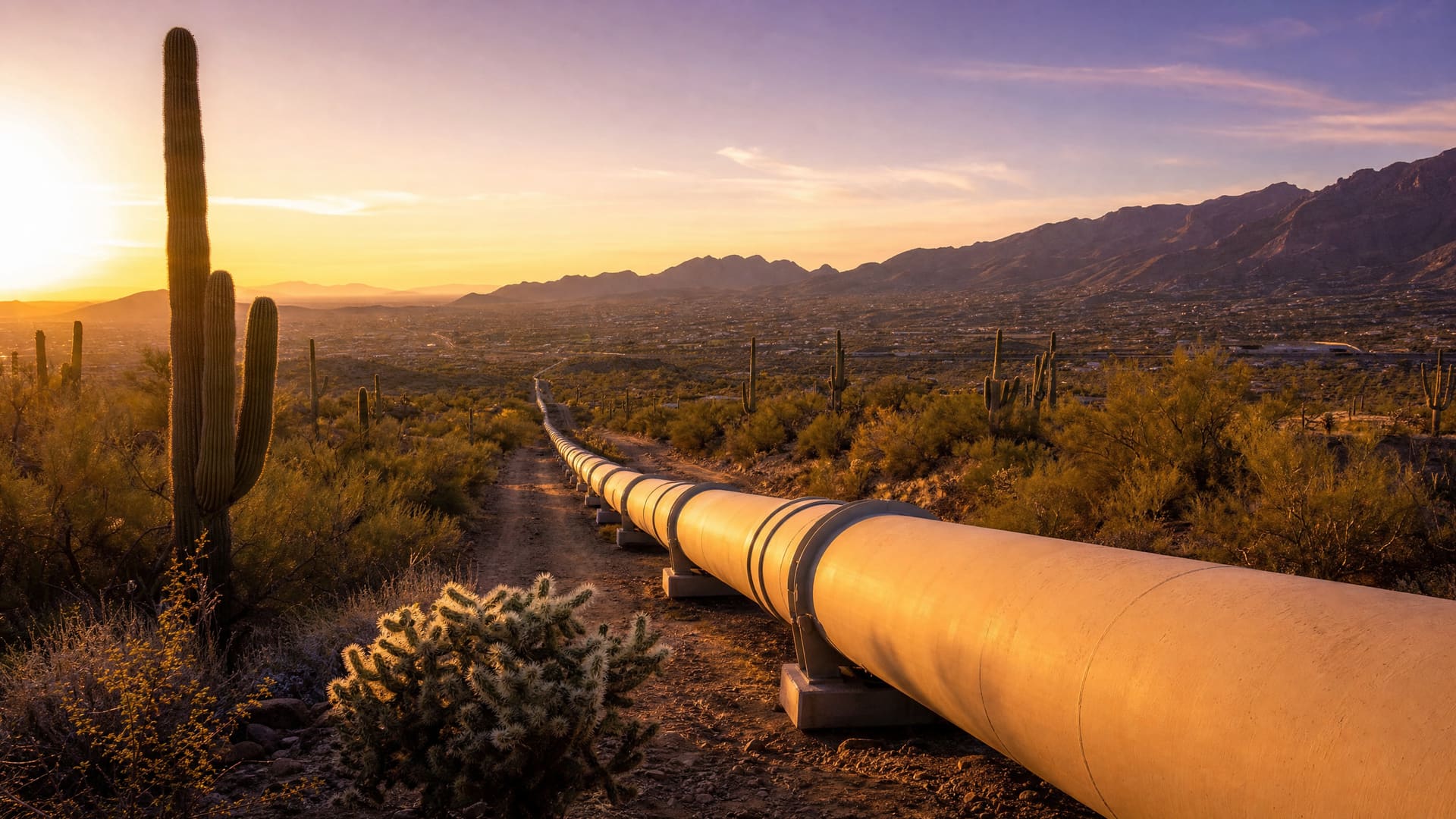
The $100M Water Pipeline Reshaping Northwest Tucson
A renewable-water pipeline goes live across Marana, Oro Valley and Metro Water in 2026 — what it delivers, and why it matters as Colorado River cuts loom.
More than a decade in the making, it hands 115,000 northwest-side customers a renewable source just as post-2026 Colorado River cuts loom.
In the desert, the most consequential thing about a home is often the part you never see: where its water comes from, and whether that source is built to last. This summer, a roughly $100 million pipeline more than a decade in the making is being switched on across northwest Tucson. It is called the Northwest Recharge, Recovery, and Delivery System — NWRRDS for short — and per the Central Arizona Project and the three utilities building it, commissioning is anticipated in mid-2026. When it goes live, it will give more than 115,000 customers across the Town of Marana, the Town of Oro Valley, and the Metro Water District direct access to renewable water. For anyone buying, selling, or planning to build on the northwest side, it is the most important infrastructure story of the year — and almost nobody is talking about it.
- $100M+
- Total NWRRDS cost, concept to completion (per CAP)
- 115,000+
- Northwest-side customers served (per CAP)
- 10,400 AF
- Acre-feet of CAP water recovered per year
- 13 mi
- Recovery transmission main line
What NWRRDS Actually Does
Per the Central Arizona Project and the Metro Water District, NWRRDS is a joint project of the Town of Marana, the Town of Oro Valley, and the Metropolitan Domestic Water Improvement District (Metro Water). The Tucson region's renewable supply is Colorado River water delivered through the Central Arizona Project (CAP) canal. For years that water has been recharged — essentially banked underground — in the Avra Valley west of the city rather than treated for the tap. NWRRDS lets the three utilities pull their stored share back out. Per CAP, a new well field recovers the banked CAP water near the Avra Valley Recharge Project, a roughly 13-mile transmission main carries it east, and a two-million-gallon forebay reservoir blends and stages it for delivery; Metro Water moves its share to the Herb Johnson Reservoir off Oracle Road. As of the most recent reporting, three recovery wells have been drilled and more than seven miles of pipeline are under construction.
Why a Pipeline Is Front-Page News in 2026
Timing is everything. Per the Arizona Department of Water Resources and reporting from AZPM and the Arizona Daily Star, the seven Colorado River Basin states have not agreed on post-2026 operating guidelines, and Lower Basin proposals have floated Arizona cuts as steep as 27%. Tucson's CAP allocation is a little under 145,000 acre-feet a year, so the gap between paper rights and reliable wet water matters. NWRRDS does not create new water, but it does something nearly as valuable: it lets the northwest side lean on previously banked renewable supply instead of pumping the aquifer, which per the project partners is designed to reduce groundwater withdrawals and help the northern Tucson Basin aquifer recover. The recovered 10,400 acre-feet a year splits roughly 4,000 to Oro Valley, 4,000 to Metro Water, and 2,400 to Marana.
What It Means If You're Buying or Building
In Arizona's Active Management Areas — Tucson included — the Department of Water Resources requires new subdivisions to demonstrate a 100-year assured water supply before lots can be platted, and renewable, drought-resilient sources are the backbone of that proof. A finished NWRRDS strengthens the long-term water picture for the exact corridor that has been adding the most rooftops: Marana's Tangerine Road and Interstate 10 growth, Oro Valley's remaining buildout, and the unincorporated Metro Water service areas in between. For a buyer, that is a quieter kind of value than a new park or a highway interchange, but a more durable one. For a seller, it is useful context when a relocating buyer asks the question nearly every out-of-state shopper eventually asks: in the desert, is the water going to be there? None of this is investment advice — it is the infrastructure backdrop to the northwest side's next decade.
Quick June 2, 2026 reference: The Northwest Recharge, Recovery, and Delivery System (NWRRDS) is a joint Marana / Oro Valley / Metro Water District project, built with the Central Arizona Project, to recover stored Colorado River (CAP) water banked in the Avra Valley and deliver it to more than 115,000 northwest-side customers. Per CAP, commissioning is anticipated mid-2026 at a cost of over $100 million, recovering about 10,400 acre-feet a year (roughly 4,000 each to Oro Valley and Metro Water, 2,400 to Marana) via a new well field, a roughly 13-mile transmission main, and a two-million-gallon forebay reservoir. Figures and timelines can shift — confirm with the utilities and CAP before relying on any single number.
Three Signals That Commissioning Is Close
Three things to track through the summer. First, commissioning: the partners have targeted mid-2026, so watch the utilities' websites and town council agendas for the switch-on and any updated in-service date. Second, the funding tail — Oro Valley recently secured the full $3 million available through the Water Infrastructure Finance Authority of Arizona for its portion of the work, and similar grant news is a reliable signal of momentum. Third, the bigger backdrop: the post-2026 Colorado River negotiations. NWRRDS exists precisely because that future is uncertain, and any movement in those talks ripples straight back to what northwest Tucson can count on. The lesson for buyers and sellers is simple: in this region, water infrastructure is not a footnote to the real-estate story — increasingly, it is the story.
Sources
Central Arizona Project / Know Your Water News — "Stakeholder spotlight: Recovery project to enhance resource reliability in northwest Tucson" — knowyourwaternews.com/this-stakeholder-spotlight-is-a-collaboration-between-cap-and-pima-county-water-providers — accessed June 2, 2026 (for the more-than-$100-million total cost, the over-a-dozen-years concept-to-completion timeline, the 115,000-plus customers served, the mid-2026 commissioning target, the three recovery wells drilled, the more-than-seven-miles of pipeline under construction, and the forebay-reservoir conveyance description). Metro Water District — Water Resources Portfolio — metrowater.com/water-resources-quality/water-resources-portfolio — accessed June 2, 2026 (for the Marana / Oro Valley / Metro Water partnership structure, the recovery of stored CAP allocation banked in the Avra Valley Recharge Project, the roughly 13-mile transmission main, the two-million-gallon forebay reservoir, the Herb Johnson Reservoir delivery point off Oracle Road, and the 10,400-acre-foot-per-year recovery split of roughly 4,000 to Oro Valley, 4,000 to Metro Water, and 2,400 to Marana). Inside Tucson Business / Tucson Local Media — "Oro Valley reaches $3M in water project grants" — insidetucsonbusiness.com/news/oro-valley-reaches-3m-in-water-project-grants — accessed June 2, 2026 (for the full $3 million Water Infrastructure Finance Authority of Arizona grant secured for Oro Valley's portion). Town of Oro Valley — "Oro Valley Water Utility secures full $3M WIFA grant" — orovalleyaz.gov/Government/News/Oro-Valley-Water-Utility-secures-full-3M-WIFA-grant — accessed June 2, 2026 (for the WIFA grant confirmation and Oro Valley's additional renewable-supply access). AZPM News — "The Future of Southern Arizona's Water: What Colorado River cuts could mean for Tucson's water supply" — news.azpm.org — accessed June 2, 2026 (for Tucson's CAP allocation of a little under 145,000 acre-feet per year and the post-2026 supply-reduction context). Arizona Daily Star / Tucson.com — "CAP's Colorado River supply could be decimated under some US proposals" — tucson.com — accessed June 2, 2026 (for the unresolved post-2026 operating guidelines and the Lower Basin proposals floating Arizona cuts as steep as 27%). Arizona Department of Water Resources — Assured Water Supply program and Active Management Area rules — azwater.gov — accessed June 2, 2026 (for the 100-year assured-water-supply requirement for new subdivisions inside Active Management Areas). All figures current as of early June 2026; project timelines, costs, and water allocations are subject to change — confirm with the Central Arizona Project and the Marana, Oro Valley, and Metro Water utilities before relying on any single figure. This post is for informational purposes only and is not an offer to sell or a solicitation of an offer to purchase real estate.
Topics
- New Development
- Infrastructure
- NWRRDS
- Water
- Central Arizona Project
- Marana
- Oro Valley
- Metro Water District
- Avra Valley
- Colorado River