The Block Where Tucson Began
Tucson's founding district — the reconstructed 1775 presidio, La Casa Cordova, the original El Charro Café, and what the 85701 ZIP costs today.
Spain certified a fort here in 1775 and finished its adobe walls eight years later. The walls came down; the footprint never did.
Tucson did not grow out of a downtown so much as out of a fort. Hugo O'Conor certified the site of the Presidio San Agustín del Tucson in 1775, on ground that had already been settled for thousands of years; the garrison arrived from Tubac the following year to a wooden palisade, and the adobe walls people picture — roughly 700 feet on a side — were only completed in 1783, after an Apache assault the previous June. The walls came down in the 1800s as the town spilled past them, but the footprint stuck: the neighborhood on that spot, El Presidio, is still here just north of downtown, packed with about 90 historic buildings you can walk between in an afternoon.
- 1775
- Year the Spanish presidio was founded on this spot
- ~90
- Historic buildings in the district
- 1848
- La Casa Cordova, among Tucson's oldest houses
- 1976
- Listed on the National Register of Historic Places
Where the City Was Founded
The Presidio San Agustín del Tucson was established in 1775 as a Spanish military fort, its adobe walls about 10 to 12 feet tall and three feet thick, enclosing a square roughly 700 feet on each side. It was built over a much older Native American village, making this one of the longest continuously inhabited sites in the country. Today a reconstruction of part of the fort stands at 196 N. Court Avenue as the Presidio San Agustín del Tucson Museum, where docent-led tours walk through what daily life inside the walls looked like. Two of its highlights predate the reconstruction entirely: an original Sonoran row house roughly 150 years old and a 2,000-year-old pit house preserved on the grounds. The museum also serves as the trailhead for the Turquoise Trail, a 2.5-mile self-guided loop that links historic sites across downtown.
Ninety Buildings, One Walkable Grid
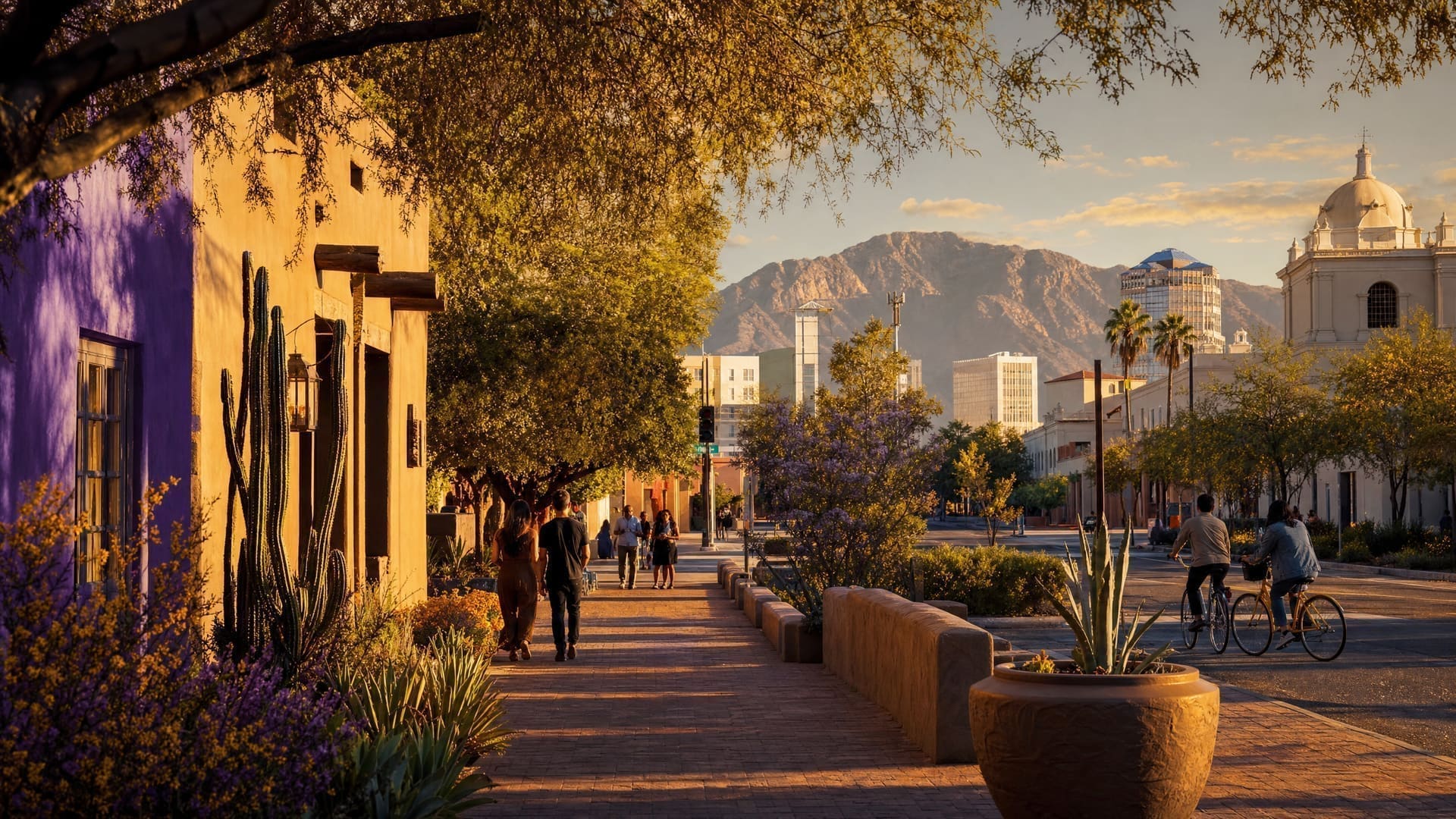
El Presidio was listed on the National Register of Historic Places on September 27, 1976, and it holds roughly 90 buildings of architectural and historical significance, loosely bounded by West Sixth and West Alameda Streets and North Stone and Granada Avenues. The architecture reads like a timeline: thick-walled Sonoran adobe row houses that abut the sidewalk from the territorial era, later Anglo-American and Victorian-influenced homes that arrived with the railroad in the 1880s, and the brick and stone that came with them. Because the blocks are tight and largely flat, the district is genuinely walkable — narrow streets, mature shade trees, and small interior courtyards rather than the wide setbacks of newer Tucson.
- Presidio San Agustín del Tucson Museum (196 N. Court Ave, Reconstructed 1775 fort, Turquoise Trail trailhead): A walk-through reconstruction of the original Spanish fort, with a roughly 150-year-old Sonoran row house, a 2,000-year-old pit house, and docent tours. It anchors the 2.5-mile Turquoise Trail loop through downtown.
- Tucson Museum of Art Historic Block (La Casa Cordova, Built ~1848, Reopened Nov 10, 2024): The museum's block preserves several historic adobe homes, including La Casa Cordova — built around 1848 and among the oldest houses in Tucson — which reopened to the public on November 10, 2024 after a restoration tied to the museum's centennial.
- El Charro Café (Original) (Court Avenue, Founded 1922, Same family ever since): The original downtown El Charro, founded by Monica Flin in 1922, is billed as the oldest Mexican restaurant in the country continuously operated by the same family — still run by Flin's descendants today.
What's On This Month
If you're planning a visit, mind the summer calendar. Through June 2026 the Presidio Museum runs reduced hours — Thursday through Sunday, 9 a.m. to 2 p.m. — and then closes for the hottest stretch, July 1 through August 21, so the next few weekends are the window before it goes dark for late summer. General admission runs about $9 for adults and $6 for children ages 6 to 13, with $3 off for seniors, military, and Pima County residents, and free entry for members and kids 5 and under. The museum also hosts a Last Fridays "Fire & Ice" evening at 196 N. Court Avenue on June 26 from 7 to 9 p.m. Hours, prices, and event details change, so confirm at tucsonpresidio.com before you go.
What It Costs to Live Downtown
El Presidio sits in the 85701 ZIP code, the downtown core, where Zillow's average home value was about $410,000 in mid-2026 — a clear premium over the roughly $333,000 citywide Tucson average, reflecting the small, sought-after supply of historic adobe properties and the walk-everywhere location next to the museums, restaurants, and offices of downtown. The broader Tucson market has cooled slightly: prices were down about 1.6% year over year over the three months ending May 2026, with a median sale price near $320,000, according to Redfin. Historic downtown housing stock is limited and rarely directly comparable, so the ZIP-level average is context, not a quote — none of this is investment advice.
Quick reference (June 22, 2026): El Presidio Historic District is just north of downtown Tucson, roughly bounded by West Sixth and West Alameda Streets and North Stone and Granada Avenues. The Presidio San Agustín del Tucson Museum is at 196 N. Court Avenue; June hours are Thursday–Sunday, 9 a.m.–2 p.m., closed July 1–August 21, with a Last Fridays "Fire & Ice" event on June 26, 7–9 p.m. Admission is about $9 for adults and $6 for ages 6–13, with discounts for seniors, military, and Pima County residents. Hours, prices, and events change — confirm at tucsonpresidio.com.
The Exact Block Where Tucson Began
Plenty of cities have a historic district; few can point to the exact block where they began and still walk you through a reconstruction of the fort that started it. El Presidio packs 250 years of Tucson — a Spanish garrison, territorial adobe row houses, a railroad-era building boom, an art museum, and a restaurant older than most of the state — into a grid you can cover on foot. For residents it's the most concentrated dose of local history in the metro; for anyone weighing a downtown address, it marks the tight, premium-priced core where the city is at its most walkable. Catch the museum before its July closure, and budget time to wander the blocks around it.
Sources
Visit Tucson — "El Presidio Historic District (Presidio District)" — visittucson.org/plan-your-visit/about-tucson/tucson-districts/presidio-district — accessed June 22, 2026 (for the district's founding as a 1775 Spanish military fort, its walkable historic character, and the Presidio San Agustín del Tucson Museum). National Park Service — "Presidio San Agustín del Tucson" and "El Presidio Historic District" — nps.gov/places/presidio-san-agustin-del-tucson.htm and nps.gov/nr/travel/amsw/sw7.htm — accessed June 22, 2026 (for the roughly 700-foot square fort with three-foot-thick adobe walls 10 to 12 feet tall, the site built over an earlier Native American community, the 2,000-year-old pit house and original Sonoran row house, and the Turquoise Trail 2.5-mile loop). Living Places / National Register documentation — "El Presidio Historic District, Tucson" — livingplaces.com/AZ/Pima_County/Tucson_City/El_Presidio_Historic_District.html — accessed June 22, 2026 (for the September 27, 1976 National Register listing, the roughly 90 contributing buildings, and the district boundaries at West Sixth, West Alameda, North Stone, and Granada). Tucson Presidio Museum — "Calendar" and visitor information — tucsonpresidio.com — accessed June 22, 2026 (for the 196 N. Court Avenue address, the June Thursday–Sunday 9 a.m.–2 p.m. hours, the July 1–August 21 summer closure, admission of about $9 adults and $6 for ages 6–13 with discounts for seniors, military, and Pima County residents, and the Last Fridays "Fire & Ice" event on June 26, 7–9 p.m.). Tucson Museum of Art — "Historic Block" and La Casa Cordova materials — tucsonmuseumofart.org/historic-block — accessed June 22, 2026 (for La Casa Cordova built around 1848 as one of the oldest houses in Tucson, owned and operated by the museum, and reopened to the public on November 10, 2024 after a restoration tied to the museum's centennial). El Charro Café (official) and Wikipedia — "El Charro Café" — elcharrocafe.com/history and en.wikipedia.org/wiki/El_Charro_Café — accessed June 22, 2026 (for the 1922 founding by Monica Flin and the claim as the nation's oldest Mexican restaurant continuously operated by the same family, on Court Avenue in El Presidio). Zillow — "Tucson, AZ 85701 Home Values" and "Tucson, AZ Housing Market" — zillow.com/home-values/95039/tucson-az-85701 and zillow.com/home-values/7481/tucson-az — accessed June 22, 2026 (for the roughly $410,000 average home value in the 85701 ZIP code and the roughly $333,000 citywide Tucson average in mid-2026). Redfin — "Tucson Housing Market" — redfin.com/city/19459/AZ/Tucson/housing-market — accessed June 22, 2026 (for prices down about 1.6% year over year over the three months ending May 2026, with a median sale price near $320,000). All figures are current as of June 22, 2026; museum hours, admission, events, and home values change, so confirm current numbers before relying on any single figure. This post is for informational purposes only and is not an offer to sell or a solicitation of an offer to purchase real estate. Kyle Berglund and Tierra Antigua Realty fully support and comply with the Fair Housing Act and the Equal Opportunity Act.
Topics
- Local Insights
- El Presidio
- Historic District
- Downtown Tucson
- Presidio San Agustin del Tucson
- Tucson Museum of Art
- El Charro Cafe
- Tucson history
- Tucson
- 85701