Downtown Links Is Finished: What the Sixth Street Underpass Changes for Dunbar/Spring
Tucson dedicated the Sixth Street Underpass on Nov. 6. What Downtown Links built along Dunbar/Spring, and the flood map, train horn and Stone Avenue questions.
A highway plan from the 1980s became a 1.3-mile parkway, a railroad underpass and a plaza deck. The neighborhood on its north side gets its southern street back, and three questions worth asking.
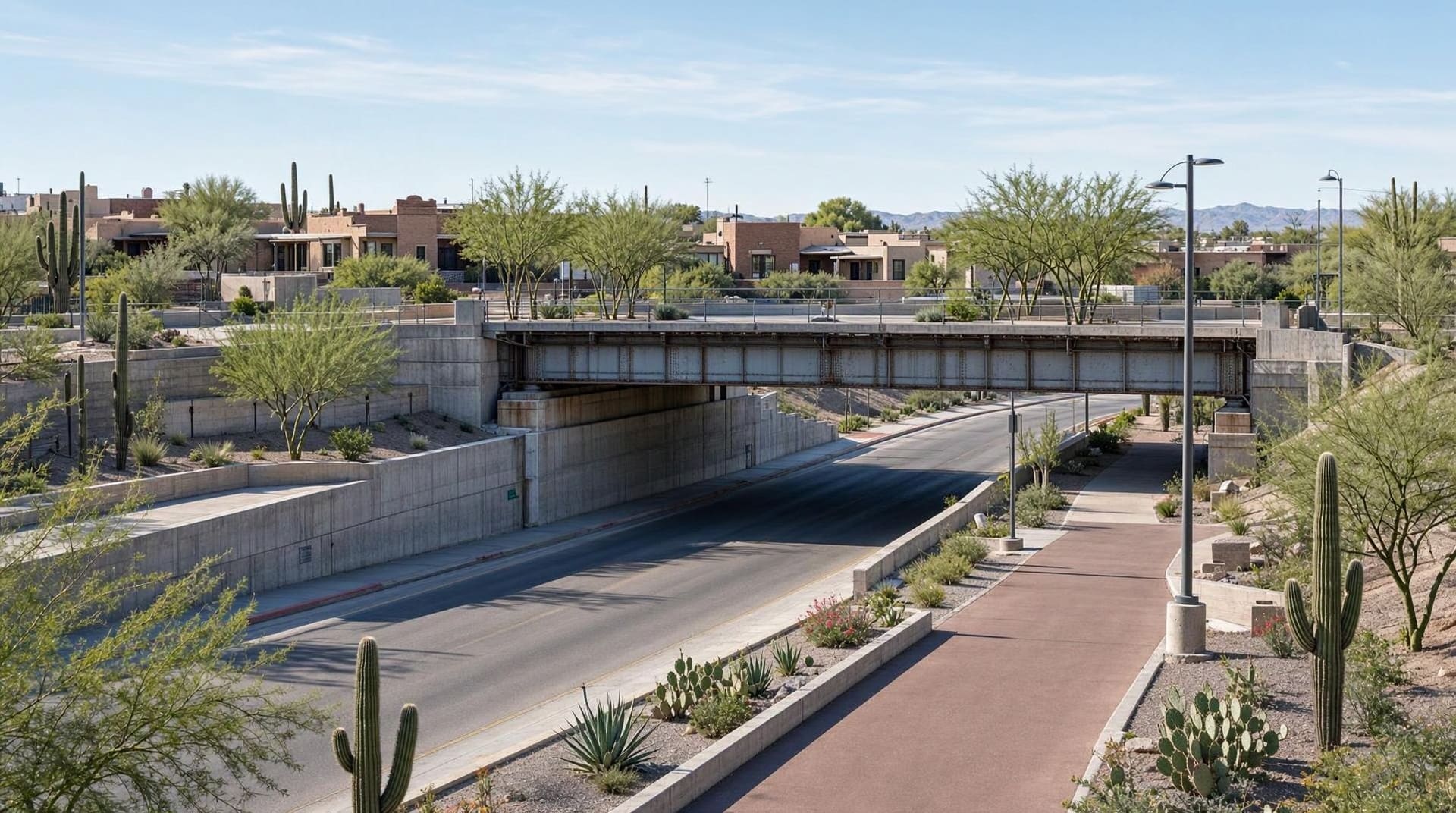
Forty-eight drilled shafts hold up the railroad over the newest stretch of Sixth Street in Tucson. Crews finished them in January 2024, after shifting Union Pacific trains onto a temporary track so they could dig the road out from underneath, and the stretch of Sixth Street they were building is one the city closed to all travel between Church and Stone avenues in late 2021. On Friday, November 6, 2026, the City of Tucson dedicated that Sixth Street Underpass at a ribbon-cutting on the Downtown Links deck plaza, and with it marked the end of a project it began building in August 2020.
The underpass sits at the southwest corner of Dunbar/Spring, the historic neighborhood bounded by Speedway Boulevard, Sixth Street, Stone Avenue and the Union Pacific tracks. For the people who live there, the construction years meant detours to get home. "There's times you have to go out of your way to find your way back into the neighborhood," resident Gabriel Valencia told KGUN 9 while the work was still under way.
What the city celebrated is formally Downtown Links Phase III West-End. Its final phase connects Barraza-Aviation Parkway to St. Mary's Road and was delivered in two segments: the new Maclovio Barraza Parkway from Broadway to Sixth Street, finished in February 2023, and the western piece finished now. The city lists an underground box culvert to reduce downtown flooding, the underpass that removes the at-grade railroad crossing at Sixth Street, a new roadway, the deck plaza, and expanded bike and pedestrian facilities. The Regional Transportation Authority adds bicycle and pedestrian overpasses at Sixth Street and Stone Avenue.
"This project has been a top priority for me and our Tucson community since my time representing Ward 1," Mayor Regina Romero said in the city's announcement. Vice Mayor Lane Santa Cruz, who represents Ward 1 now, put it more briefly: "Downtown Links now connects people, not just places." At the ceremony, Romero told KVOA the city "had to find additional funds to be able to finish it."
- Nov. 6, 2026
- Ribbon-cutting and dedication of the Sixth Street Underpass
- 1.3 miles
- Length of the Downtown Links corridor, Barraza-Aviation Parkway to the I-10 frontage road
- $76.1 million
- RTA funding listed for the project, plus $8.5 million in regional HURF dollars
- 48
- Drilled shafts completed for the railroad underpass by January 2024
A Highway Plan That Became a Parkway
Downtown Links started as something much larger. The Arizona Department of Transportation once planned to extend Barraza-Aviation Parkway through downtown as a limited-access highway, a design the project's own history says would have meant a significant loss of properties in the Historic Warehouse District. In 1989 the City of Tucson offered to take the project over, and more than 20 alternative routes and alignments were weighed in public over the years that followed.
The shape that was finally built dates to 2006 and 2008. In December 2006 a Citizen Advisory Committee approved an alignment north of the Union Pacific railroad that meets Sixth Street at Seventh Avenue. After four committee meetings and two public meetings in the first half of 2008, the committee endorsed what it called the Curved Sixth Street Alignment, and Mayor and Council approved it 6-0 on July 8, 2008. The money came from the Regional Transportation Authority plan voters approved in 2006, a 20-year half-cent sales tax.
The work came in pieces. The first phase, a drainage system under Eighth Street, cost $7.4 million and finished in May 2012. The second, St. Mary's Road west of the tracks to Interstate 10, cost $7.3 million and finished in April 2014. The third is the one that ran from August 2020 to this month, and it is the one Dunbar/Spring lived beside.
Why the Last Phase Took Six Years
Building a road under a working main line is slow by design. The project's construction log shows the sequence: Seventh Avenue closed permanently to through traffic between Sixth and Seventh streets in August 2020; a double-barrel box culvert went in from the tracks west of Stone Avenue toward Sixth Avenue and Seventh Street in 2021; Sixth Street closed between Church and Stone avenues late that year; and on June 3, 2022, crews poured the first abutment for the deck plaza, on the west side of Stone Avenue north of Sixth Street, where the plaza now spans the new Sixth Street alignment.
The underpass itself was the hard part. In August 2025 the city said coordination with Union Pacific and with a fiber-optic utility inside the railroad's right-of-way had delayed it into early 2026. By January 27, 2026, the multi-use path was fully paved and tied into the Stone Avenue bicycle and pedestrian bridge, new light poles lined it, and landscaping was going in around the deck plaza; the Church Avenue and Sixth Street intersection and the paving of the new Sixth Street were still ahead.
Longtime resident Dominic Oldershaw told KGUN 9 what he expected the finish to fix: "There shouldn't be the backups that there are here at Fifth Street and Stone." Whether it does is something a resident can now test on an ordinary weekday, which is more useful than any projection.
What the Finished Corridor Changes for Dunbar/Spring Owners
The housing is the reason Dunbar/Spring has a page on this site. Its southern half was platted in 1904 as an extension of downtown, and most of its homes are Sonoran row houses, Craftsman bungalows, Territorial cottages and brick Mission Revival houses built between about 1910 and the late 1920s. Part of it was listed on the National Register in 1989 as the John Spring Neighborhood Historic District. There is no fee HOA; exterior changes go through the volunteer Dunbar/Spring Neighborhood Association and the city's design review under the 11th Avenue/Dunbar-Spring Design Guidelines, which is worth reading before you budget a renovation.
The first change is the plainest: Sixth Street, the neighborhood's southern boundary, runs through again, now beneath the tracks instead of across them. The at-grade railroad crossing there is gone, and the deck plaza that sits at the district's southwest edge is finished public space rather than a work zone.
The second is drainage. Phase III reconstructs the Tucson Arroyo culvert from Sixth Avenue to Tenth Avenue and ties into the 2012 Eighth Street system, completing work for the Arroyo Chico watershed. The project's FAQ says the new facility will improve historical flooding problems and may allow properties to be removed from the FEMA floodplain. May is the operative word. A parcel's flood zone changes when the flood map does, so a buyer should look up the current designation for the specific address rather than assume the culvert has already changed it.
The third is train horns, and it deserves the same care. The project upgraded the at-grade crossings at Main Avenue, at Fifth Street, at Sixth Street and Seventh Avenue, and on Seventh Avenue to establish eligibility for a quiet zone, which is the federal term for a stretch of track where trains do not routinely sound their horns. Eligibility is not designation. This post found no announcement that a quiet zone is in effect, so anyone weighing a home near the tracks should ask the city's Department of Transportation and Mobility where that stands.
For what homes in the neighborhood cost and how that has moved, see the Dunbar/Spring page on this site, where those figures are kept current.
Stone Avenue Is the Next Corridor to Watch
Downtown Links was a 2006 ballot item. The next round of regional projects is already funded: on March 10, 2026, voters approved the Regional Transportation Authority's new 20-year, $2.67 billion plan, again paid for with a half-cent sales tax. One project in that plan runs along Dunbar/Spring's eastern boundary. The RTA's High Capacity Transit project, also called the Stone Avenue BRT, held an open house on November 9, three days after the ribbon-cutting.
For an owner on the east side of the neighborhood, that is the corridor to follow now. Downtown Links shows how long the gap between a vote and a finished street can run here: approved in 2006, built from 2020, dedicated in 2026. The open-house stage is when the details of a project are still being set, and it is the cheapest time to read them.
Three Checks Before You Buy Near the Tracks
Drive the new Sixth Street at the hours you would actually commute, and walk the multi-use path to the Stone Avenue bridge and the deck plaza. Look up the current flood zone for the exact parcel. Ask the city whether the quiet zone the crossing upgrades were built for has been established. None of those answers is in a ribbon-cutting announcement, and all three are easy to get before an offer rather than after a closing.
Sources
City of Tucson Department of Transportation and Mobility — "You're Invited! Downtown Links Ribbon Cutting" — https://www.tucsonaz.gov/Departments/Transportation-Mobility/DTM-News-Releases/Downtown-Links-Ribbon-Cutting — accessed November 12, 2026
Regional Transportation Authority — "RTA, City of Tucson celebrate completion of Downtown Links roadway project" — https://rtamobility.com/news/rta-city-of-tucson-celebrate-completion-of-downtown-links-roadway-project/ — accessed November 12, 2026
Regional Transportation Authority — "Downtown Links project approaches the finish line" — https://rtamobility.com/?p=13201 — accessed November 12, 2026
KVOA — "City of Tucson celebrates Sixth Street overpass completion" — https://www.kvoa.com/news/local/city-of-tucson-celebrates-sixth-street-overpass-completion/article_224273bf-eb18-47fe-999b-df11131df252.html — accessed November 12, 2026
KGUN 9 — "Linked up: Dunbar Spring residents hopeful as Downtown Links nears completion" — https://www.kgun9.com/news/community-inspired-journalism/midtown-news/linked-up-dunbar-spring-residents-hopeful-as-downtown-links-nears-completion — accessed November 12, 2026
Downtown Links — "FAQ" (funding, phases, drainage and crossing upgrades) — https://www.downtownlinks.info/faq — accessed November 12, 2026
Downtown Links — "Project History" — https://www.downtownlinks.info/archive/project-overview/project-history/ — accessed November 12, 2026
Downtown Links — "Construction Updates" — https://www.downtownlinks.info/category/construction-updates/ — accessed November 12, 2026
Downtown Links — "News & Alerts" — https://www.downtownlinks.info/current-status/ — accessed November 12, 2026
Project details are as published by the City of Tucson and the Regional Transportation Authority; confirm current conditions, flood zone designations and any quiet zone status with the City of Tucson before relying on them. Community details are from this site's Dunbar/Spring page. This post is for informational purposes only and is not an offer to sell or a solicitation of an offer to purchase real estate.
Topics
- Local Insights
- Dunbar/Spring
- Downtown Links
- Sixth Street
- Regional Transportation Authority
- Historic Districts
- Central Tucson