History in the Park at Fort Lowell: A Scavenger Hunt on November 14, 2026
Fort Lowell's History in the Park on Nov. 14: a scavenger hunt, a cavalry band at 11 a.m., museum admission, and the 2026 design rules for owners nearby.
The Tucson Presidio Trust fills the park around its museum with demonstrations, a re-created cavalry band and a hunt for the site's hidden corners. The same ruins shape what the neighborhood around them may build.
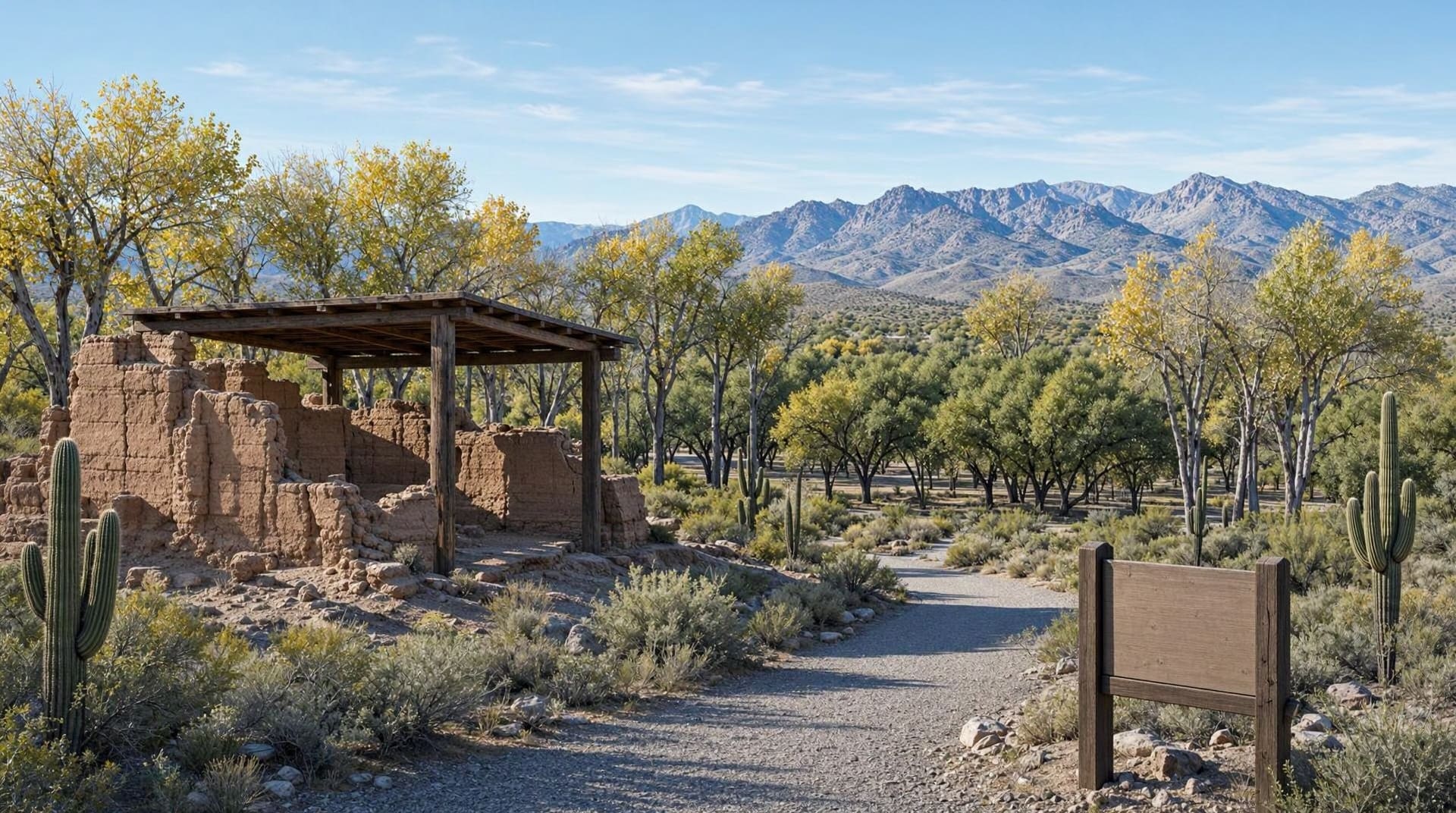
The scavenger hunt at Fort Lowell Park on November 14 sends people looking for the park's hidden corners, and the best-hidden thing there is underground. On the southwest corner of Craycroft and Fort Lowell roads, on the same parcel as the ruins of the fort's best-preserved officers' quarters, lies a cluster of buried Hohokam pit houses: part of a village archaeologists call the Hardy Site, where people lived and farmed from about 300 to 1250 CE. More than six centuries later the U.S. Army built a post on the same ground, where Tanque Verde Creek and Pantano Wash meet to form the Rillito.
The Tucson Presidio Trust, which runs the Fort Lowell Museum in the reconstructed commanding officer's quarters, holds History in the Park on Saturday, November 14, 2026, from 10 a.m. to 1 p.m. Its calendar lists the park-wide scavenger hunt, historic demonstrations and displays on daily life for the soldiers, their households and other Tucsonans of the period, and an 11 a.m. concert by the 4th Cavalry Regimental Band of Fort Lowell. The event's community-calendar listing on KXCI adds a blacksmith demonstration and says the program covers daily life for the post's soldiers and Apache Scouts as well. It is included with museum admission.
- Nov. 14, 2026
- History in the Park, 10 a.m. to 1 p.m. at the Fort Lowell Museum and park
- 11 a.m.
- Concert by the 4th Cavalry Regimental Band of Fort Lowell
- $5
- Museum admission, which covers the event; $4 for veterans
- 1873–1891
- Years the U.S. Army operated the post
What the Hunt Is Really Looking For
The post the hunt circles was one of some 200 military establishments in the Southwest, the City's design guidelines for the district say. The Army began building it in 1873, ran it as a base of supply operations during its campaigns against the Apache, and decommissioned and abandoned it in 1891. The Tucson Presidio Trust calls the Apache Wars America's longest-running military conflict, and its museum's displays cover the daily lives of the soldiers and their households alongside the history of the region's Apache people, plus the Hohokam village under the park.
What the hunt finds above ground is mostly adobe. Unstabilized, sun-dried adobe is the most common historic construction type in the district, according to the same guidelines, and the fort's walls were built of it. Unbaked adobe erodes when it is left to the weather, which is why so much of the post survives as ruin rather than as building, and why the remnants that do survive are the ones someone has protected. That is the thread worth following on a scavenger hunt here: notice what has been covered, capped or rebuilt, and ask why.
The Army decommissioned the post in 1891. Sonoran and Chihuahuan farming and ranching families came north to the bottomlands along the Rillito and Pantano, adapted the empty fort buildings, and built the Village of El Fuerte to the west of the fort. In the 1930s the ruins of the quartermaster's commissary storehouse and the post trader's store were restored as homes, and the area drew artists, authors and professionals. Farming in the area continued until the 1970s.
The park itself grew in pieces. The City added the Quartermasters Commissary compound on the northwest corner of Fort Lowell and Craycroft in 2002. In 2004, with Pima County cultural-resources bond money and a land swap, it acquired the Adkins Parcel across the street, which holds the three best-preserved officers' quarters, the ruins of the guardhouse and those buried pit houses. Fort Lowell Park and the area around it were listed in the National Register of Historic Places in 1978 as the Fort Lowell Multiple Resource Area.
The Band Plays the Post's Own Era
The 4th Cavalry Regimental Band of Fort Lowell is a re-creation by the Old Arizona Brass Band, a Tucson educational nonprofit that bandmaster Ray Hicks founded in the fall of 1996. Its volunteers perform the music of the military and civilian bands that played in Arizona from 1872 to 1912. In its cavalry configuration the band fields 20 to 22 musicians in U.S. Army blue, and it describes its frontier sound as leaning on E-flat cornets, alto horns and tubas. By the band's own account, the unit it re-creates is the 4th Cavalry's regimental band at Fort Lowell in the late 1880s, so the 11 a.m. set puts that repertoire back on the ground where the original band played it.
What the 2026 Design Guidelines Mean for Fort Lowell Owners
The ruins in the park and the homes around it are governed by the same instrument. The Fort Lowell neighborhood page on this site describes a district of thick-walled Sonoran adobe row houses, Sonoran Military and Santa Fe-Sonoran Ranch homes, Bungalow Vernacular cottages, mid-century red-brick ranches and 1980s and 1990s two-story Spanish Colonial and Pueblo Revival homes, many on irrigated, pecan-shaded lots. There is no fee HOA: the volunteer Old Fort Lowell Neighborhood Association handles preservation and advocacy, and a few newer infill subdivisions carry small HOAs of their own. What governs exterior change is the City's Fort Lowell Historic Preservation Zone.
That zone has new design guidelines. The 2026 revision moved through the Fort Lowell Historic Preservation Zone Advisory Board in January and September 2025, the Tucson-Pima County Historical Commission's Plans Review Subcommittee in June 2025 and the City's Design Review Committee in January 2026, and the City Manager approved it in April 2026. The zone itself dates to 1981, when the City designated the area south of Fort Lowell Road; when the City annexed land north of the road in 1992, the county's historic district there and the City zone were combined, with a 200-foot buffer on three sides limited to one story and 16 feet.
The scope is the part buyers underestimate. Inside the zone, review applies to new fences, walls, gates, ramadas and sheds, to solar and HVAC installations, to pools and pool fencing, and to roof, window and door replacements, including work that would not otherwise need a permit. Projects go to the advisory board and the Plans Review Subcommittee and are approved by the City's Planning and Development Services director; the guidelines tell an owner to start by emailing the City's historic preservation staff at PDSDHistoric@tucsonaz.gov, who decide whether a project needs minor or full review.
Some of the specifics are concrete enough to plan around. Fourteen feet is the tallest height of a contributing building in the zone, apart from the old Post Trader's Store. Solar panels should stay off street-facing roof slopes, sit behind parapets on flat roofs, or be ground-mounted where no other slope works. Solid front walls and fences should stay at or under four feet from street-side grade, stepping up to six feet on the sides and rear, and corrugated or solid sheet-metal fencing is not acceptable. In unenclosed yards the guidelines call for native plants such as velvet mesquite, creosote and palo verde, and strongly discourage turf, synthetic lawn and decorative boulders.
Classification matters too. A 1995 survey counted about 30 contributing historic properties, and nearly 70 homes built after 1980 in La Sonrisa, San Miguel, Bosque Ranch and Adobes del Bosque are classed as contributing non-historic, reviewed under the same design and demolition standards. Before making an offer on a home there, confirm whether it sits inside the zone or the buffer and how it is classified, because that decides what you may add, replace or remove. History in the Park itself changes none of this: it adds no homes, rezones nothing and carries no fee. For what homes in Fort Lowell have sold for and how the area has changed, the Fort Lowell page carries the LiveBy-sourced record.
Getting to the Fort on Saturday Morning
The museum and park are at 2900 N. Craycroft Road, Tucson 85712; the park is open from 6 a.m. to 10:30 p.m. Admission is $5, $4 for veterans, and free for children 13 and under and for museum members; visitors 13 and under must come with an adult, and groups of more than eight are asked to schedule ahead at info@TucsonPresidio.com. Outside event days the museum is open Thursday through Saturday from 10 a.m. to 3 p.m., with last admission at 2:30. The splash pad runs April 1 through October 31, so it will be closed; the walking path, ponds, ramadas and interpretive signs will not. Questions go to the museum at 520-526-2335.
Sources
Tucson Presidio Trust — "Fort Lowell Museum" (hours, admission, History in the Park and November calendar) — https://tucsonpresidio.com/fort-lowell — accessed November 11, 2026
KXCI Community Radio — "History in the Park" event listing — https://kxci.org/events/history-in-the-park/ — accessed November 11, 2026
City of Tucson Planning and Development Services — "Fort Lowell Historic Preservation Zone Design Guidelines, Revision 2026" — https://www.tucsonaz.gov/files/sharedassets/public/v/1/city-services/planning-development-services/documents/fortlowell-design-guidelines_2026-revision_final.pdf — accessed November 11, 2026
City of Tucson Parks and Recreation — "Fort Lowell Park" — https://www.tucsonaz.gov/Departments/Parks-and-Recreation/Parks/Fort-Lowell-Park — accessed November 11, 2026
Pima County — "Loop History" (Fort Lowell Park at the confluence of Pantano Wash and Tanque Verde Creek) — https://www.pima.gov/loop-history?contentId=47aa99b8-8fdd-410c-bd38-67c5575d5dc5 — accessed November 11, 2026
Old Arizona Brass Band — home page — http://oabb.homestead.com/ — accessed November 11, 2026
Event times, programming and admission are set by the Tucson Presidio Trust and can change; confirm with the Fort Lowell Museum before attending. Community details are from this site's Fort Lowell page. This post is for informational purposes only and is not an offer to sell or a solicitation of an offer to purchase real estate.
Topics
- Things to Do
- Fort Lowell
- Fort Lowell Park
- Fort Lowell Museum
- Tucson Presidio Trust
- Historic Preservation
- Hohokam
- Central Tucson