San Xavier's 1797 Façade Is Being Restored by Hand
Mission San Xavier del Bac is free to visit and mid-restoration: a $749,000 National Park Service grant funds a five-phase conservation of its retablo façade.
Southwest of downtown off Interstate 19, conservators are stripping mid-century concrete off an 18th-century entrance and recreating its carvings with traditional materials. Free admission, free tours, and a 95-degree cutoff that October finally clears.
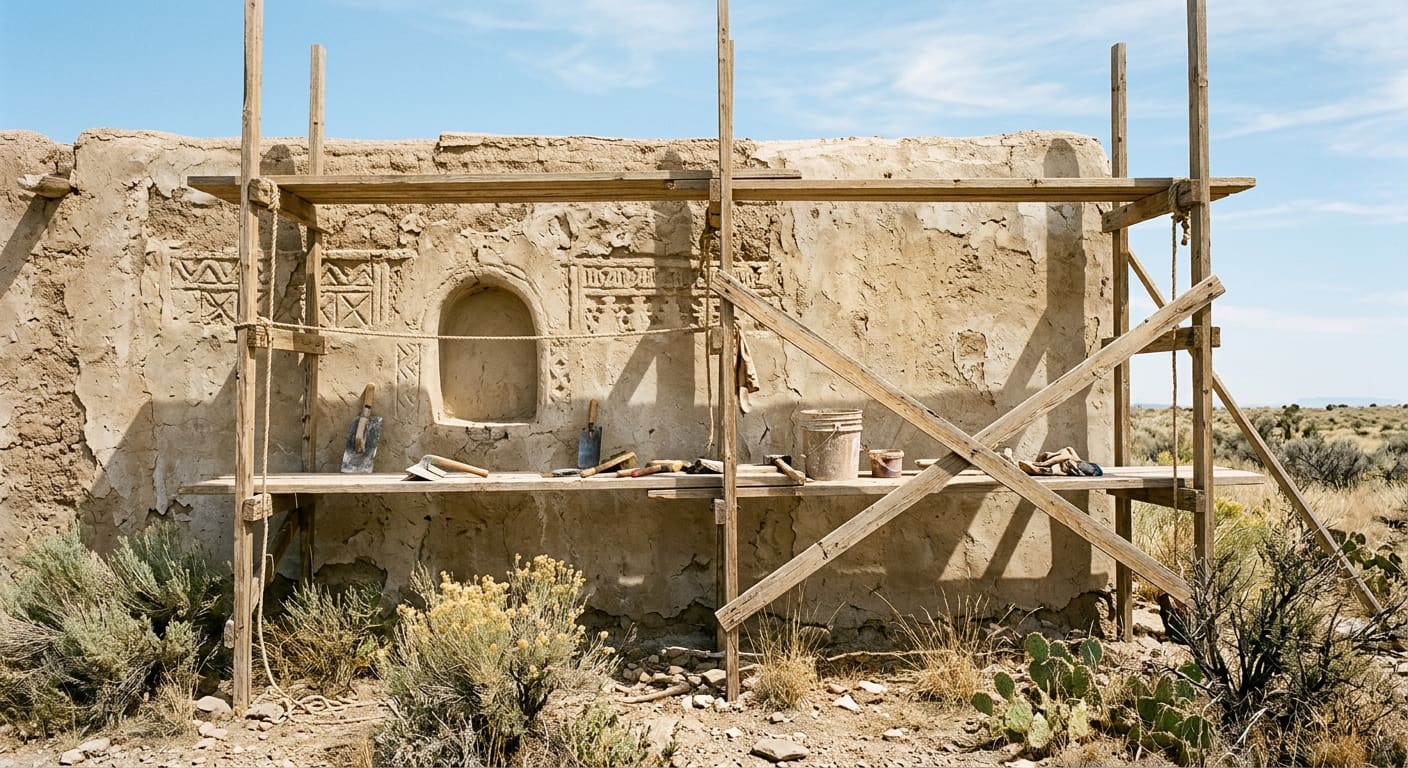
For a good part of each year, the carved front of Mission San Xavier del Bac is behind scaffolding. Preservation there is winter work: Patronato San Xavier's spring 2026 newsletter opens by noting that winter is the busiest season of the year for it, and records that the scaffolding went up across the retablo façade — the carved frontispiece set between the two bell towers — at the end of October. That leaves a short stretch each fall when the entrance is uncovered and the heat has finally dropped far enough for the free walking tours to run reliably. Early October is that stretch.
- 1783–1797
- Years the current church was built
- $749,000
- National Park Service grant for the façade
- Five
- Phases in the retablo façade conservation plan
- 86.3°F
- Tucson's normal October high (1991–2020)
The Entrance Holds the Last of the Original Paint
That façade — an ornate, altarpiece-like composition, which is what retablo means — was once brightly colored. The National Park Service's own grant file puts the loss plainly: two centuries of exposure to the harsh desert climate "has robbed the facade of decorative elements and much of the original color." What survives there survives nowhere else on the building. Starr Herr-Cardillo, Patronato San Xavier's director of conservation, told KGUN 9 that the façade "is really the only place on the outside that still has original finishes and paints on it." That is why one wall is absorbing this much work.
What the Crews Are Actually Doing
The plan runs in five phases. Phase one stabilized the surface and toned color-matched fills to the historic plaster around them. The work that followed took on the harder problem: repairs carried out roughly seventy years ago, when damaged sections were rebuilt with chicken-wire lath and inches-thick concrete plaster that obscured the original plaster and ornament underneath. The current team is removing those materials and recreating the lost elements with traditional ones, following the original lines and curves where they can still be read. Consulting architects and engineers who visited the site in October agreed with the local team that the façade's reproduction estípite columns — the tapered, inverted-obelisk pilasters that mark Mexican baroque — should be replaced with more accurate replicas.
Both the money and the hands are on the record. The National Park Service awarded Patronato San Xavier $749,000 in August 2024 from the Semiquincentennial Grant Program — a $10 million round covering 19 preservation projects in nine states, funded through the Historic Preservation Fund — and Patronato committed $573,050 in matching funds, with KGUN 9 reporting a total project cost above $1 million. Timothy Lewis and Matilde Rubio of Tohono Restoration lead the conservation work, and the team expects to finish between 2027 and 2028. Three other crews worked the site over the same season: a conditions assessment of the Convento and Granjon wings, a new lighting plan for the church interior, and a commissioned study of how to heat and cool a building whose historic plasters and artwork would not survive a conventional system.
Free to Enter, and Much Easier in October
Admission costs nothing. Per the mission, the church is open 9 a.m. to 4 p.m., the gift shop 8 a.m. to 5 p.m., and the museum and mausoleum 9 a.m. to 4 p.m., at 1950 W. San Xavier Road, southwest of downtown and straight off Interstate 19. Patronato's docent-led tours run several times a day Monday through Friday and, when possible, on Saturday, on a donation basis with no registration; each runs roughly thirty minutes, and group and school tours are temporarily suspended. The detail worth planning around is the cutoff: Patronato halts tours when the temperature passes 95 degrees. Tucson's normal September high, on the National Weather Service's 1991–2020 figures, is 95.1 degrees. October's is 86.3. Both figures are averages of daily highs rather than ceilings, and individual October days still clear 95, so October improves the odds rather than removing the risk — check the day's forecast and the mission's current tour status before you drive down.
It Is a Working Parish, Not a Museum Piece
Two facts shape how a visit actually goes. The first is that this is an active parish church on the San Xavier District of the Tohono O'odham Nation, in the village of Wa:k — which, as the Park Service's grant description notes, makes it one of the few mission churches in the country still ministering to the descendants of the community that built it. Services run on their own schedule and come first. The second is volume: the Park Service puts attendance above 250,000 a year. Neither the Park Service nor the mission publishes a time-of-day breakdown of that total, so plan for company at whatever hour you arrive rather than betting on a quiet one. Construction of the church you walk into began in 1783 under Father Juan Bautista Velderrain on a 7,000-peso loan and finished in 1797; it was named a National Historic Landmark in 1960.
Getting there is the simple part. The towers are visible from Interstate 19 and the exit puts you at the gate. The surrounding stretch of southwest Tucson runs flat and fast to drive — Drexel Heights to the north and west, Midvale Park up the interstate — and Drexel Heights is bordered on its north edge by the 20,000-acre Tucson Mountain Park, so a desert trailhead is minutes from the mission parking lot.
Want the façade uncovered? That is an early-fall window rather than a date: scaffolding went up across it at the end of October last season, and Patronato calls winter its busiest preservation season. Want it covered? Come once it is up — watching conservators lift 1950s concrete off 18th-century plaster is its own kind of visit, and the tours run either way. The phasing is expected to run to 2027 or 2028, so confirm the current scaffolding status, hours and tour times before you drive down.
Sources
National Park Service — "Semiquincentennial Grant Program FY23 project descriptions" (sortable dataset CSV) — nps.gov/common/uploads/sortable_dataset/1207/C8EF42AE-0A27-E960-C30865A9E37E6549/nri-Semiquin23ProjectDescriptionWeb.csv — accessed October 1, 2026 (for the $749,000 award to Patronato San Xavier, the $573,050 match, the 1783–1797 construction dates, the village of Wa:k, the 250,000-plus annual visitors, the early National Historic Landmark designation, and the quoted description of what the desert climate did to the façade). National Park Service — "National Park Service Awards $10 Million to Historic Sites and Structures in 9 States to Celebrate America's 250th Anniversary," August 22, 2024 — nps.gov/orgs/1207/national-park-service-awards-$10-million-to-historic-sites-and-structures-in-9-states-to-celebrate-america-s-250th-anniversary.htm — accessed October 1, 2026 (for the $10 million round, 19 projects across nine states, the Historic Preservation Fund, and the program's creation by Congress in 2020). National Park Service — "San Xavier del Bac Mission," Spanish Missions travel itinerary — nps.gov/subjects/travelspanishmissions/san-xavier-del-bac-mission.htm — accessed October 1, 2026 (for the 1960 National Historic Landmark designation, Father Juan Bautista Velderrain's 1783 construction start on a 7,000-peso loan, the active-parish status, and the 1950 W. San Xavier Road address). Patronato San Xavier — "Patronato Newsletter, Spring 2026" — patronatosanxavier.org/wp-content/uploads/2026/03/Patronato_Newsletter_Spring2026_FNL-WEB-1.pdf — accessed October 1, 2026 (for winter as the busiest preservation season, the scaffolding raised across the retablo façade at the end of October, the removal of roughly seventy-year-old chicken-wire lath and concrete plaster, the estípite column replica finding from the October site visit, and the three other projects: the Convento and Granjon conditions assessment, the interior lighting plan, and the heating-and-cooling study). Patronato San Xavier — "Visit" — patronatosanxavier.org/visit/ — accessed October 1, 2026 (for donation-basis public tours Monday through Friday and Saturday when possible, no registration, the roughly thirty-minute length, the suspension of group and school tours, and the 95-degree cutoff). San Xavier Mission — "Visitor Information" — sanxaviermission.org/visiting/ — accessed October 1, 2026 (for the 9 a.m. to 4 p.m. church hours, 8 a.m. to 5 p.m. gift shop, 9 a.m. to 4 p.m. museum and mausoleum, and the address). KGUN 9 — "San Xavier Mission undergoing preservation work" — kgun9.com/news/community-inspired-journalism/westside-news/san-xavier-mission-undergoing-preservation-work — accessed October 1, 2026 (for the five-phase structure, the completed first phase, the total project cost above $1 million, Timothy Lewis and Matilde Rubio of Tohono Restoration as project leads, the 2027–2028 completion expectation, and the Herr-Cardillo quotation). National Weather Service, Tucson — "Tucson Monthly and Daily Normals and Extremes," 1991–2020 normals — weather.gov/twc/TucsonMonthlyNormalExtremes — accessed October 1, 2026 (for the 95.1-degree September and 86.3-degree October normal highs). Pima County — "Tucson Mountain Park" — pima.gov/1272/Tucson-Mountain-Park — accessed October 1, 2026 (for the approximately 20,000-acre park size). All details current as of October 1, 2026; hours, tour schedules and construction phasing change, so confirm with the mission before relying on any single one. This post is for informational purposes only and is not an offer to sell or a solicitation of an offer to purchase real estate. Kyle Berglund and Tierra Antigua Realty fully support and comply with the Fair Housing Act and the Equal Opportunity Act.
Topics
- Things to Do
- Mission San Xavier del Bac
- Historic Preservation
- Southwest Tucson
- Patronato San Xavier
- National Historic Landmark
- Day Trips