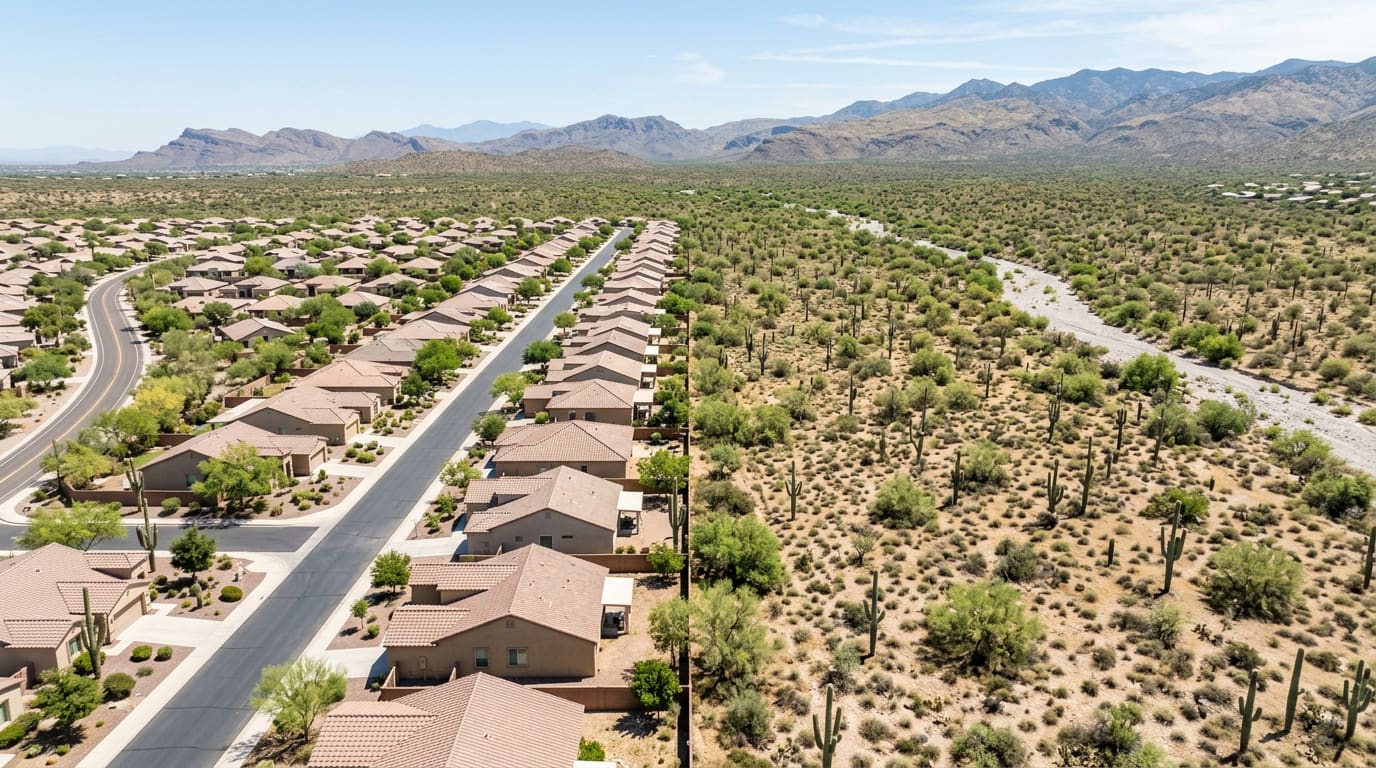
The Town With No Property Tax Wants a Bigger Map
Oro Valley levies no property tax, so its September 16 annexation strategy targets retail corners. A.R.S. 9-471 sets the clock and caps the zoning.
Oro Valley's council was set to take up an annexation strategy on September 16. Arizona's statute decides the rest: a thirty-day clock, two separate petition counts, and a cap on what the town may zone your parcel.
Oro Valley's one-page budget summary states it in capital letters: the town does not levy a property tax. Sales taxes carry the load instead: $29,972,793, or 23.4 percent of a $127.99 million fiscal 2026/27 budget, and its largest single source. Hold that next to the annexation strategy the council was set to take up on September 16, which points at commercial intersections rather than at subdivisions, and the shape of the map makes sense. What a boundary change does to a specific parcel is decided somewhere else — in A.R.S. § 9-471, which sets the clock, the two signature counts, and the ceiling on how the town may zone what it takes in.
- $0
- Town property tax levy, stated in Oro Valley's own FY 2026/27 budget summary
- 23.4%
- Share of town revenue sources from sales taxes — $29,972,793 of $127.99 million
- 30 days
- Waiting period after the blank petition is filed, before any signature may be gathered
- 4.00%
- The town's rate on construction contracting and on utility service
Retail Corners First, State Land Later
The council was scheduled to take up a new annexation strategy at its September 16 meeting. Local reporting ahead of it described near-term attention on North Oracle Road and West Ina Road along with state trust land near West Tangerine Road and North Oracle Road, and a longer-range interest in reaching across the Catalina Foothills toward La Encantada at North Campbell Avenue and East Skyline Drive. That ordering is not editorial. Under A.R.S. § 9-471(A)(1), state land — other than state rights-of-way or land the state holds by tax deed — cannot be included in an annexation filing unless the written approval of the state land commissioner and the selection board established by section 37-202 is filed with it, so the parcels that move fastest are the privately held ones.
What Annexation Cannot Do to Your Zoning on Day One
The provision to read first, if your parcel sits inside a proposed boundary, is subsection N of that same statute: a city or town annexing an area shall adopt zoning classifications that permit densities and uses not greater than those permitted by the county immediately before annexation. The annexation itself cannot upzone anything. The same sentence says what the protection is not — subsequent rezonings of the annexed territory go through the town's ordinary procedures, under its notice and hearing rules rather than the county's. Separately, subsection Q requires the council, on or before the date it adopts the ordinance, to have approved a plan, policy or procedure for providing the annexed area with appropriate levels of infrastructure and services to serve anticipated new development within ten years after the annexation becomes final.
Where the Rates Change
Inside town limits the Arizona Department of Revenue's rate table governs. Oro Valley's retail transaction privilege tax rate is 2.50 percent and has been since March 1, 2015; restaurants and bars match it; hotels add a 6.00 percent bed tax on top. The two rates a homeowner meets most often are higher: construction contracting — prime, speculative builder and owner-builder alike — is 4.00 percent, and so is utility service. The town also added a use tax of 2.50 percent effective July 1, 2026 under Ordinance No. 26-10, a second run at a tax first approved in January and invalidated after the state revenue department missed a procedural deadline. Tucson Spotlight reported the council passed it 4-3 on June 17, the same night it adopted the budget, after the town's chief financial officer told council that expenditure growth was outrunning revenue growth by about $1.7 million.
The Petition Is Two Counts, and They Can Disagree
Arizona does not let a town annex by declaration. Section 9-471 starts with a blank petition and an accurate map filed with the county recorder, and notice to the county assessor and the board of supervisors. No signature may be gathered for thirty days after that filing, and a public hearing has to fall inside the last ten of those days. Every owner whose property would become subject to town taxation gets first-class mail with a map. Only then, and only within one year, may a petition circulate.
What the petition has to carry is the part worth reading twice: signatures from the owners of one-half or more in value of the real and personal property, and from more than half of the persons owning it. Two separate counts, taken under two different subsections — F sets how the value is determined, G how the owners are counted. Several owners of one undivided parcel count as one owner. A person who owns twenty parcels also counts as one owner — so the largest landholder in a study area is one signature on the head count while carrying whatever share of the value its parcels represent, and under subsection U, an owner who has signed a pre-annexation agreement is counted toward both totals whether or not that owner ever signs the petition.
- Open the Mailed Notice (First-class mail, Accurate map, Public hearing): The statute requires notice by first-class mail, with a map of the territory, to every owner whose property would be subject to town taxation — plus newspaper publication and posting in at least three conspicuous public places. The public hearing falls in the last ten days of the thirty-day waiting period, and it is the hearing the statute guarantees on a specific proposed boundary.
- Work Out Which Count You Are In (Half by value, Majority by person, Pre-annexation agreements): The threshold is one-half or more in value of the real and personal property and more than half of the persons owning it, measured from the last assessment. Co-owners of a single undivided parcel are one owner, and an owner of many parcels is also one owner. An owner who signed a pre-annexation agreement counts toward both totals without signing the petition at all.
- Mark the Thirty Days After the Vote (Ordinance adopted, Verified petition, Attorney fees): Annexation becomes final thirty days after the governing body adopts the ordinance. A verified petition questioning the annexation's validity must be filed within those same thirty days and not otherwise, and the burden of proof is on the petitioner. A property owner who prevails is awarded reasonable attorney fees and costs from the annexing municipality.
Reading a Boundary Change Before It Reaches You
A boundary study is a slower document than a rezoning sign, and it is public earlier. The blank petition at the county recorder, the mailed map and the public hearing all happen before the ordinance exists, and the town's annexation page names a staff contact for a specific parcel. What the statute does not supply is a second chance after the vote. So the date I would put on a calendar is the thirty days after adoption, and the number I would price out first is 4.00 percent on contracting and utility service — a line in a remodel bid or a new-build budget, not an abstraction. Set that against the law enforcement, planning and permitting the town would begin providing, and the trade is at least legible. If you are not certain which side of a proposed line a parcel sits on, ask the town and your title company before a petition circulates, not after the ordinance passes.
Quick reference (September 16, 2026): the Oro Valley Town Council was scheduled to discuss a new annexation strategy at its September 16, 2026 meeting, per The Tucson Agenda's September 14 column — the sole source for the areas named in this post, and one this post could not corroborate against the town's own agenda before publication; confirm the agenda, the outcome and any specific boundary with the Town of Oro Valley, whose annexation page lists a staff contact. Areas named in that report are reported priorities, not filed annexations, and no annexation described here has been petitioned or adopted. The Town of Oro Valley does not levy a property tax, per its own FY 2026/27 budget summary; annexation therefore does not add a town property tax, though county, district and other levies on a parcel are set separately and are unaffected by this post. Tax rates, statutes and town policies change: verify current rates with the Arizona Department of Revenue and current procedure with A.R.S. § 9-471 before relying on either. This is general information, not legal, tax or investment advice, and it is not a statement about any specific parcel's status.
Sources
TucsonSentinel.com — The Tucson Agenda (an opinion-section column), "Marana revisits water future; Oro Valley looks at expansion" — tucsonsentinel.com/opinion/report/091426_agenda_marana_water_op/marana-revisits-water-future-oro-valley-looks-expansion — published September 14, 2026, accessed September 16, 2026 (for the Oro Valley Town Council being scheduled to take up a new annexation strategy at its Wednesday meeting; for short-term priorities along North Oracle Road and West Ina Road and state trust land near West Tangerine Road and North Oracle Road; and for the longer-term interest in annexing across the Catalina Foothills toward La Encantada at North Campbell Avenue and East Skyline Drive). This is the sole source for the areas named above, it is a column rather than a news report, and the town's own September 16, 2026 council agenda and minutes are the record that supersedes it — check them before relying on any area named here. Town of Oro Valley — "Know Your Town's Budget, Town of Oro Valley | FY 2026/27 Budget" — orovalleyaz.gov/files/assets/public/v/1/documents/finance/other-financial-documents/know-your-towns-budget-fy26-27.pdf — accessed September 16, 2026 (for the statement that the town does not levy a property tax; for the fiscal year 2026/27 budget of $127.99 million, a 15.5 percent decrease from the adopted FY 2025/26 budget of $151.5 million; and for sales taxes of $29,972,793, or 23.4 percent of total sources, ahead of state shared revenue at $24,554,722, or 19.2 percent). Arizona Revised Statutes § 9-471 — azleg.gov/ars/9/00471.htm — accessed September 16, 2026 (for the blank petition and accurate map filed with the county recorder and notice to the clerk of the board of supervisors and the county assessor; for the written approval of the state land commissioner and the selection board established by section 37-202 where state land other than state rights-of-way or land held by the state by tax deed is included; for the thirty-day waiting period before signatures may be obtained; for the public hearing within the last ten days of that period and the publication, posting and first-class mail notice requirements; for the one-year window to circulate and file the signed petition; for the requirement that it be signed by the owners of one-half or more in value of the real and personal property and more than one-half of the persons owning such property; for subsection F's determination of property value and subsection G's treatment of multiple owners of an undivided parcel, and an owner of multiple parcels, as one owner; for subsection U counting a pre-annexation agreement toward both thresholds; for subsection D's thirty-day verified petition window and burden of proof; for subsection E making the annexation final thirty days after adoption of the ordinance; for subsection N requiring zoning classifications permitting densities and uses not greater than those permitted by the county immediately before annexation, with subsequent rezonings under the city or town's own procedures; for subsection Q's requirement that, on or before the date the ordinance is adopted, the governing body have approved a plan, policy or procedure to provide infrastructure and services within ten years after the annexation becomes final; and for subsection R's award of reasonable attorney fees and costs to a property owner who prevails). Arizona Department of Revenue — "Oro Valley Transaction Privilege Tax Rates," Model City Tax Code city profile — azdor.gov/model-city-tax-code/city-profile/oro-valley — accessed September 16, 2026 (for retail sales, restaurants and bars, and hotels at 2.50 percent; for the additional 6.00 percent bed tax; for prime contracting, speculative builders and owner-builder contracting at 4.00 percent; for utilities at 4.00 percent; for the transaction privilege tax rate of 2.50 percent effective March 1, 2015; and for Ordinance No. 26-10, passed June 17, 2026, setting a use tax rate of 2.50 percent effective July 1, 2026). Tucson Spotlight — "Marana, Oro Valley adopt divergent 2026-27 budgets" — tucsonspotlight.org/marana-oro-valley-adopt-divergent-2026-27-budgets — published June 30, 2026, accessed September 16, 2026 (for the use tax passing on a 4-3 vote; for the $128 million budget adopted the same night; for the tax having previously been approved January 14 and invalidated after the Arizona Department of Revenue missed a procedural deadline; and for the town's chief financial officer stating that the difference between expenditure growth and revenue growth is about $1.7 million to the negative). Town of Oro Valley — "Annexation" — orovalleyaz.gov/Government/Departments/Town-Managers-Office/Annexation — accessed September 16, 2026 (for the town's description of its annexation process and notification by mail, newspaper advertisement and posted notices; for the services it lists as beginning on annexation, including law enforcement from the Oro Valley Police Department and planning, zoning, permitting and building inspection; and for the staff contact listed for annexation questions). Priorities reported by a news outlet are not filed annexations, and nothing here describes a petition that has been circulated or an ordinance that has been adopted. Statutes, tax rates and town policies change; confirm anything you intend to rely on with the Town of Oro Valley, the Arizona Department of Revenue and the current text of the statute, and confirm a specific parcel's status with Pima County and your title company. Nothing here is legal, tax or investment advice. This post is for informational purposes only and is not an offer to sell or a solicitation of an offer to purchase real estate. Kyle Berglund and Tierra Antigua Realty fully support and comply with the Fair Housing Act and the Equal Opportunity Act.
Topics
- Local Real Estate News
- Oro Valley
- Annexation
- Zoning
- Municipal Budgets
- Sales Tax
- Arizona Statutes