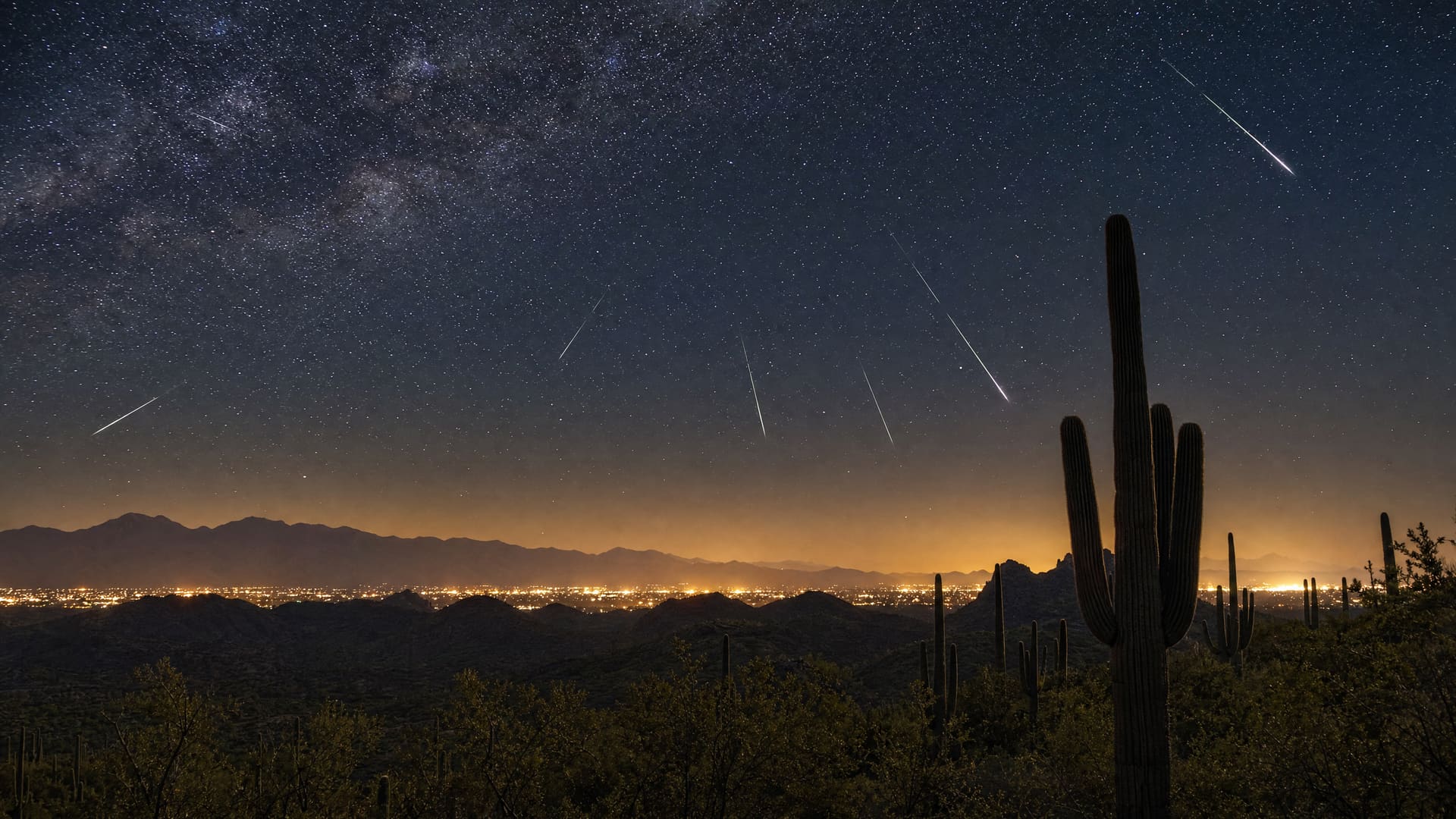
The Perseids Peak After Midnight. The Parks Near Tucson Close First.
The Perseids peak Aug. 12-13, 2026 under a new moon. Catalina State Park closes at 10 p.m. and Gates Pass locks at 8 — here is what stays open near Tucson.
This event has passed. This coverage was current through August 13, 2026. The venue details, access notes and background below still apply — check the organizer for the next date.
Three places you can legally stand at 3 a.m. within about an hour of town, what each one costs to get into, and the trailhead that locks its gate overnight with your car still parked inside.
The Perseids peak after midnight on Wednesday under a moon that is exactly zero percent lit — the darkest sky this shower gets. Every park on the usual Tucson shortlist locks its gate well before then. The saving grace is that this is a solvable problem here in a way it is not in most metro areas this size: Tucson and Pima County adopted the world's first comprehensive outdoor lighting code in 1973, after astronomers at Kitt Peak and the University of Arizona watched the valley's glow creep toward their instruments.
- 0%
- Moon illumination at the August 12 peak
- 50-100
- Meteors an hour at a dark site, by published estimates
- 8 p.m.
- When Gates Pass locks — cars parked inside cannot leave
- 24 hrs
- Saguaro East's walk-in access, after the car gate shuts
The Window Runs Midnight to Dawn
The shower peaks the night of Wednesday, August 12 into the predawn of Thursday, August 13. Rate estimates for a genuinely dark site run from 50 to 75 meteors an hour at the conservative end to 60 or 100 at the optimistic end. The radiant sits in Perseus, which rises in late evening and climbs until dawn — so the productive window runs roughly midnight to first light, not right after sunset. Bring no telescope. A meteor crosses too much sky too fast for magnification, so the equipment list is a reclining chair, twenty minutes of dark adaptation with your phone face-down, and patience.
Take both mornings if you can. Published 2026 forecasts put the moment of maximum at different hours spread across August 12 and 13, and much of that range falls in Arizona daylight, when nobody sees anything — so the two dark windows on either side of it are what a Tucson viewer actually gets, and the shower is climbing through both. EarthSky's guidance for this year is the predawn hours of both mornings, Wednesday the 12th and Thursday the 13th. If you are reading this on Tuesday, the earlier of the two is tonight, and everything below applies to it exactly as written.
The Gates Close Before the Good Part
This is the part national coverage skips, and it is the difference between a good night and a wasted drive. Gates Pass Trailhead in Tucson Mountain Park — the spot most people name first — runs 6 a.m. to 8 p.m., and the gates lock behind you: between 8 p.m. and 6 a.m., cars parked inside cannot leave. Saguaro National Park's Rincon Mountain District stops vehicles at the front gate at 8:30 p.m., and the Cactus Forest Loop closes and locks around 8 p.m. On the west side, the Bajada Loop admits vehicles during daylight only. Catalina State Park, at 11570 N. Oracle Road in Oro Valley, runs 5 a.m. to 10 p.m. — the most generous of the group, and still short of the hours that matter. Oracle State Park is the sharpest irony: a certified International Dark Sky Park about forty miles north where day use ends at 5 p.m. and vehicles must be out by then.
What Actually Stays Open
- Catalina Highway / Mount Lemmon (Coronado National Forest, 6,000+ ft climb, Open year-round): The Sky Island Parkway climbs more than 6,000 feet off the desert floor, and the mountain averages 20 to 30 degrees cooler than the valley — in August, the difference between sitting outside three hours and giving up after one. Open year-round, though it can close for snow or fire. Developed day-use sites charge a fee or take the Coronado Recreational Pass; highway pull-outs do not.
- Mt. Lemmon SkyCenter (9,157 ft elevation, $85 adult / $60 youth, Ends before the window): The guided option, and the one caveat on this list: SkyNights starts two hours before sunset and runs about five hours, so it is over roughly three hours after dark — finished before the midnight-to-dawn window opens. Take it for the telescopes and the 9,157-foot sky, not as a way to be somewhere legal at 3 a.m. The University of Arizona runs it nightly, year-round, capped at 28 people, minimum age 7, reservations required, roughly $62.50 to $88.50 with fees. If the forecast is uncertain it converts to a 'Chance of Clear' format, and guests can attend, reschedule, or take a 50 percent refund.
- Las Cienegas National Conservation Area (~50 miles southeast, Free, No permit): BLM ground about ten miles north of Sonoita, open to the public 365 days a year with no gate to beat. Primitive camping needs no permit and is capped at 14 consecutive days; bring water and firewood. The Empire Ranch headquarters buildings keep sunrise-to-sunset hours, but the land around them does not close.
- Saguaro East, On Foot (Walk or bike in, 24 hours, $15 per person / 7 days): The gate stops cars at 8:30 p.m., but the park is open around the clock to anyone entering on foot or by bicycle, and the trails never close. Note which fee applies: entering on foot or by bike is $15 per person for visitors 16 and older, good seven days in both districts. The $25 pass is the private-vehicle rate, and a private vehicle is exactly what the closed gate is stopping. A real option if you would rather not drive an hour each way — park legally outside the gate and carry a red light.
The real risk is weather, not light. The National Weather Service runs Arizona's monsoon on a fixed calendar — June 15 through September 30 — and mid-August sits in the wettest stretch of it, with the 2026 outlook leaning above normal for Tucson. Check the sky the afternoon you plan to drive, not the forecast you read on Monday — and remember the Perseids do not switch off at the peak. The nights on either side still produce.
The Code Underneath the Sky
The 1973 ordinance is not a historical curiosity. It is an active permitting requirement, updated most recently in 2024: exterior fixtures have to be full cutoff — no light emitted at or above an angle of 90 degrees — and the rated color temperature of light sources is capped at 3500K, with tighter zones inside 15 miles of Kitt Peak's summit and 12.5 miles of Mount Hopkins'. If you are building or remodeling in the City of Tucson or unincorporated Pima County, the fixtures on your exterior walls are a code item, not a design preference. The payoff is visible from any pull-out on the Catalina Highway: the drive to a sky worth watching is half an hour, not two.
Quick reference (August 11, 2026): Perseid peak is the night of Wednesday, August 12 into predawn Thursday, August 13, with a new moon and best viewing from about midnight to first light; the predawn hours of Wednesday, August 12 are the other window worth taking. Catalina State Park, 11570 N. Oracle Rd., Oro Valley — 5 a.m. to 10 p.m. Saguaro National Park East front gate — 5 a.m. to 8:30 p.m.; walk-in and bike-in access 24 hours; $15 per person on foot or by bike, $25 per private vehicle, each good seven days. Gates Pass Trailhead — 6 a.m. to 8 p.m., gates locked overnight. Oracle State Park day use — 7 a.m. to 5 p.m. Mt. Lemmon SkyCenter SkyNights — nightly, reservations required, minimum age 7, and it ends well before the midnight-to-dawn window. Hours, fees and closures change; confirm before you drive.
Know Which Gate Closes When
Tucson spent fifty years protecting the conditions for a night like Wednesday. The only thing standing between most residents and a genuinely dark sky is knowing which gate closes when — so pick the spot before dinner, not at 11 p.m. from a parking lot.
Sources
EarthSky — "Perseid meteor shower 2026! It's time to watch" — earthsky.org/astronomy-essentials/everything-you-need-to-know-perseid-meteor-shower/ — accessed August 11, 2026 (for the August 12-13 peak night, the guidance to watch after midnight through dawn on both the August 12 and August 13 mornings, the new moon on August 12 at zero percent illumination, the estimate of 50 to 75 meteors per hour at a dark site, and the radiant in Perseus rising in late evening and standing highest before dawn). Phoenix New Times — "Perseids meteor shower 2026: Arizona peak time, viewing tips" — phoenixnewtimes.com/arts-culture/perseids-meteor-shower-2026-arizona-40689347/ — accessed August 11, 2026 (for the 60 to 100 meteors per hour range under ideal conditions and the guidance to get away from metro light). Flandrau Science Center and Planetarium, University of Arizona — "Meteor Showers!" — flandrau.org/content/tucson-meteor-showers — accessed August 11, 2026 (for best viewing between midnight and sunrise). Pima County — "Gates Pass Trailhead" — pima.gov/1328/Gates-Pass-Trailhead — accessed August 11, 2026 (for the 6 a.m. to 8 p.m. gate hours and the overnight lock that prevents vehicles from leaving between 8 p.m. and 6 a.m.). National Park Service — "Operating Hours & Seasons, Saguaro National Park" — nps.gov/sagu/planyourvisit/hours.htm — accessed August 11, 2026 (for the Rincon Mountain District front gate at 5 a.m. to 8:30 p.m., the Cactus Forest Loop Drive closing and locking around 8 p.m., the Bajada Loop Scenic Drive admitting vehicles during daylight hours only, and 24-hour walk-in and bike-in access). Friends of Saguaro National Park — "Tips for Visitors" — friendsofsaguaro.org/tips — accessed August 11, 2026 (for the same gate hours and after-hours foot and bicycle access). National Park Service — "Fees & Passes, Saguaro National Park" — nps.gov/sagu/planyourvisit/fees.htm — accessed August 11, 2026 (for the $25 private-vehicle fee and the $15 per-person fee for visitors 16 and older entering on foot or by bicycle, each valid seven days across both districts). Arizona State Parks and Trails — "Catalina State Park" and its Facility Information page — azstateparks.com/catalina — accessed August 11, 2026 (for the 5 a.m. to 10 p.m. daily hours and the 11570 N. Oracle Road address in Oro Valley, 85737). Arizona State Parks and Trails — "Oracle State Park" and "Dark Sky Viewing Info" — azstateparks.com/oracle and azstateparks.com/oracle/dark-skies/viewing-info — accessed August 11, 2026 (for the 7 a.m. to 5 p.m. day-use hours, the requirement that vehicles exit by 5 p.m., and the park's location roughly 40 miles north of Tucson). DarkSky International — "Oracle State Park" — darksky.org/places/oracle-state-park-dark-sky-park/ — accessed August 11, 2026 (for the International Dark Sky Park certification). USDA Forest Service, Coronado National Forest — "Catalina Highway Scenic Drive" and the Mount Lemmon day-use recreation pages — fs.usda.gov/r03/coronado/recreation/catalina-highway-scenic-drive — accessed August 11, 2026 (for year-round access subject to snow and fire closures, and for day-use sites requiring a fee, the Coronado Recreational Pass, or an America the Beautiful pass). Wikipedia — "Catalina Highway" — en.wikipedia.org/wiki/Catalina_Highway — accessed August 11, 2026 (for the highway gaining more than 6,000 feet from the desert floor). Mt. Lemmon SkyCenter, University of Arizona — "SkyNights" program and Plan Your Visit pages — skycenter.arizona.edu/plan-your-visit/programs/skynights — accessed August 11, 2026 (for the nightly year-round schedule, the roughly five-hour program starting two hours before sunset — which places its end well before the midnight-to-dawn viewing window — the 28-person cap, the minimum age of 7, the reservation requirement, the 9,157-foot elevation, and the 'Chance of Clear' policy with attend, reschedule or 50 percent refund options). SciTech Institute — "Mt. Lemmon SkyCenter: SkyNights StarGazing Program" — scitechinstitute.org — accessed August 11, 2026 (for the $60 youth and $85 adult base prices and the $62.50 to $88.50 range with fees). Mount Lemmon Lodge — "Mount Lemmon Stargazing" — mountlemmonlodge.com/mount-lemmon-stargazing-the-skycenter/ — accessed August 11, 2026 (for Mount Lemmon averaging 20 to 30 degrees cooler than Tucson). Bureau of Land Management — "Las Cienegas National Conservation Area" — blm.gov/national-conservation-lands/arizona/las-cienegas — accessed August 11, 2026 (for public access 365 days a year, primitive camping without a permit, and the 14-consecutive-day limit). Empire Ranch Foundation — "Hours, Map & Directions" and "Visiting Policies" — empireranchfoundation.org/visit/hours-map-directions/ — accessed August 11, 2026 (for the headquarters buildings and outdoor areas keeping sunrise-to-sunset hours, the location about 50 miles southeast of Tucson and 10 miles north of Sonoita, and the advice to bring water and firewood). City of Tucson and Pima County — "Outdoor Lighting Code" — tucsonaz.gov/files/sharedassets/public/v/1/pdsd/documents/boards-committees-commissions/olcc/013024/olcc-draft.pdf — accessed August 11, 2026 (for the full-cutoff requirement barring light at or above an angle of 90 degrees, the 3500K rated color-temperature cap, and the E1a special lighting areas within 15 miles of the summit of Kitt Peak and 12.5 miles of the summit of Mount Hopkins). Pima County — "Outdoor Lighting Codes in Pima County" — pima.gov/3604/Outdoor-Lighting-Codes-in-Pima-County — accessed August 11, 2026 (for the 1973 adoption, the role of Kitt Peak and University of Arizona astronomers, the code being the first of its kind, and the most recent update in 2024). National Weather Service, Tucson — Monsoon Information Page and the 2026 Arizona Monsoon Outlook — weather.gov/twc/MonsoonInfo and weather.gov/media/twc/monsoon/2026ArizonaMonsoonOutlookOnePagerEnglish.pdf — accessed August 11, 2026 (for the fixed June 15 through September 30 Arizona monsoon season and the outlook leaning above normal for Tucson). All details are current as of August 11, 2026; park hours, fees, program pricing and weather change, so confirm before relying on any single figure. This post is for informational purposes only and is not an offer to sell or a solicitation of an offer to purchase real estate. Kyle Berglund and Tierra Antigua Realty fully support and comply with the Fair Housing Act and the Equal Opportunity Act.
Topics
- Things to Do
- Perseid Meteor Shower
- Stargazing
- Dark Skies
- Mount Lemmon
- Catalina Highway
- Catalina State Park
- Saguaro National Park
- Oro Valley
- Tucson
- Pima County