Your Winter Water Bill Quietly Sets a Year of Sewer Fees
Pima County bases a year of sewer fees on December-February water use. The 2027-28 rates, the math per 748 gallons, and the move-in and appeal rules.
Pima County averages three winter water bills to price the next twelve months of sewer service, so a sprinkler left on a summer schedule into December is billed as wastewater until mid-2028.
Every gallon a Tucson-area sprinkler puts on the ground this December, January and February will be billed again next year as sewage. Pima County Regional Wastewater Reclamation sets each home's monthly sewer charge from the average of those three water bills, and it applies that number every month from July through the following June. That water soaked into a yard and never touched a pipe. The meter cannot tell the difference, so the bill charges it as if it went down a drain.
- Dec–Feb
- Billing periods Pima County averages to set your sewer volume
- $3.870
- Sewer charge per CCF (748 gallons) per month, from July 2027
- $13.863
- Fixed monthly residential service fee, from July 2027
- 60 days
- Window to appeal a new sewer fee after the bill that shows it
How the Winter Quarter Average Works
The county calls it the winter quarter average. Its residential formula is a fixed service fee plus your average winter water use, measured in CCF — one hundred cubic feet, or 748 gallons — times a volume rate. Winter is used because it is normally the stretch of the year when outdoor watering is at its minimum, which makes what comes out of the meter a fair stand-in for what goes into the sewer.
The rates are already set. The Pima County Board of Supervisors adopted a four-year schedule on June 17, 2025: a 3 percent increase in the first year, then 1.75 percent a year after that. The current fiscal year, July 2026 through June 2027, charges $13.624 a month plus $3.803 per CCF. The average this winter produces takes effect in July 2027, when the schedule reaches $13.863 plus $3.870 per CCF.
What 748 Gallons a Month Costs
Each CCF on your winter average adds $3.870 to every sewer bill for twelve months, or $46.44 over the year. A home that averages 5 CCF a month this winter — 3,740 gallons — pays about $33.21 a month for sewer from July 2027. The same home averaging 9 CCF, perhaps because a lawn or a bed of annuals is still on its October watering schedule, pays about $48.69. That is $15.48 a month and $185.76 a year for water that went into the soil.
The window opens earlier than the calendar suggests. Tucson Water's billing periods cover the previous 30 days of use, so the city notes that a December bill can include water used in November, when irrigation may still be running at fall levels. If you want a lower average, the controller change belongs in early November, not on New Year's Day.
Winter Watering That Fits the Average
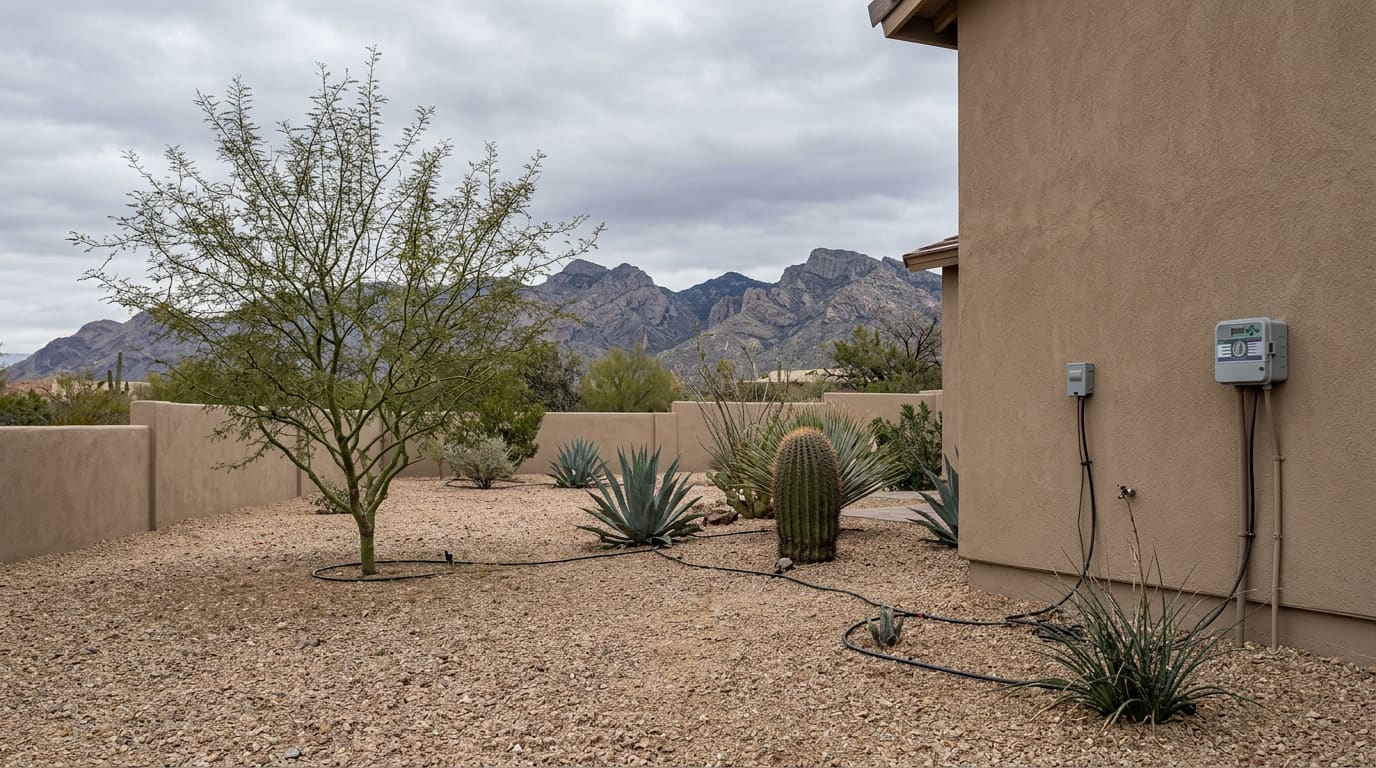
Most desert plantings need far less than a fall schedule delivers. The University of Arizona Cooperative Extension's watering schedule for established Southern Arizona landscapes calls for no irrigation at all from December through February for cacti, agaves, yuccas and desert trees and shrubs. In October and November it waters desert trees and shrubs every 14 to 21 days and cacti every 21 to 28. Desert ground covers and perennials drop to every 14 to 21 days in winter. A perennial ryegrass lawn is the exception: the same sheet waters it every 5 to 7 days from December through February, exactly the months the county averages.
A slow leak matters more in these three months than in any others. A drip emitter blown off its line or a running toilet in January is not a one-month cost here: it is folded into the average and billed for a year.
If You Are Buying, Selling or Leaving for the Season
A buyer inherits a sewer fee built on someone else's winter. The county's code allows a one-time new move-in adjustment based on the first two full months of actual metered water use at the address, which is worth requesting if the previous owner kept a thirsty yard or left the house vacant for a winter.
If your fee looks wrong, the appeal clock is short. Pima County gives customers 60 days after receiving the bill that shows a new user fee to challenge it, and while an appeal can be filed any time in the fiscal year, credits reach back only 60 days. Appeals are judged on three consecutive months of occupied water use from the prior billing year. The county takes them online or at 520-724-6609.
Owners who spend part of the year elsewhere have a separate route. The code provides a vacancy adjustment for a home with no discharge to the sewer, but it requires 30 days' notice before the home is vacated.
Who Pays It, and the Date That Matters
Pima County bills sewer through the water providers it contracts with, including Tucson Water and Oro Valley Water, and the rate schedule is the same whichever one sends the bill. A home on a septic system does not pay this charge at all. For everyone else, the cheapest sewer bill of 2027-28 is set by what the irrigation controller does between early November and the end of February.
Quick reference: Pima County sets each home's sewer volume from its December, January and February water billing periods and applies it from July for 12 months. From July 2027 the residential rate is $13.863 a month plus $3.870 per CCF (748 gallons). Appeals are due within 60 days of the bill showing a new fee; call 520-724-6609.
Sources
Pima County — "Appeal on Winter Quarter Average" — https://www.pima.gov/1778/Appeal-on-Winter-Quarter-Average — accessed October 22, 2026
Pima County Board of Supervisors — Ordinance amending Pima County Code Chapter 13.24, Sanitary Sewer User Fees, adopted June 17, 2025 (Tables 1 and 2, FY2025-26 through FY2028-29) — https://content.civicplus.com/api/assets/d84098a2-93ad-4ce3-be8a-241744a99ad0 — accessed October 22, 2026
Pima County Regional Wastewater Reclamation — Residential sewer user fee notice, "Due to rising costs of operation and maintenance, Pima County recently raised its sewer rates" (2025) — https://content.civicplus.com/api/assets/caa52252-9d1e-4369-97f3-948ac74043c8 — accessed October 22, 2026
City of Tucson, Tucson Water — "Sewer / Wastewater Rates Winter Averaging" — https://www.tucsonaz.gov/Departments/Water/Your-Water-Bill/Sewer-Rates — accessed October 22, 2026
KVOA News 4 Tucson — "Pima County raises wastewater fees: How it impacts Tucson customers" (August 1, 2025) — https://www.kvoa.com/news/local/pima-county-raises-wastewater-fees-how-it-impacts-tucson-customers/article_58a56ea4-8c0d-4aca-afdd-d7390b38beb5.html — accessed October 22, 2026
University of Arizona Cooperative Extension — "Recommended Watering Schedule for Southern Arizona Established Garden & Landscape Plants" — https://extension.arizona.edu/sites/default/files/2025-02/Watering-Guide.pdf — accessed October 22, 2026
All details are current as of October 22, 2026; sewer rates, billing periods and appeal rules are set by Pima County and can change, so confirm your own account with Pima County Regional Wastewater Reclamation before relying on any figure here. This post is for informational purposes only and is not an offer to sell or a solicitation of an offer to purchase real estate. Kyle Berglund and Tierra Antigua Realty fully support and comply with the Fair Housing Act and the Equal Opportunity Act.
Topics
- Local Insights
- Tucson
- Pima County
- Sewer Fees
- Water Bills
- Homeownership
- Desert Landscaping