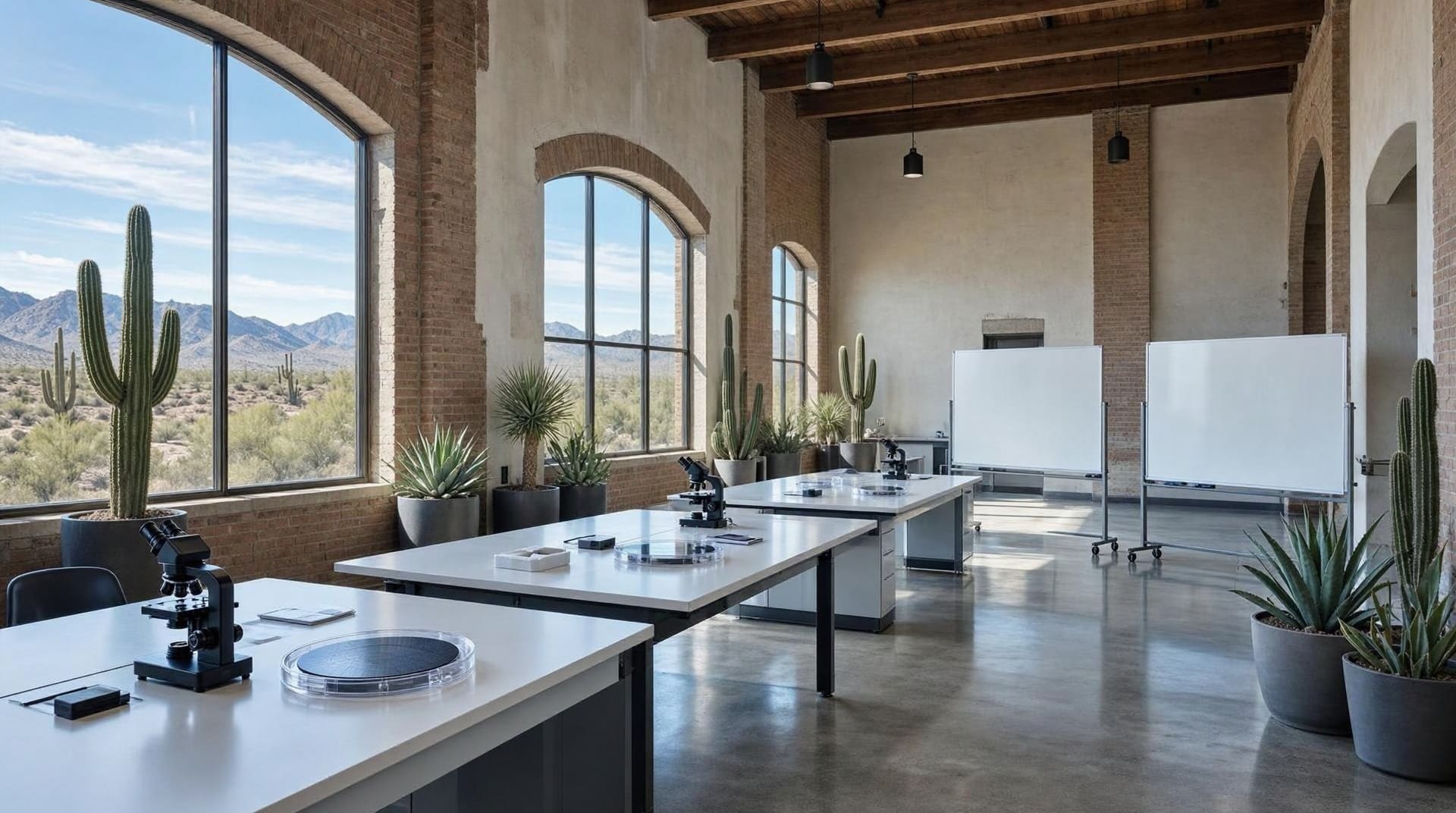
A 1928 Montgomery Ward Store Becomes Downtown Tucson's Semiconductor Talent Hub
Pima County and the U of A opened a semiconductor talent hub in the 1928 Roy Place Building on Stone Avenue. What the deal commits, and what it means downtown.
Pima County and the University of Arizona set a November 13, 2026 ribbon-cutting for the Arizona-Taiwan Talent & Innovation Hub. The agreement behind it runs 24 months and commits no money, which is worth reading closely.
In 1956, Walgreens bought the old Montgomery Ward store on Stone Avenue and had it re-skinned in a modernist style, stripping off most of its Spanish Colonial ornament and covering what was left. It took a complete set of the 1929 construction plans, and a discovery phase that dug out buried remnants of the original trim, before Pima County could put the façade back. On the morning of Friday, November 13, 2026, the county and the University of Arizona scheduled a ribbon-cutting in that restored building, 44 N. Stone Ave., to open the Arizona-Taiwan Talent & Innovation Hub.
The hub is a training and partnership base for the semiconductor industry, built around Taiwan's National Yang Ming Chiao Tung University (NYCU). In a September 14 memo asking supervisors to hold the date, County Administrator Jan Lesher said the event planned to include dignitaries from across the state and partners from Taiwan, among them NYCU's president. The University of Arizona described the hub as a base for semiconductor economic development, education, research and workforce preparation.
- Nov. 13, 2026
- Ribbon-cutting at the Roy Place Building, 44 N. Stone Ave.
- 16,700 sq ft
- Project size its restoration architects list for the historic building
- 24 months
- Term of the county-university agreement approved Aug. 25, 2026
- January 2027
- When the university expects hub courses to begin
A Building Roy Place Designed, and Walgreens Hid
The building takes its current name from its architect. Roy Place arrived in Tucson in 1917 after working in Chicago and at the Boston firm Shepley, Rutan & Coolidge, and over the next three decades he drew a large share of the city's landmarks: the Pioneer Hotel in 1928, the Pima County Courthouse in 1929, and, as the University of Arizona's chief architect from 1924 to 1940, campus buildings including Centennial Hall. Pima County dates the Montgomery Ward store to 1928; its restoration architects work from the 1929 plan set.
It stood on one of downtown's most prominent corners, between Steinfeld's department store and the Pioneer Hotel. The 1956 remodel by Terry Atkinson is what most living Tucsonans would have known until the county hired Tucson firm Poster Mirto McDonald to reverse it. The first phase, paid for with Pima County bond funds and finished in 2011, restored the Stone Avenue façade and the corner entry tower; a second phase followed in 2015. The firm lists the project cost at about $1.7 million. Missing pieces were reconstructed to match the originals, and historic material that survived was kept in place.
The building has not been empty since. The University of Arizona has used it as its downtown presence since 2011, according to the county, and Startup Tucson calls itself the building's longest-running occupant. "As the longest-running occupant of that building, we are thrilled to see these partners come together," Megan Finck, the organization's director of programs and events, said when the hub was announced.
What the Hub Is Supposed to Do
The agreement the Board of Supervisors approved on August 25, 2026 is a memorandum of understanding between Pima County and the University of Arizona. Its stated purpose is a framework for planning, developing and operating the hub "in furtherance of regional economic development, workforce development, small business support, academic and cultural exchange, and international collaboration in semiconductors and related advanced technologies." The objectives listed in the county's briefing memo include joint curricula with NYCU, startup support, and collaborative research with industry partners such as Taiwan Semiconductor Manufacturing Company and Advanced Semiconductor Engineering.
The agreement divides the work plainly. The county makes space available in the building under later agreements, leads coordination with state and Taiwan-side government partners, and handles marketing and visiting delegations. The university develops joint degree and certificate programs with NYCU, provides language and cross-cultural training, arranges student exchanges and research partnerships, supports commercialization through Tech Launch Arizona, and keeps faculty and staff at the hub. The university's own account describes a pipeline that reaches from elementary and high school through community college and graduate research, plus short professional modules for people already working in chip manufacturing and its supply chain.
NYCU is the anchor because of where it sits. The university notes that it has educated engineers and technology leaders for Hsinchu Science Park, one of the centers of Taiwan's semiconductor industry. "A partnership of this scale needs a visible home," said Lindy Bixby, the University of Arizona's chief research partnerships officer.
Read the Agreement Before the Ribbon
A ribbon-cutting is a ceremony. The document behind this one is more modest than the word "hub" suggests, and its limits are written into it. The memorandum runs for 24 months, and either party may withdraw on 30 days' written notice. It does not commit the county or the university to any specific funding amount. The revenue the partners plan to explore includes lease and sub-lease agreements, industry-sponsored research, consortium membership fees, tuition-based programming, technology licensing and grants, and the county memo says specific financial commitments will come in subsequent agreements.
The hub also arrives at the end of a long run of paper. A declaration of collaboration was signed on September 7, 2025; the university sent a letter of intent proposing the Roy Place Building on January 23, 2026; a six-party memorandum with the Taiwanese city of Kaohsiung followed on March 13; and a sister-city agreement among Pima County, Kaohsiung and the City of Tucson was signed on May 31. Within 60 days of the August agreement, the partners were to begin a space-use plan, working groups on academic programming, industry engagement, facilities and communications, a funding strategy and a launch timeline. The university expects courses to start in January 2027.
None of this is a fabrication plant, and no one has said it will be. It is a teaching and partnership office in a historic downtown building, and the measure of it will be whether classes fill and companies show up, which is something a resident can watch from the sidewalk over the next two years.
What the Hub Means for Living in Downtown Tucson
Downtown Tucson has its own page on this site because it is unlike most of the region: it is the city's urban core, with historic architecture, historic homes, walkable streets, the 4th Avenue district and the University of Arizona close by. That mix is the reason a buyer chooses it, and it is also the reason a project like this matters more here than it would in a suburban office park.
The direct change is daytime activity. A county-owned building on Stone Avenue is being given a defined job, with students, instructors, visiting delegations and startups all named as its users. For an owner within walking distance, that means more weekday activity on a block that already had tenants, and a public owner that has now tied a 1920s landmark to a defined purpose, at least for the agreement's two years.
The honest limits matter just as much. The hub adds no housing, the agreement behind it is short and unfunded on its face, and its effect on downtown will depend on programs that have not started yet. A buyer weighing downtown should treat it as one more reason the core is active during the day, not as a promise about what the neighborhood will become. For what homes downtown cost and how that has moved, see the Downtown Tucson page on this site, where those figures are kept current.
Where to Look on Stone Avenue
If you are downtown, walk past 44 N. Stone Ave. and look up at the corner tower: almost everything above the storefronts is the 1929 design put back from drawings, and the half-century when it was hidden is why the restoration is worth noticing. Then, in January, check whether the courses the university has promised have actually begun. That will say more about this hub than the ribbon did.
Sources
Pima County — "Historic Roy Place Building to become home of Arizona-Taiwan Talent & Innovation Hub" — https://www.pima.gov/content/news/historic-roy-place-building-to-become-home-of-arizona-taiwan-talent-innovation-hub — accessed November 13, 2026
Pima County County Administrator — "Talent and Innovation Hub Ribbon Cutting Ceremony – Save the Date" (memorandum, September 14, 2026) — https://content.civicplus.com/api/assets/az-pimacounty/41bc4359-5eac-40f3-8e08-2db0be2b20be — accessed November 13, 2026
Pima County County Administrator — "Additional Information Regarding a Memorandum of Understanding Establishing the Arizona-Taiwan Talent & Innovation Hub at the Roy Place Building" (memorandum, August 20, 2026) — https://content.civicplus.com/api/assets/3afc0c87-d9c6-47f0-8edd-8ac5fb830e06 — accessed November 13, 2026
University of Arizona Research, Innovation & Impact — "Arizona-Taiwan partnership advances semiconductor talent and innovation" — https://research.arizona.edu/news/arizona-taiwan-partnership-advances-semiconductor-talent-and-innovation — accessed November 13, 2026
BizTUCSON — "Historic Roy Place Building to House Arizona-Taiwan Talent & Innovation Hub" — https://biztucson.com/historic-roy-place-building-to-house-arizona-taiwan-talent-innovation-hub/ — accessed November 13, 2026
Tucson Daily Brief — "November 10, 2026" (ribbon-cutting time and place) — https://tucsondailybrief.com/posts/2026-11-10.html — accessed November 13, 2026
Poster Mirto McDonald — "Montgomery Ward Building" (restoration project page) — https://www.pmm.design/roy-place-building — accessed November 13, 2026
Wikipedia — "Roy Place" (career and list of works) — https://en.wikipedia.org/wiki/Roy_Place — accessed November 13, 2026
Program details are as published by Pima County and the University of Arizona; confirm schedules and offerings with them directly. Community details are from this site's Downtown Tucson page. This post is for informational purposes only and is not an offer to sell or a solicitation of an offer to purchase real estate.
Topics
- New Development
- Downtown Tucson
- Roy Place Building
- Semiconductors
- University of Arizona
- Pima County
- Historic Buildings