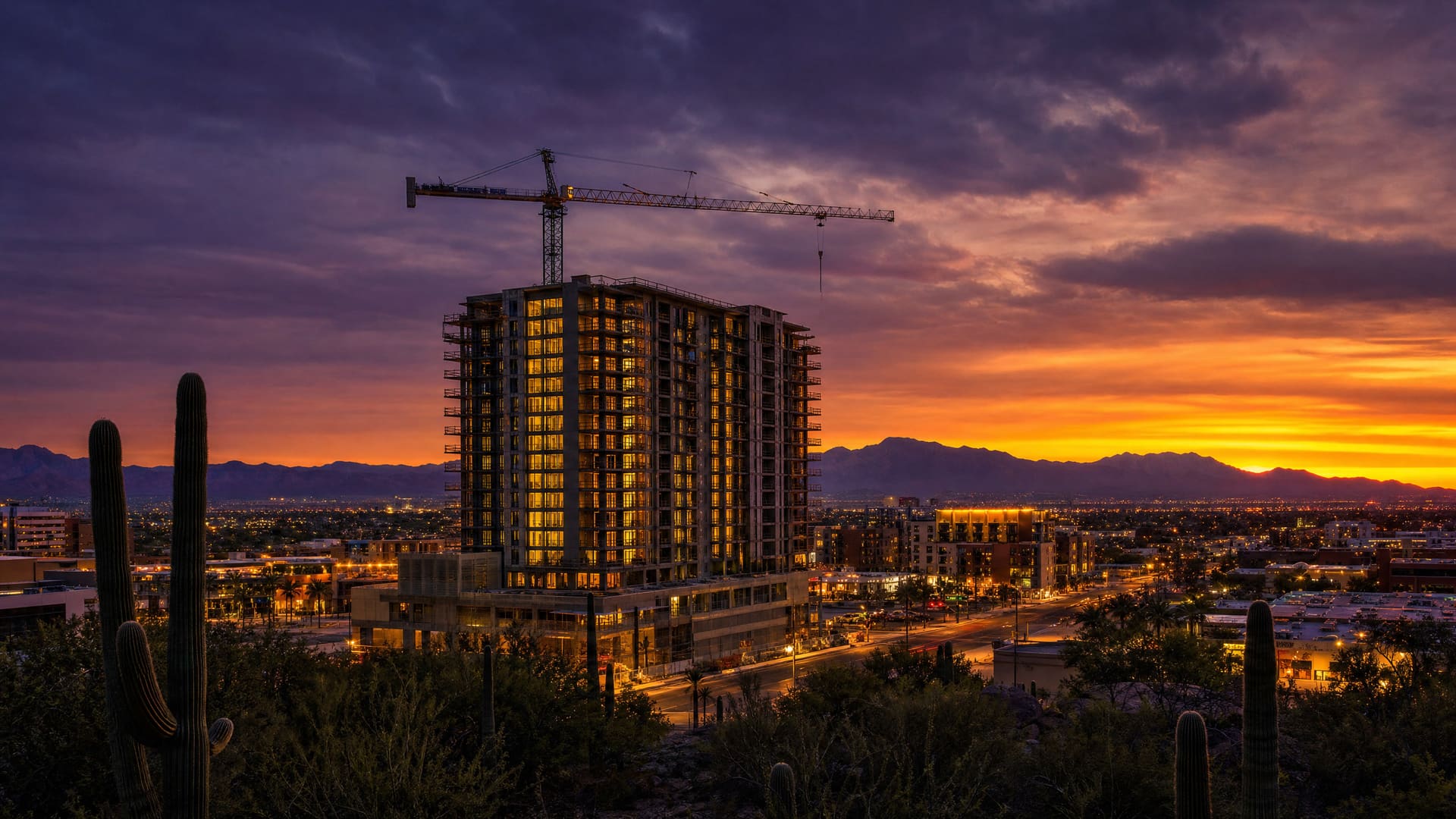
The 1,300-Bed Tower Going Up on Campbell
U of A's nine-story, $250M residence hall at Speedway and Campbell broke ground July 14, 2026 — 1,300 beds, fall 2028 opening, and how it is financed.
A nine-story, $250 million building for 1,300 students — and the university is not borrowing a dollar of it against its own balance sheet.
On the corner of Speedway Boulevard and Campbell Avenue, crews have started work on one of the largest buildings the University of Arizona has added to its residential core in years. The Catalina is a nine-story residence hall for more than 1,300 students, with its own dining hall, financed through a roughly $250 million public-private deal that keeps the debt off the university's own books. It broke ground on July 14, 2026, and is due to open in fall 2028.
- 9
- Stories at Speedway and Campbell
- 1,300+
- Beds, plus a ground-floor dining hall
- $250M
- Total development cost (P3 financing)
- Fall 2028
- Planned opening to students
A Nine-Story Building on a Midtown Corner
The Catalina goes up at the corner of Speedway and Campbell, one of the busiest intersections on the edge of the University of Arizona campus in midtown Tucson. At nine stories it is a genuinely tall addition to a residential district that has long run to low- and mid-rise dorms, and the program is built around what students have been asking for: suite-style units with private bathrooms and shared gathering spaces rather than the double-loaded corridors of older halls. A dining hall on the ground floor is part of the building, so residents will not have to cross campus to eat. The university describes it as a living-learning community, with room for programming and student-support services folded into the same footprint as the beds.
How You Build a $250 Million Dorm Without Borrowing for It
The more unusual story is the money. Rather than issue its own debt, the University of Arizona is delivering The Catalina as a public-private partnership. Mortenson leads the development, design, construction, and financing, while a not-for-profit called the Collegiate Housing Foundation (CHF) — working with RBC Capital Markets — raises tax-exempt bonds to finance, build, and operate the building. CHF buys the land from Mortenson at fair market value and turns it over to the university once the bond financing closes, then runs the hall under a 50-year ground lease with the U of A. Reporting on the deal puts the total cost of development at no more than $250 million, with the direct construction cost estimated near $145 million. The practical effect is that a major building gets added to campus without the university taking the loan onto its own balance sheet.
- The Building (9 stories, 1,300+ beds, Dining hall): A nine-story residence hall at Speedway and Campbell with more than 1,300 suite-style beds, private bathrooms, shared gathering spaces, and a ground-floor dining hall. First residents move in fall 2028.
- The Financing ($250M total, ~$145M construction, 50-year ground lease): A public-private partnership: Mortenson handles development and construction; the nonprofit Collegiate Housing Foundation, with RBC Capital Markets, raises tax-exempt bonds to finance, build, and operate the hall under a 50-year lease with the university.
- The Timeline (Groundbreaking Jul 14, 2026, Opens fall 2028, Two-year build): Ground broke on July 14, 2026, with university officials on site; construction runs about two years, with the building set to welcome its first residents for the fall 2028 term.
Why the University Is Adding Beds Now
The Catalina lands alongside a policy shift. Beginning in fall 2026, the University of Arizona expects most first-time, full-time students to live on campus, with exceptions for those who live within 30 miles of campus or face specific hardships. The university ties that expectation to its own retention numbers: since 1988, first-year students living on campus have averaged about 81 percent first-to-second-year retention, compared with roughly 73 percent for those living off campus. A live-on expectation only works if there are beds to fill, and a nine-story hall with more than 1,300 of them is a direct answer to that math. It is worth noting that the incoming fall 2026 class is projected to be somewhat smaller than the prior year's, so the building is less about a single enrollment spike than about pulling first-year students into campus housing that the university says helps them stay enrolled.
What 1,300 Beds Mean Off Campus
For anyone who owns, rents, or invests near the university, a building this size is worth watching. The blocks around campus — Sam Hughes, West University, Jefferson Park, and the Speedway and Campbell corridors — have long absorbed student demand into single-family rentals, older apartments, and purpose-built student housing. Pulling more than 1,300 first-year students into a new on-campus hall in 2028 adds a large block of university-run beds to that market at the same time the live-on expectation reshapes where freshmen live. Whether that eases pressure on nearby rentals or simply shifts it toward upper-division students is the open question, but the direction is clear: the university is bringing more of its own housing supply online rather than leaning entirely on the surrounding neighborhoods. If you are weighing a purchase or a rental in midtown, the corner of Speedway and Campbell is one of the more consequential things changing near campus.
Quick reference (July 21, 2026): The Catalina is a nine-story University of Arizona residence hall at Speedway Boulevard and Campbell Avenue in midtown Tucson. It broke ground July 14, 2026, will house more than 1,300 students in suite-style units with a ground-floor dining hall, and is set to open in fall 2028. It is being delivered as a public-private partnership — Mortenson on development and construction, the nonprofit Collegiate Housing Foundation with RBC Capital Markets on tax-exempt bond financing under a 50-year ground lease — with total development cost put at no more than $250 million and direct construction near $145 million. Schedules and figures on projects this size change, so confirm current details with the University of Arizona before relying on any single number.
A Visible Bet on On-Campus Living
The Catalina is a big, visible bet on on-campus living: a nine-story hall for more than 1,300 students, paid for through a financing structure that adds the building without adding university debt, and timed to a new expectation that most first-year students live on campus. The near-term milestone is a roughly two-year build at Speedway and Campbell; the longer story is what a large new block of university housing does to the rental market that has grown up around the U of A. For anyone tracking midtown, it is the most concrete thing under construction on the campus edge right now.
Sources
University of Arizona News — "University of Arizona breaks ground on The Catalina, adding on-campus housing for more than 1,300 students" — news.arizona.edu/news/university-arizona-breaks-ground-catalina-adding-campus-housing-more-1300-students — accessed July 21, 2026 (for the nine-story residence hall for more than 1,300 students, the ground-floor dining hall, the suite-style units with shared gathering spaces, the living-learning community framing, the partnership with Mortenson and the Collegiate Housing Foundation, and the fall 2028 opening). Arizona Public Media (AZPM) — "University officials celebrate the groundbreaking of Catalina dorm" — news.azpm.org/p/uanews/2026/7/14/230514-university-officials-celebrate-the-groundbreaking-of-catalina-dorm — accessed July 21, 2026 (for the July 14, 2026 groundbreaking and the location at the corner of Speedway Boulevard and Campbell Avenue). Connect CRE — "U of A Building $250M Campus Dorm" — connectcre.com/stories/u-of-a-building-250m-campus-dorm — accessed July 21, 2026 (for the roughly $250 million total development cost, the direct construction cost estimated near $145 million, the tax-exempt bond financing with the Collegiate Housing Foundation and RBC Capital Markets, CHF buying the land at fair market value and conveying it to the university on financial close, and the 50-year ground lease under which CHF finances, builds, and operates the hall). AZ Big Media — "The Catalina brings nine-story dorm to University of Arizona" — azbigmedia.com/real-estate/multifamily/the-catalina-brings-nine-story-dorm-to-university-of-arizona — accessed July 21, 2026 (for Mortenson leading the development, design, construction, and financing through a customized development strategy). University of Arizona News — "New approaches to housing and admissions support student success" — news.arizona.edu/employee-news/new-approaches-housing-and-admissions-support-student-success — accessed July 21, 2026 (for the fall 2026 expectation that most first-time, full-time students live on campus, the exceptions for students living within 30 miles of campus or facing specific hardships, and the retention figures of about 81 percent first-to-second-year retention for on-campus first-year students versus about 73 percent off campus since 1988). University of Arizona Provost — "Update on Enrollment for Fall 2026" — provost.arizona.edu/news/update-enrollment-fall-2026 — accessed July 21, 2026 (for the incoming fall 2026 class trending somewhat smaller than the fall 2025 class). All figures are current as of July 21, 2026; construction schedules, financing terms, and university policies change, so confirm current details before relying on any single figure. This post is for informational purposes only and is not an offer to sell or a solicitation of an offer to purchase real estate. Kyle Berglund and Tierra Antigua Realty fully support and comply with the Fair Housing Act and the Equal Opportunity Act.
Topics
- New Development
- The Catalina
- University of Arizona
- Student Housing
- Speedway and Campbell
- Midtown Tucson
- Public-Private Partnership
- Mortenson
- Tucson
- 85719