The Tucson Family Business That Patents Desert Plants
Civano Growers and Civano Nursery began in 1998 as a Tucson tree-salvage crew. Now 19 U.S. plant patents name one of the Shipley brothers as inventor.
Civano Growers and Civano Nursery started as a crew boxing up native trees ahead of the bulldozers. Twenty-eight years on, the family breeds the mesquites, desert willows and Texas Rangers going into new Tucson-area yards.
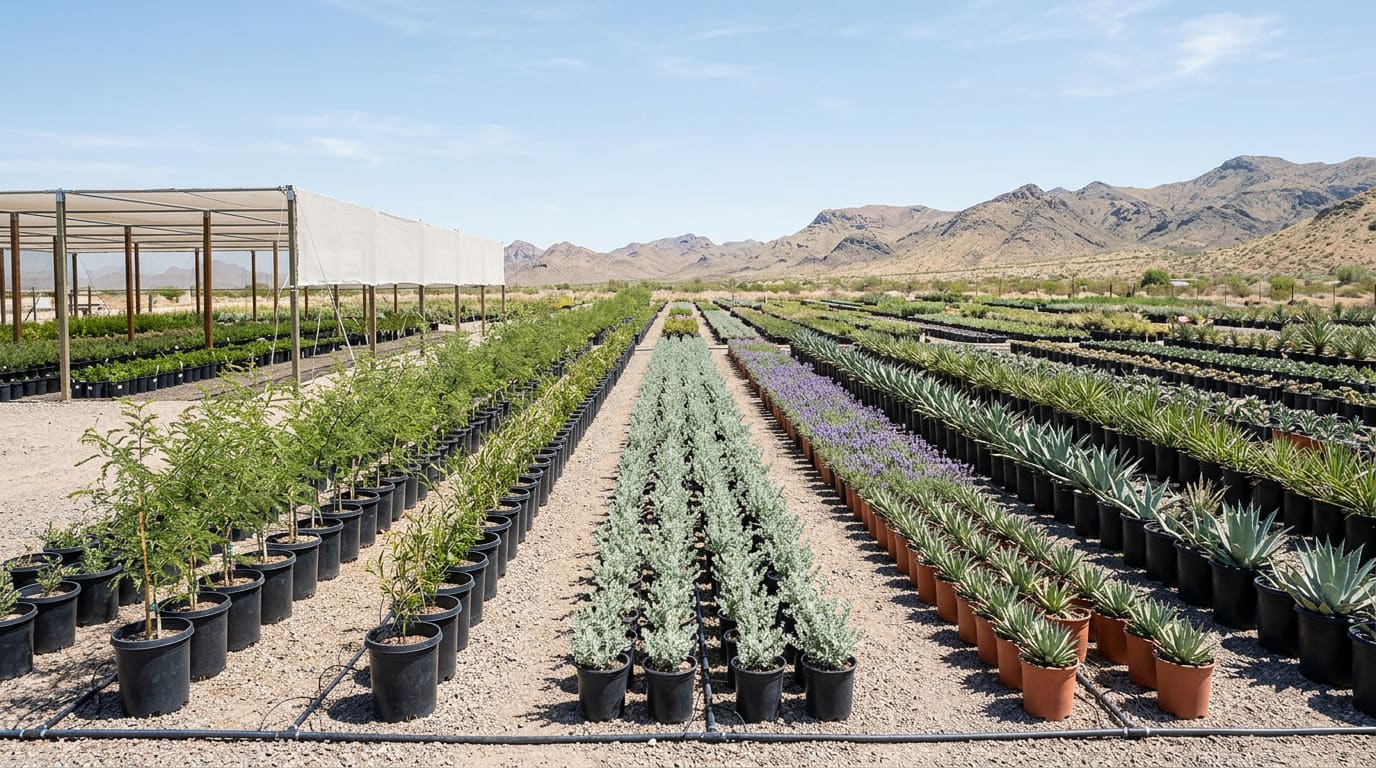
Most Tucson-area yards are planted out of a short list, and a surprising share of that list was invented on a farm south of the city. Civano Growers and Civano Nursery are, between them, the largest plant-growing operation in the Tucson area — a wholesale farm near Sahuarita and a retail garden center on South Houghton Road, run by one family. What makes the business unusual is not its size. It is that the inventory is partly proprietary: the company breeds its own desert trees and shrubs, and the federal patent record has 19 plant patents naming Nicholas Benoit Shipley as the inventor.
- 1998
- Year the Shipleys started, as a tree-salvage operation
- 19
- U.S. plant patents naming Nicholas Benoit Shipley as inventor
- 70 acres
- The farm near Sahuarita, bought about four years in
- ~120
- People employed at the growing site
It Began as a Crew Working Ahead of the Bulldozers
The company's roots go back to 1998, and the first business was not growing plants but rescuing them. Les Shipley and his sons Nick, Alex and Chris, with Chris's wife Melanie, started a tree-salvage operation: they worked with contractors to identify and preserve large native trees standing on land about to be developed, boxed them up and relocated them. It is a trade that put the family on development sites across the region, looking at what grew there before and what went in after. About four years later they bought a 70-acre farm near Sahuarita, at 12190 Old Nogales Highway, which is where the breeding and the patenting happen now; roughly 120 people work there. The retail side, the Civano Garden Center, opened in 1999 at 5301 S. Houghton Road, inside the Civano development it takes its name from.
The Product Is a Plant Nobody Else Sells
Chris Shipley is president and co-owner, running the business with his father, two brothers and wife, and he describes the strategy as a deliberate answer to being one nursery among many. "If we could take the best plants that are sold commonly and do something to them that make them fit a niche and make them better in our view, then we could have something," he told BizTUCSON. His brother Nick is the one behind the breeds. The program began with the two most common plants in the region — mesquite and desert willow, both of them staples of the landscaping that goes into new developments here — and works by cross-pollination and cloning rather than anything happening in a lab. The mesquite result is marketed as Civano Seedless: thornless, seedless, and, in Shipley's framing of why that matters, "The tree is great looking, and you don't have to be out there in 110 degrees raking." The desert willow got bigger leaves, better flowers and no seed, which turns a sprawling tree into a shapelier and lower-maintenance one.
The Patent Record Is the Part You Can Check
Breeding claims are easy to make and, unusually, these ones are filed. U.S. Plant Patent PP23,360 covers a hybrid mesquite called Leslie Roy, granted January 29, 2013, with Nicholas Benoit Shipley named as inventor. The patent says the tree came out of a cross-pollination of an unnamed Prosopis chilensis and an unnamed Prosopis velutina — the thornless Chilean mesquite and the native velvet mesquite — and that it was selected out of 300 trees that the cross produced. What it claims is a short, checkable list: thornlessness, cold tolerance to at least minus 12 degrees Celsius, an upright and outwardly spreading habit, and a semi-evergreen look in winter, the combination making it better suited to parking lots and streetscapes. Nineteen plant patents in the USPTO record carry Shipley's name, and the spread of them is the business plan in miniature: a desert willow called Bubba Jones in 2021, Hesperaloe parviflora called Stop Lights in 2022 and a Hesperaloe hybrid called Little Giant in 2023, a globemallow called Orange Crush in 2022, a pine-leaf milkweed called Monarch Magnet 2.0 in 2023, and a run of Leucophyllum — the Texas Ranger shrub — named Microburst and Purple Rain in 2023, Laredo in 2024 and Little Lynn in 2025. Laredo is the shrub the four Shipleys are standing in front of in BizTUCSON's photograph.
Why a Smaller Shrub Is the Whole Business Case
Read the patent titles again and the pattern is hard to miss: Little Giant, Little Lynn, Little Miss Sunshine. Shipley names the reason directly. "Home lot sizes are shrinking. Our climate keeps changing. It's getting hotter, getting colder," he said. The Texas Ranger is his worked example — a flowering bush that can reach ten feet by ten feet and swallow a meaningful share of a small yard, when "the size that people want are 3-by-3 and 4-by-4." The argument he makes for the smaller version is a cost argument, not an aesthetic one: "If you have to prune something down every month, that costs money. It's more labor. It uses more water." Stephanie Vickers, Civano's sales and marketing manager, says the varieties have to hold up across Arizona, California, New Mexico, Texas, Nevada and parts of Oklahoma — "hardy enough to survive a wide range of climate and soil and low rain" — and that the catalog has been narrowed over the last five to six years to roughly 100 items. Over the next 12 to 16 months the company is building a new sales office and expanding its planting acreage, aimed at commercial buyers who order in bulk: housing developers who need 300 to 500 plants of a single variety. Which is the quiet part for anyone watching new subdivisions go in around the region — the plant list arriving with them is being narrowed, patented and scaled on one farm south of the city.
Sources
BizTUCSON — Tom Leyde, "Civano Nursery, Growers Cultivate a Lush Southwest" — biztucson.com/civano-nursery-growers-cultivate-a-lush-southwest — published September 30, 2026, accessed October 2, 2026 (for Civano Growers and Civano Nursery being the largest plant-growing operation in the Tucson area, family-owned, with wholesale and retail outlets; the company's founding in 1998 and the tree-salvage operation started by Les Shipley with sons Nick, Alex and Chris and Chris's wife Melanie, identifying and preserving large native trees from development sites and relocating them; the purchase four years later of a 70-acre farm near Sahuarita at 12190 Old Nogales Highway where plants are bred and patented, employing about 120 people; the Civano Garden Center opening in 1999 at 5301 S. Houghton Road; Chris Shipley as president and co-owner running the business with his father, two brothers and wife, and his quotations about the niche strategy, the Civano Seedless mesquite and raking in 110 degrees, shrinking home lot sizes and a changing climate, the Texas Ranger reaching ten feet by ten feet against the 3-by-3 and 4-by-4 sizes customers want, and the labor and water cost of monthly pruning; Nick Shipley as the breeder; the program beginning with mesquite and desert willow as plants often included in the landscaping of new developments in the region; the desert willow's bigger leaves, better flowers and lack of seed; cross-pollination and cloning as the breeding methods; Stephanie Vickers as sales and marketing manager and her quotations on hardiness and on the six states and parts of Oklahoma the varieties are grown for, and on the reduction to about 100 items over five to six years; the new sales office under construction and the planting-acreage expansion over the next 12 to 16 months aimed at commercial customers such as housing developers needing 300 to 500 plants of one variety; and the photograph of Les, Alex, Nick and Chris Shipley in front of a Laredo Texas Ranger). United States Patent and Trademark Office, via Google Patents — "Prosopis hybrid 'Leslie Roy'", U.S. Plant Patent PP23,360 (publication USPP23360P2) — patents.google.com/patent/USPP23360P2/en — filed August 1, 2011, granted January 29, 2013, accessed October 2, 2026 (for Nicholas Benoit Shipley as the named inventor; the parentage as a cross-pollination of an unnamed Prosopis chilensis and an unnamed Prosopis velutina; the selection out of 300 trees resulting from that cross; and the claimed characteristics of thornlessness, cold tolerance of at least minus 12 degrees Celsius, an upright and outwardly spreading growth habit, a semi-evergreen appearance in winter, and the resulting suitability for parking lots and streetscapes). United States Patent and Trademark Office, via Google Patents inventor search — "Nicholas Benoit Shipley" — patents.google.com — accessed October 2, 2026 (for the count of 19 plant patents naming him as inventor, and for the publication numbers, titles and grant dates of the desert willow 'Bubba Jones' USPP33637P2 of November 16, 2021; Hesperaloe parviflora 'Stop Lights' USPP34195P2 of May 3, 2022; Sphaeralcea 'Orange Crush' USPP34220P2 of May 10, 2022; Hesperaloe hybrid 'Little Giant' USPP35283P2 of July 25, 2023; Leucophyllum hybrid 'Purple Rain' USPP35354P3 of August 29, 2023; Leucophyllum hybrid 'Microburst' USPP35437P2 of October 24, 2023; Asclepias linaria 'Monarch Magnet 2.0' USPP35492P3 of November 21, 2023; Leucophyllum 'Laredo' USPP36336P2 of December 24, 2024; Leucophyllum 'Little Lynn' USPP36523P2 of March 4, 2025; and Hesperaloe parviflora 'Little Miss Sunshine' USPP36551P2 of March 18, 2025). Business details, addresses, product lines and plans change, and nothing here is an endorsement or a commercial relationship — confirm hours, stock and current offerings with the business directly. Plant performance depends on site, soil, exposure and irrigation, and a patent claim describes a cultivar rather than a guarantee for any particular yard. This post is for informational purposes only and is not an offer to sell or a solicitation of an offer to purchase real estate. Kyle Berglund and Tierra Antigua Realty fully support and comply with the Fair Housing Act and the Equal Opportunity Act.
Topics
- Local Business Spotlight
- Civano Nursery
- Sahuarita
- Landscaping
- Desert Plants
- Tucson