Tucson Is Getting a Fiber Ring. It Won't Reach Your House.
A 134-mile open-access fiber backbone around metro Tucson broke ground September 24. What it is, what it is not, and which areas it was routed to reach.
A $43.3 million open-access backbone broke ground at Three Points on September 24, on a two-year build. What it carries, which roads it follows, and why a finished ring still leaves the last mile unbuilt.
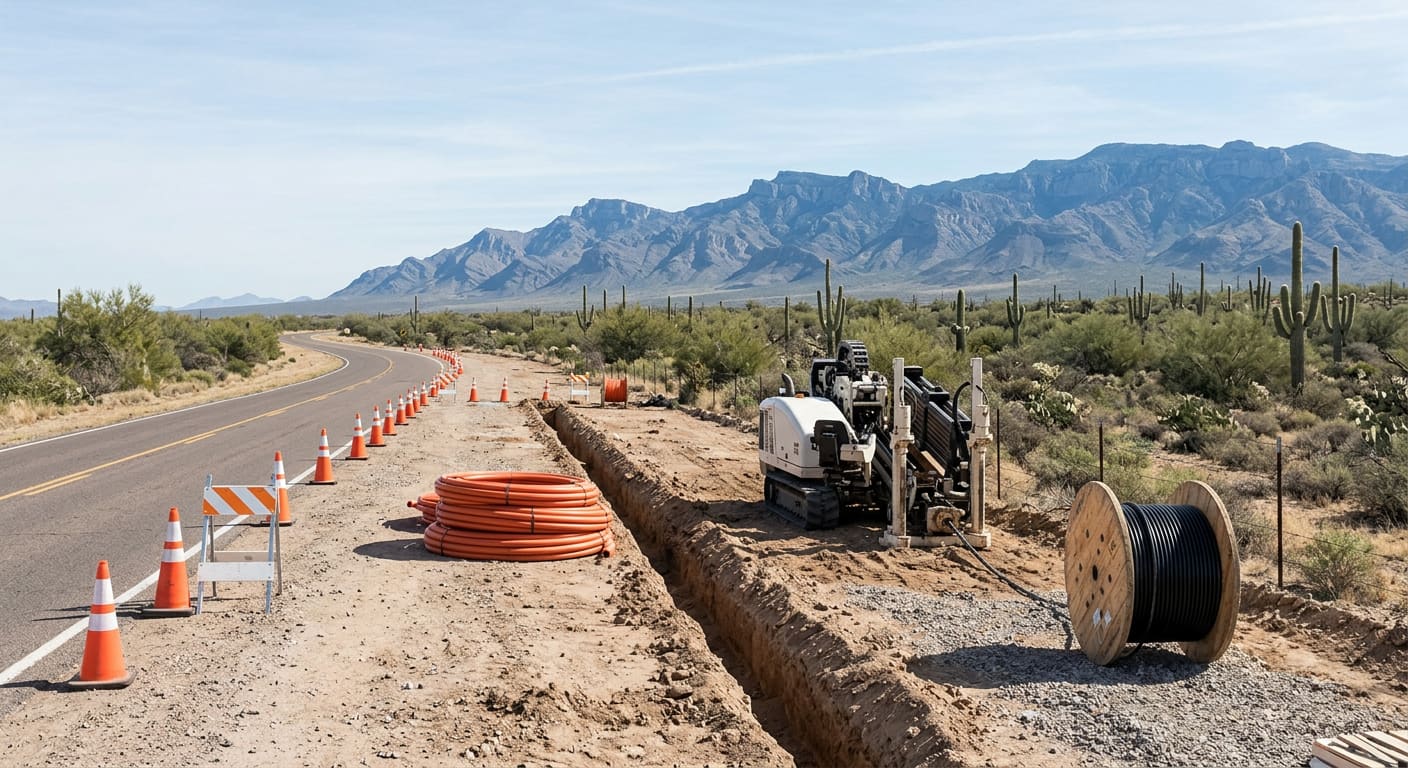
The work that started at a fire station on South Sandario Road on September 24 does not look like a broadband project. It looks like a trench. Pima County's Regional Middle Mile Fiber Optic Ring is conduit and glass laid in a loop around the outside of metro Tucson, and the county chose Three Points — out past the western edge of the built-up valley, where Ajo Way and Sandario meet — to put the first shovel in. Crews are on a two-year schedule. When they finish, the thing they have built will still not connect a single house — and that is not a flaw in the plan. It is what this kind of project is.
- Sept. 24, 2026
- Groundbreaking, Three Points Fire Station, 7400 S. Sandario Road
- $30,281,277
- Federal award from the NTIA Enabling Middle Mile Broadband Infrastructure Program
- $43,283,954
- Total project cost on the federal award record, implying roughly $13M non-federal
- 134.61 miles
- Length of the open-access ring on the federal award and environmental assessment
- 2 conduits
- One reserved for government and anchor institutions, one leased commercially
- 2 years
- Construction schedule from the September 2026 groundbreaking
What "Middle Mile" Actually Means
The phrase is doing real work, and it is the part most likely to be misread. A middle-mile network is the stretch of fiber between the internet's backbone and the equipment in a neighborhood. It is not the drop that runs from a pole or a pedestal to a meter on a wall — that is the last mile, and it stays the responsibility of whichever internet service provider decides to build it. Pima County's director of internet services has described the ring's function plainly: it gives providers access at a far lower cost than each of them trenching their own line out to a sparsely populated area.
That cost is the whole reason rural corners of the county have thin service. Running fiber twenty miles to reach a few hundred meters is arithmetic no private company wins. A shared, publicly owned backbone changes the arithmetic without changing who sells the service: the ring is open access, meaning any qualified provider — and other government entities — can lease, share or swap capacity on it on non-discriminatory terms. The county is building a road, not opening a store.
What Is Actually Going in the Ground
The design calls for two separate conduits. One is reserved for government and anchor institutions — county facilities, fire stations, the new Oro Valley police station on Oracle Road, the kind of sites that sit at the end of an expensive circuit today. The second is the commercial pathway, the one a provider leases. Construction is mostly directional boring, which pulls conduit underground without opening the surface, with open trenching in the road shoulder where boring will not serve. The completed loop lands on four Tier 1 central office facilities, which is what physically connects it to the public internet rather than to itself.
The route crosses the City of Tucson and the towns of Marana, Oro Valley and Sahuarita, all of which backed the grant and are paying in. Oro Valley's council signed on unanimously in September 2025 for $200,000 plus in-kind permitting and plan review; Pima County is putting up $13 million against the federal share. The questions from the dais that night were not about bandwidth. They were about torn-up roads and shared-use paths — on La Cañada, a pavement moratorium means the contractor has to replace 500 feet of surface in either direction wherever the work crosses. That is what a backbone looks like from street level.
Which Areas It Was Routed to Reach
- Three Points (Groundbreaking site, Far west): Where the first trench opened, at the fire station on South Sandario Road. The board chair singled it out as the right place to start, calling access to high-speed internet a right rather than a privilege.
- Avra Valley (West of the Tucson Mountains, Large-lot): Named from the outset as a target area. Parcels out here are large and far apart, which is precisely the geometry that makes a private last-mile build hard to justify.
- Picture Rocks (Northwest, Desert lots): Another community named when the grant was announced. It sits between the Tucson Mountains and the Silverbell corridor, close to the metro on a map and further away on a fiber route.
- Vail (Southeast, Growing): The southeast-side entry on the original list. The area has been adding rooftops faster than it has been adding utility corridors, which is a different version of the same gap.
What a Backbone Does Not Do
Here is the sentence worth carrying out of this: the ring being finished does not mean a line reaches a particular lot. A completed middle mile lowers the cost of the last mile; it does not commit anyone to building it, and it sets no date by which a given address gets service. The county's framing of the payoff is itself conditional: once the ring is done, providers will be able to extend service into underserved parts of the county. Able to is not the same as scheduled to.
Oro Valley is a working illustration of the split. While the county was assembling the backbone, two independent providers began building fiber to the home there on their own schedule — private investment, not town money, and not part of this project. That is the last mile, and it moved on a separate track from the ring entirely. A middle mile makes more of those decisions pencil out. It does not make them.
So the practical move for anyone shopping outside the metro's serviced core has not changed, and will not change when the last splice is made. Check the specific address, not the region. The FCC's National Broadband Map reports what providers claim is available at a given location, and providers themselves will confirm or deny a service address over the phone in a few minutes. Ask the seller what they actually have and what they actually pay, and ask what the installation required — a satellite dish, a fixed-wireless antenna and a fiber drop are three different answers to the same question, with three different monthly costs.
There is a second thing worth knowing before an offer on a large rural parcel: whether the utility easements crossing it are the kind a future provider could use, and whether the seller has ever been quoted a construction charge for a drop. Those quotes can run into five figures on a long private lane, and they are far easier to discover before closing than after. A trench going in at Three Points this week is good news for that arithmetic. It is not a substitute for asking.
Quick reference (September 25, 2026): Pima County's Regional Middle Mile Fiber Optic Ring broke ground September 24, 2026 at the Three Points Fire Station, 7400 S. Sandario Road, on a two-year construction schedule. It is funded by a $30,281,277 award under the NTIA Enabling Middle Mile Broadband Infrastructure Program, authorized by the Infrastructure Investment and Jobs Act and made in 2023 as a five-year grant, against a total project cost of $43,283,954 on the federal award record. The award and the project's environmental assessment describe a 134.61-mile open-access ring, built in two conduits — one reserved for government and anchor institutions, one leased commercially. Route partners are the City of Tucson and the towns of Marana, Oro Valley and Sahuarita. The county has not published a firm in-service date beyond that two-year construction window. Schedules, mileage and costs on a multi-year federal project change — confirm current details with the Pima County Office of Digital Inclusion before relying on any single figure, and confirm broadband availability with providers for the specific address.
Sources
KVOA — "Pima County breaks ground on $30.3M fiber optic network" — kvoa.com/news/local/pima-county-breaks-ground-on-30-3m-fiber-optic-network/article_1c7c270f-e705-4c98-823f-66e1d61b70c4.html — accessed September 25, 2026 (for the September 24 groundbreaking at the Three Points Fire Station, 7400 South Sandario Road; the $30.3 million cost and 134-mile network; the two-year construction schedule; the description of the middle mile as the fiber bridge between internet service providers and local internet connections; the open-access ring around the county's urban core; the 2023 National Telecommunications and Information Administration five-year grant authorized by the Infrastructure Investment and Jobs Act; the Office of Digital Inclusion as coordinating entity with director Michelle Simon; county administrator Jan Lesher; Arizona Commerce Authority president and CEO Sandra Watson; and the quotations from Board of Supervisors Chair Jennifer Allen that she is thrilled to be breaking ground and can think of no better place to do it than Three Points, and that access to high-speed internet is not a privilege but a right)
National Telecommunications and Information Administration, BroadbandUSA — "Pima County Regional Middle Mile Fiber Optic Ring," Enabling Middle Mile Broadband Infrastructure Program awardee record — broadbandusa.ntia.gov/funding-programs/enabling-middle-mile-broadband-infrastructure-program/awardee/pima-county-regional-middle-mile-fiber-optic-ring — accessed September 25, 2026 (for the federal award amount of $30,281,277 and total project cost of $43,283,954; the 134-mile contiguous open-access fiber network ring; the statement that the infrastructure will be made available to all viable internet service providers and other government entities to lease, share or swap resources on a non-discriminatory basis; the purpose of serving communities, county and local facilities, anchor institutions and recreational areas; and the four Tier 1 central office connections providing physical interconnection to the public internet backbone)
National Telecommunications and Information Administration, BroadbandUSA — "Environmental Assessment and Finding of No Significant Impact, Pima County Regional Middle Mile Project" — broadbandusa.ntia.gov/funding-programs/documentation-and-reporting/EA_FONSI_Pima_County_Regional_Middle_Mile_Project — accessed September 25, 2026 (for the 134.61-mile figure for the open-access fiber middle mile ring around the county's urban core)
Tucson Spotlight — "Oro Valley council unanimously approves $33M regional broadband project" by Ian Stash (September 8, 2025) — tucsonspotlight.org/oro-valley-council-unanimously-approves-33m-regional-broadband-project/ — accessed September 25, 2026 (for the unanimous Oro Valley Town Council vote of September 3, 2025 approving the intergovernmental agreement; the town's $200,000 contribution in the 2026-27 fiscal year; the $13 million Pima County contribution against the federal share; the project being in the design phase; the two conduits, one for government and anchor institutions and one reserved for commercial use; the use of directional boring with open trench in some areas along the shoulder of roads; the La Cañada pavement moratorium requiring replacement of 500 feet in either direction where the work crosses; the targeted connection to the Oro Valley Police Department's new Oracle Road station; and the council discussion of road and shared-use path impacts)
KOLD News 13 — "Pima County will build a 134 mile internet ring to bring services to rural areas" (June 19, 2023) — kold.com/2023/06/19/pima-county-will-build-134-mile-internet-ring-bring-services-rural-areas/ — accessed September 25, 2026 (for Picture Rocks, Three Points, Avra Valley and Vail as the rural communities named when the grant was announced; the support of Marana, Oro Valley, Sahuarita and Tucson; the local match figure; and the explanation by Javier Baca, Pima County director of internet services, that the middle mile provides access to internet providers in a much more affordable way rather than providing service directly)
KGUN 9 — "Pima County aims to expand access to high speed internet" — kgun9.com/news/local-news/pima-county-aims-to-expand-access-to-high-speed-internet — accessed September 25, 2026 (for the $30.3 million federal grant plus local funds; the reach of the ring as far as Oro Valley and Sahuarita; the explanation that the ring removes the need for providers to front-load the cost of getting access out to remote areas; and the remarks of county administrator Jan Lesher and information technology director Javier Baca)
Town of Oro Valley — "Fiber-to-the-Home broadband internet coming to Oro Valley" — orovalleyaz.gov/Government/News/Fiber-to-the-Home-broadband-internet-coming-to-Oro-Valley — accessed September 25, 2026 (for the independent providers Wyyerd and Ripple Fiber building fiber to the home in Oro Valley as private investment rather than town-funded work, with construction expected from Fall 2025 through Spring 2026; and for the town's own statement that Pima County's federally funded Middle Mile project provides backbone infrastructure connecting communities across the region and is distinct from last-mile delivery to individual properties)
Federal Communications Commission — National Broadband Map — broadbandmap.fcc.gov — accessed September 25, 2026 (for the address-level record of broadband services providers report as available at a given location)
All details are current as of September 25, 2026; federal grant schedules, route mileage, municipal agreements and broadband availability change, so readers should confirm current information with the Pima County Office of Digital Inclusion and with service providers for a specific address before relying on any single figure. This post is for informational purposes only and is not an offer to sell or a solicitation of an offer to purchase real estate. Kyle Berglund and Tierra Antigua Realty fully support and comply with the Fair Housing Act and the Equal Opportunity Act.
Topics
- New Development
- Infrastructure
- Broadband
- Pima County
- Three Points
- Picture Rocks
- Avra Valley
- Vail
- Oro Valley