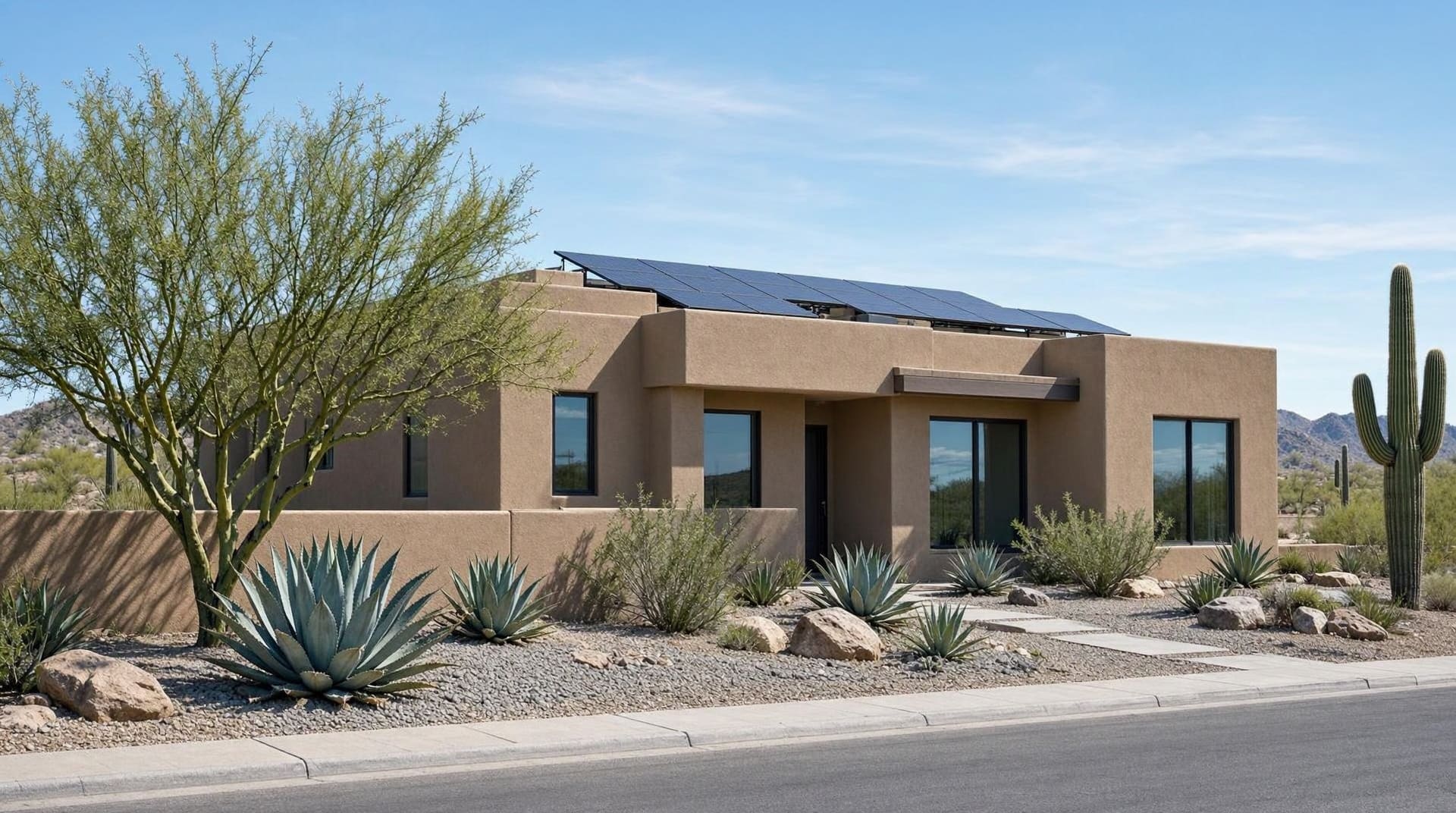
In Civano, the Solar on the Roof Comes With a Contract
Selling a Civano home with solar: what Arizona makes solar contracts disclose, how leases transfer, and how TEP's 10-year export rate lock carries over.
Arizona makes every solar lease spell out how it transfers. Tucson Electric Power's export rate stays with the house. The rest depends on which of three arrangements the seller signed.
Under one Tucson solar program, if the buyer of the house will not take over the contract, the seller pays an exit fee. That is Tucson Electric Power's own residential solar program, and it is one of three different contracts a home with panels can carry. Arizona at least makes each of them say how a transfer works. Under A.R.S. § 44-1763, a lease or purchase agreement for a home solar system has to disclose, with a separate acknowledgment from the customer, any restriction on transferring the system, whether a transfer needs a third party's review or approval, and the name, address and telephone number of whoever does the approving. A second required disclosure covers any restriction the solar contract places on selling the house itself. If you are selling a home with panels on the roof, the first useful page is the one the seller initialed.
That matters in Civano more than most places, because solar is part of how the neighborhood describes itself. The harder question is which kind of solar a particular house has, since the transfer works three different ways.
- 10 years
- Length of TEP's export rate lock, counted from the system's original interconnection
- 45 business days
- Written notice TEP's residential solar program requires before an owner buys the system
- 3 business days
- Minimum cancellation window Arizona requires in a new solar sale or lease
- 1980
- Year after which a deed restriction that bans solar is void in Arizona
Three Arrangements, Three Transfers
An owned system is the simplest. If it is paid off, the panels are part of the house and transfer with it. If it was financed, the loan has to be dealt with in the sale like any other debt, and its documents say how. Arizona law requires the installer to warrant the collectors, heat exchangers, storage and installation for at least two years, or to provide an energy production guarantee instead, and the remaining components for at least one year. A buyer should ask for the warranty statement and any production guarantee, along with who holds the obligations if the installer has since changed hands, because a contract has to disclose whether those obligations can be sold to a third party.
A lease or power purchase agreement means a third party owns the equipment and the homeowner pays for the system or its output. At a sale, the buyer either assumes the agreement or the seller resolves it. Sunrun's published process is a typical example of the assumption route: the seller submits a transfer request through the company's portal, both parties sign a transfer form, and the buyer completes a soft credit application that the company says does not affect their credit score or home loan. The transfer completes after escrow closes. Sunrun's advice is to start the request as soon as the home is under contract, so the transfer can close alongside escrow. Other providers' terms differ, and the contract's own disclosure names who approves the transfer.
The third arrangement is particular to Tucson. Tucson Electric Power's Residential Solar Program put TEP-owned panels on customers' roofs in exchange for a fixed solar payment for electric use at the property. TEP's sample agreement lays out what happens at a sale. The owner can transfer the agreement's terms to the buyer. If the buyer does not want to take it on, the seller pays an exit fee from a table in the agreement. After the sixth year, the owner may instead buy the system as-is, and if that purchase is part of a home sale, TEP gives the closing agent escrow instructions requiring payment in full. The owner must give TEP 45 business days' written notice of an intent to purchase. That is roughly nine weeks, so a seller who wants to buy the system before closing should start before listing, not after accepting an offer.
The Export Rate Stays With the House
Separate from who owns the panels is how TEP credits the power they send back to the grid. Under TEP's Rider 14, the Resource Comparison Proxy export rate is set annually for new solar customers, effective October 1 each year. A customer's initial rate is based on the rate in effect when the interconnection application was submitted and applies for ten years from the system's interconnection. After that, the credit floats with the current year's rate.
The rider's transfer clause is the part buyers rarely hear about. A customer who moves to a site already served under the rider keeps the same export rate in effect for that site, locked for the remainder of the ten years from the original interconnection. The lock belongs to the site, so a buyer inherits whatever is left of it, not a fresh ten years. Two actions end it early. Moving the system to another site forfeits the lock. Adding a material amount of capacity, defined as 10% or 1 kilowatt, whichever is greater, moves the system to the current year's rate for the years remaining. A buyer planning to add panels should price that in.
Some older systems are on TEP's grandfathered net metering rider instead, and the rider says plainly that a customer who switches from it to the export-rate rider loses net metering status and cannot switch back. Ask TEP which rider the meter is on, and the interconnection date, before treating the seller's past bills as a guide to yours.
What the Paperwork Means for Owning in Civano
Civano is a New Urbanist community on Tucson's southeast side near Houghton and Drexel roads, built from 1999 onward and, as this site's page for it describes, designed from the start around solar energy and efficiency, with homes built to use far less energy than the 1995 Tucson model energy code. That history is why a Civano listing is more likely than most to mention solar, and why the listing remark alone is not enough. A 2000s-era house may have a system that has been owned, leased, refinanced or replaced since.
Two Arizona rules work in an owner's favor here. An association cannot prohibit installing or using a solar energy device, although it may adopt reasonable placement rules that do not impair the device or add to its cost, under A.R.S. § 33-1816. And for property tax purposes, A.R.S. § 42-11054 directs that a solar energy device or grid-tied photovoltaic system producing energy mainly for on-site use is considered to add no value to the property. For what homes in Civano have sold for and how the area has changed, see the Civano page below, which is where this site keeps those figures current.
Five Questions for the Listing Agent
Is the system owned outright, financed, leased, on a power purchase agreement, or part of TEP's program? Who approves a transfer, and has the seller started the request? Which TEP rider is the meter on, and what was the original interconnection date? Has any capacity been added since? And where are the warranty statement and any production guarantee? Each answer should come with a document. Tell the title company about any solar agreement early, so it can review the documents before closing.
Contract terms vary by provider and by agreement date. Read the actual agreement and confirm current terms with the solar company and with TEP before relying on any of this in a sale.
Sources
Arizona State Legislature — "A.R.S. § 44-1763, Distributed energy generation system agreements; disclosures" — https://www.azleg.gov/ars/44/01763.htm — accessed November 19, 2026
Arizona State Legislature — "A.R.S. § 44-1762, Solar energy device warranties; installation standards" — https://www.azleg.gov/ars/44/01762.htm — accessed November 19, 2026
Arizona State Legislature — "A.R.S. § 44-1761, Definitions" — https://www.azleg.gov/ars/44/01761.htm — accessed November 19, 2026
Arizona State Legislature — "A.R.S. § 33-1816, Solar energy devices; reasonable restrictions" — https://www.azleg.gov/ars/33/01816.htm — accessed November 19, 2026
Arizona State Legislature — "A.R.S. § 33-439, Restrictions on installation or use of solar energy devices invalid" — https://www.azleg.gov/ars/33/00439.htm — accessed November 19, 2026
Arizona State Legislature — "A.R.S. § 42-11054, Standard appraisal methods and techniques" — https://www.azleg.gov/ars/42/11054.htm — accessed November 19, 2026
Tucson Electric Power — "Rider-14, Resource Comparison Proxy Export Rate for Certain Partial Requirements Service" — https://docs.tep.com/wp-content/uploads/714-Rider-14-RCP.pdf — accessed November 19, 2026
Tucson Electric Power — "TEP Residential Solar Program agreement (sample)" — https://docs.tep.com/doc/renewable/sample_contract.pdf — accessed November 19, 2026
Sunrun — "Solar FAQs" — https://www.sunrun.com/go-solar-center/solar-faq — accessed November 19, 2026
Sunrun — "Service transfer: buying a Sunrun solar home" — https://www.sunrun.com/go-solar-center/solar-articles/service-transfer-buying-a-sunrun-solar-home — accessed November 19, 2026
Tariff and contract terms are as published by the sources above and can change; confirm current terms with TEP and the solar provider. Community details are from this site's Civano pages. This post is for informational purposes only and is not an offer to sell or a solicitation of an offer to purchase real estate.
Related reading
Posts about the same places, or in the same category, nearest in time. Each carries its own sources and revision date.
- Civano Breeds Tucson's Desert Plants — October 2, 2026 · Local Business Spotlight · also about Civano
- The First Road RTA Next Actually Paid to Fix — August 23, 2026 · New Development · also about Civano
- Civano: The Subdivision That Had to Prove It — July 28, 2026 · Local Insights · also about Civano
- Colossal Cave: A 70°F Escape Near Vail — June 7, 2026 · Things to Do · also about Civano
Topics
- Local Real Estate News
- Civano
- Solar
- Tucson Electric Power
- Selling a Home
- Buying a Home