Thirty Years of Cutting Holes in Tucson's Curbs
Inside Dunbar/Spring, the central Tucson historic district whose curb cuts and 1,600 street trees became a citywide stormwater model — and what homes cost.
A volunteer planting program that started in 1996 has put more than 1,600 native trees in the public right-of-way here, watered almost entirely by what runs off the pavement during monsoon storms.
In 1998 a homeowner north of downtown Tucson took a saw to the curb in front of his house — six openings, no permit, nobody asked. The point was to let street runoff leave the pavement and soak into the dirt strip where he had been planting trees. The city did not find out for three years, and then only because he told them himself. The same maneuver is now permitted, funded by a line item on your water bill, and installed by the City of Tucson on public streets. Dunbar/Spring is the place you can walk through the thirty-year version of it.
- 1,600+
- Native food- and medicine-bearing trees planted in the public right-of-way since 1996
- 1M+ gal
- Street stormwater directed into neighborhood earthworks in an average year
- 110,000 gal
- New capture capacity built at the 30th annual planting in 2026
- $0.13/CCF
- Green infrastructure fee on Tucson water bills funding the Storm to Shade program
Six Cuts, Three Years, One Ordinance
The homeowner was Brad Lancaster, who had organized the neighborhood's first annual tree planting in 1996 and then ran into the obvious problem: desert trees in a desert city need water, and hauling it defeats the purpose. Cutting the curb was illegal at the time. What followed was roughly three years of arguing with Tucson's Transportation Department before the practice was legalized for capturing stormwater on public rights-of-way. The reversal did not stop at one neighborhood. In October 2008 Tucson's Mayor and Council adopted Ordinance 10597, the first commercial rainwater harvesting requirement in the country, taking effect in June 2010 — every commercial site plan has to show that harvested rainwater will supply at least half its estimated annual landscape water budget.
What It Looks Like at Street Level
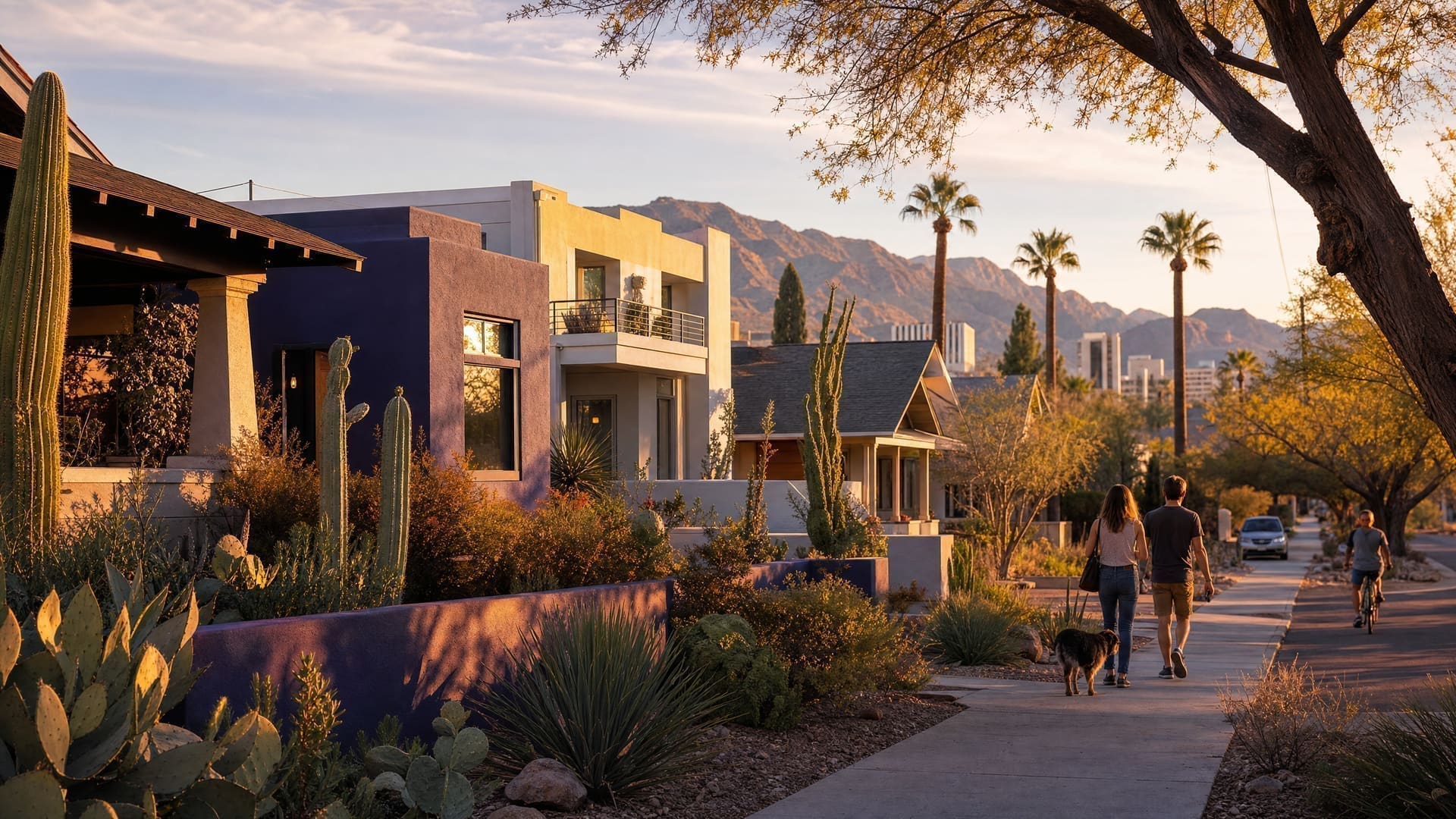
Walk the grid and the pattern repeats: a notch cut through the curb, a shallow basin dug behind it, and a tree sitting low in that basin rather than proud of the grade. Velvet mesquite, palo verde, catclaw acacia, desert hackberry, ironwood and desert willow do most of the work, chosen because they produce pods, fruit or medicine as well as shade. The Dunbar/Spring Neighborhood Foresters count more than 1,600 trees and many hundreds of understory plants put in since 1996, and more than a million gallons of street runoff routed into right-of-way earthworks in an average year. The 2026 event was the thirtieth annual planting and spilled over into the adjoining West University neighborhood, adding earthworks sized to capture upward of 110,000 gallons a year. Lancaster's own estimate for what the canopy buys: shading up to 75 percent of a street's surface can pull summer neighborhood temperatures down by as much as 10 degrees.
- The Curb Cuts (Street runoff, Right-of-way basins, City permit): Notches sawed through the curb that let stormwater off the asphalt and into a sunken planting basin instead of down the gutter. Cuts, core drills and basins in the public right-of-way all require a permit from the city's Permits and Codes Section.
- The Right-of-Way Canopy (Mesquite & palo verde, Ironwood, Desert willow): Native and near-native trees planted between sidewalk and street, selected for food and medicine value as well as shade. The stated goal is a living cool-island effect — the inverse of an over-paved heat island.
- The Street Grid (Speedway to 6th Street, Stone Ave to the railroad, Platted 1904): A compact historic district north of downtown, bounded by Speedway, 6th Street, Stone Avenue and the rail line. The housing runs from Sonoran row houses and Territorial cottages to Craftsman bungalows and early-20th-century revival styles.
The City Copied Its Own Neighborhood
Storm to Shade is the municipal version of the same idea: the City of Tucson's green stormwater infrastructure program, which installs and maintains curb cuts, flush curbs and vegetated basins on public property so runoff from paved surfaces irrigates street trees. It is paid for by a green infrastructure fee of $0.13 per CCF of water used, charged on monthly water bills, and it feeds Tucson Million Trees, the initiative aiming for a million new trees by 2030 — roughly 120,000 of them planted over the four years leading up to a 2025 accounting. All of it is idle until the sky cooperates, which is why August is when you should look at any of it. Tucson's monsoon runs mid-June through September, and this year opened ahead of schedule: 1.36 inches on four wet days through July 14, against a 0.92-inch average pace for the date.
What It Costs to Buy In
The district is small, which makes its price data noisy — the published sources disagree with each other more than they would in a subdivision with a hundred annual sales. Redfin put the median sale price at $417,000 for the three months ending April 2026, up 16.7 percent year over year. Homes.com showed a median sale price of $396,250, down 11 percent. Movoto listed a May 2026 median list price of $398,000, about $314 per square foot, with a median 36 days on market. Read those as a range rather than a number, and expect wide variation lot by lot: the housing stock spans a century of construction, and mature right-of-way canopy is not evenly distributed across the grid. None of this is investment advice.
Quick reference (August 5, 2026): Dunbar/Spring is a historic district just north of downtown Tucson, bounded by Speedway Boulevard, 6th Street, Stone Avenue and the railroad, and platted in 1904. Its volunteer neighborhood foresters have planted more than 1,600 native food- and medicine-bearing trees in the public right-of-way since 1996, irrigated by street runoff through curb cuts, and harvest more than a million gallons of stormwater annually. Curb cuts, core drills and right-of-way basins require a City of Tucson permit. Published median prices ranged from roughly $396,000 to $417,000 in spring 2026 depending on the source. Permit fees, program terms and home values change — confirm current details before relying on any single figure.
Tour the Curb, Not Just the House
If you are touring here, the walk-up matters as much as the interior. Check whether the address already has a curb cut and a basin that still holds water, whether anything shades the west and south walls through the afternoon, and whether the mature trees stand on the lot or in the right-of-way — the second kind sits on a public strip governed by city permit, not on the deed. Two houses on the same block can differ by a decade of canopy.
And if you buy somewhere else entirely, the method travels. A curb cut permit runs through the city's Permits and Codes Section at 201 N. Stone Avenue and has been quoted at $50 with a licensed contractor. Tucson Electric Power residential customers can order up to two five-gallon shade trees at $5 each through the Trees for You program, picked up at designated garden centers. That is the whole trick, and it is not an aesthetic one: the water was already running down the street.
Sources
Upworthy — "In 1998, a man illegally cut holes in a Tucson street curb. The result changed the law." — upworthy.com/in-1998-a-man-illegally-cut-holes-in-a-tucson-street-curb-the-result-changed-the-law — accessed August 5, 2026 (for the six curb openings sawed in front of the house in 1998, the fact that cutting into the curb was illegal, and the three years that passed before the city learned of it, when the homeowner told them himself). Arizona Daily Star (tucson.com) — "Developer's planned curb cuts for water harvesting met with city resistance" — tucson.com/news/local/developers-planned-curb-cuts-for-water-harvesting-met-with-city-resistance — accessed August 5, 2026 (for the roughly three years it took to persuade the city's Transportation Department to legalize curb cuts capturing stormwater for use on public rights-of-way in the Dunbar/Spring neighborhood, and for curb cuts now being allowed to capture water for use on public rights-of-way and other public property). Arizona Daily Star (tucson.com) — "Neighbors: Area's trees creating cool urban effect" — tucson.com/news/local/article_1b49c599-0f87-5f2d-a44a-e95c10f37c12.html — accessed August 5, 2026 (for the 1996 start of the annual tree planting organized by Brad Lancaster, the species planted along neighborhood streets including mesquite, palo verde, acacia, hackberry, ironwood and desert willow, the living cool-island-effect goal, the practice of building a water-harvesting basin around each planted tree, and Lancaster's estimate that shading up to 75 percent of a street's surface can cool summer neighborhood temperatures by up to 10 degrees Fahrenheit). Dunbar/Spring Neighborhood Foresters — "Annual rain & native food forest plantings another success in 2026" — dunbarspringneighborhoodforesters.org — accessed August 5, 2026 (for more than 1,600 native food- and medicine-bearing trees and many hundreds of multi-use native understory plants planted since 1996, more than a million gallons of stormwater directed annually into public right-of-way water-harvesting earthworks, the 2026 event being the 30th annual Rain, Tree & Food Forest Planting, its extension into the adjoining West University neighborhood, and the more than 110,000 gallons of average-year stormwater capture capacity built at it). Resilient West — "Tucson, AZ Commercial Rainwater Harvesting Ordinance" — resilientwest.org/case-study/tucson-az-commercial-rainwater-harvesting-ordinance — accessed August 5, 2026 (for Ordinance 10597 adopted by Tucson's Mayor and Council on October 14, 2008 as the first commercial rainwater harvesting requirement of its kind in the nation, its effective date of June 1, 2010, and the requirement that commercial development site plans show 50 percent of the estimated annual landscape water budget supplied by a rainwater harvesting system). City of Tucson Climate Action Hub — "Storm to Shade" and "About GSI" — climateaction.tucsonaz.gov/pages/s2s-about — accessed August 5, 2026 (for Storm to Shade as the city's green stormwater infrastructure program approved by Mayor and Council to install and maintain GSI on public property, and for curb cuts and flush curbs routing stormwater from impervious surfaces into vegetated basins where it infiltrates to irrigate native trees and vegetation). The Revelator — "As Heat Deaths Rise, Planting Trees Is Part of the Solution" — therevelator.org/shade-equity — accessed August 5, 2026 (for the green infrastructure fee of $0.13 per CCF of water used, collected on monthly water bills to fund Storm to Shade tree plantings and water harvesting, and for approximately 120,000 trees planted over the prior four years). City of Tucson Climate Action Hub — "Tucson Million Trees" — climateaction.tucsonaz.gov/pages/milliontrees-about — accessed August 5, 2026 (for the initiative to plant one million trees by 2030 to increase the city's tree canopy). Arizona Daily Star (tucson.com) — "Tucson monsoon: Rain more 'miss' than 'hit' so far" — tucson.com/news/local/weather/article_622607fb-8e26-4f67-91c3-daa72fe95116.html — accessed August 5, 2026 (for 1.36 inches of monsoon rain on four wet days through July 14, 2026, against a 0.92-inch average pace for the date). Watershed Management Group — "Tucson Water Curb Cut/Core Drill Information" — watershedmg.org/document/tucson-water-curb-cutcore-drill-information — accessed August 5, 2026 (for curb cuts, core drills and water harvesting basins requiring a permit from the City of Tucson Permits and Codes Section at 201 N. Stone Avenue, and for the sketch of curb cut, core drill, basin and planting locations required with a right-of-way application). Adaptation Clearinghouse — "Tucson, Arizona Rebates for Curb Cuts to Harvest Rainwater" — adaptationclearinghouse.org/resources/tucson-arizona-rebates-for-curb-cuts-to-harvest-rainwater.html — accessed August 5, 2026 (for the $50 curb cut permit and the requirement to use a licensed contractor). Tucson Electric Power — "Trees For You" — tep.com/trees-for-you — accessed August 5, 2026 (for TEP residential customers ordering up to two 5-gallon shade trees at a discounted $5 each, and for the shift to pickup at designated garden centers). RealTucson.com — "Tucson's Historic Neighborhoods" — realtucson.com/2016/02/07/tucsons-historic-neighborhoods — accessed August 5, 2026 (for the neighborhood's boundaries at Speedway on the north, 6th Street on the south, the railroad on the west and Stone Avenue on the east, its 1904 platting, and its mix of Sonoran, Territorial, bungalow, Victorian and early-20th-century revival architecture). Redfin — "Dunbar Spring, Tucson Housing Market" — redfin.com/neighborhood/67133/AZ/Tucson/Dunbar-Spring/housing-market — accessed August 5, 2026 (for the median sale price of $417,000 for the three months ending April 2026, up 16.7 percent year over year). Homes.com — "Dunbar/Spring, Tucson Real Estate & Homes for Sale" — homes.com/tucson-az/dunbar-spring-neighborhood — accessed August 5, 2026 (for the median home sale price of $396,250, down 11 percent year over year). Movoto — "Dunbar Springs, Tucson Homes For Sale & Real Estate" — movoto.com/tucson-az/dunbar-springs — accessed August 5, 2026 (for the May 2026 median list price of $398,000, the median $314 per square foot, and the median 36 days on market). All figures are current as of August 5, 2026; permit fees, program terms, utility offerings and home values change, so readers should confirm current information before relying on any single figure. This post is for informational purposes only and is not an offer to sell or a solicitation of an offer to purchase real estate. Kyle Berglund and Tierra Antigua Realty fully support and comply with the Fair Housing Act and the Equal Opportunity Act.
Topics
- Local Insights
- Dunbar/Spring
- Downtown Tucson
- Rainwater Harvesting
- Curb Cuts
- Urban Forestry
- Storm to Shade
- Historic Districts
- Tucson