In Picture Rocks, the Deed Doesn't Move the Well
Buying in Picture Rocks with a private well and septic: the ADWR well ownership form, the septic inspection no one can waive, and the 15-day Notice of Transfer.
Arizona tracks every well but regulates none of the water in a private one, and it requires a septic inspection nobody can waive. In Picture Rocks, where private wells and septic systems are standard, both come up at closing.
When a house with a private well changes hands in Arizona, recording the deed does not tell the state who owns the well. The Groundwater Management Act of 1980 required every well in the state to be registered with the Arizona Department of Water Resources, and a University of Arizona Cooperative Extension guide notes that many wells are still listed under whoever first registered them between 1981 and 1985. Several sales later, the name on the well record and the name on the deed can be two different people. In Picture Rocks, where most homes draw their own water, treat their own wastewater and heat with propane, that is worth checking before an offer, not discovering after closing.
- 35 gpm
- Maximum pumping rate for an exempt (domestic) well
- 6 months
- Window before a sale for the required septic inspection
- 15 days
- Time a buyer has after closing to file the septic Notice of Transfer
- 1985
- Year by which most Arizona wells had been registered with ADWR
Registered, but Not Regulated
Every water well in Arizona has to be registered with ADWR. What happens after that is mostly up to the owner. A well that serves a single home, or up to 25 homes, and pumps no more than 35 gallons per minute is what the state calls an exempt or domestic well. The extension guide is blunt about what that label means: domestic wells, private or shared, are not overseen or regulated by any state, county or local agency. The Arizona Department of Environmental Quality regulates public water supply wells, not the well behind a house.
That leaves three things with the owner. The first is keeping the registration in the owner's own name. The second is how the well performs, since there is no standard a well has to meet when the property is sold. The third is water quality. Nothing requires a private well to be tested, and no agency checks it routinely. The extension authors recommend testing anyway and keeping the results, because buyers and lenders will ask. They also make a point that surprises a lot of buyers: Arizona does not treat groundwater as the landowner's property. An exempt well right works more like a permit to pump a resource the state manages.
Getting the Well Into the Buyer's Name
The form is ADWR's 55-71A, Request to Change Well Information. It updates the registered owner's name and address, among other details, and the extension guide says escrow officers use it to record a transfer of well ownership at closing. A buyer can check the record before closing in ADWR's imaged well records, which are public, and match the well's registration number against the seller's paperwork.
A second form matters on an older property. Under A.R.S. §45-600 the well owner files a Pump Installation Completion Report, form 55-56, within 30 days of installing pumping equipment, and the extension authors recommend filing a new one each time a pump is replaced or reset. A file with a recent 55-56 tells a buyer when the pump was last touched. A file without one leaves the question to the seller's memory.
The extension guide counts shared wells, which serve more than one home, among the domestic wells no agency oversees. When a well serves more than one house, the registration says nothing about who pays for repairs, who controls the pump or who gets access to the equipment. A buyer should ask whether a written sharing agreement exists and read it before the inspection period ends.
The Septic Inspection Nobody Can Waive
Wastewater gets more oversight than water does. Every home on a septic system needs an Aquifer Protection Permit from ADEQ, issued as a general permit, and Arizona Administrative Code R18-9-A316 requires an inspection whenever the property changes hands. The seller hires a qualified inspector within six months before the transfer. The extension guide notes that the buyer, the seller, the agents, the lender and the title company cannot waive it. The only exception is a new system that has never been used. If the house hasn't sold within six months of the inspection, a new one is required.
The inspector's Report of Inspection records the system's physical and operational condition, any deficiencies and repairs, and whether the tank was pumped. If it was not, the report has to say why. It describes the system on the day it was inspected and does not promise how it will perform later. Before closing, the seller has to give the buyer the report along with any permit, operation and maintenance records the seller has. In Pima County the inspector's report is submitted through the county's Citizen Access Portal, where the county invoices a $50 fee.
The extension guide also suggests questions for a buyer to put to that report. Was the tank pumped? Is there a scale drawing showing the tanks, the primary dispersal area and the reserve area? Were repairs recommended? Did the inspector mark anything "unable to locate", and if so, is there an explanation?
The Form the Buyer Files After Closing
The last step belongs to the buyer. Within 15 calendar days after the transfer, the new owner completes a Notice of Transfer for each septic system on the property and sends it to the Pima County Development Services Department. That is what moves the system's permit into the buyer's name. Pima County's page says the county charges no fee for the Notice of Transfer and asks buyers not to include payment, and the form is emailed to the county's onsite wastewater staff. It is easy to miss, because by then the closing is done and nobody else is required to file it.
What Wells, Septic and Propane Mean for Buying in Picture Rocks
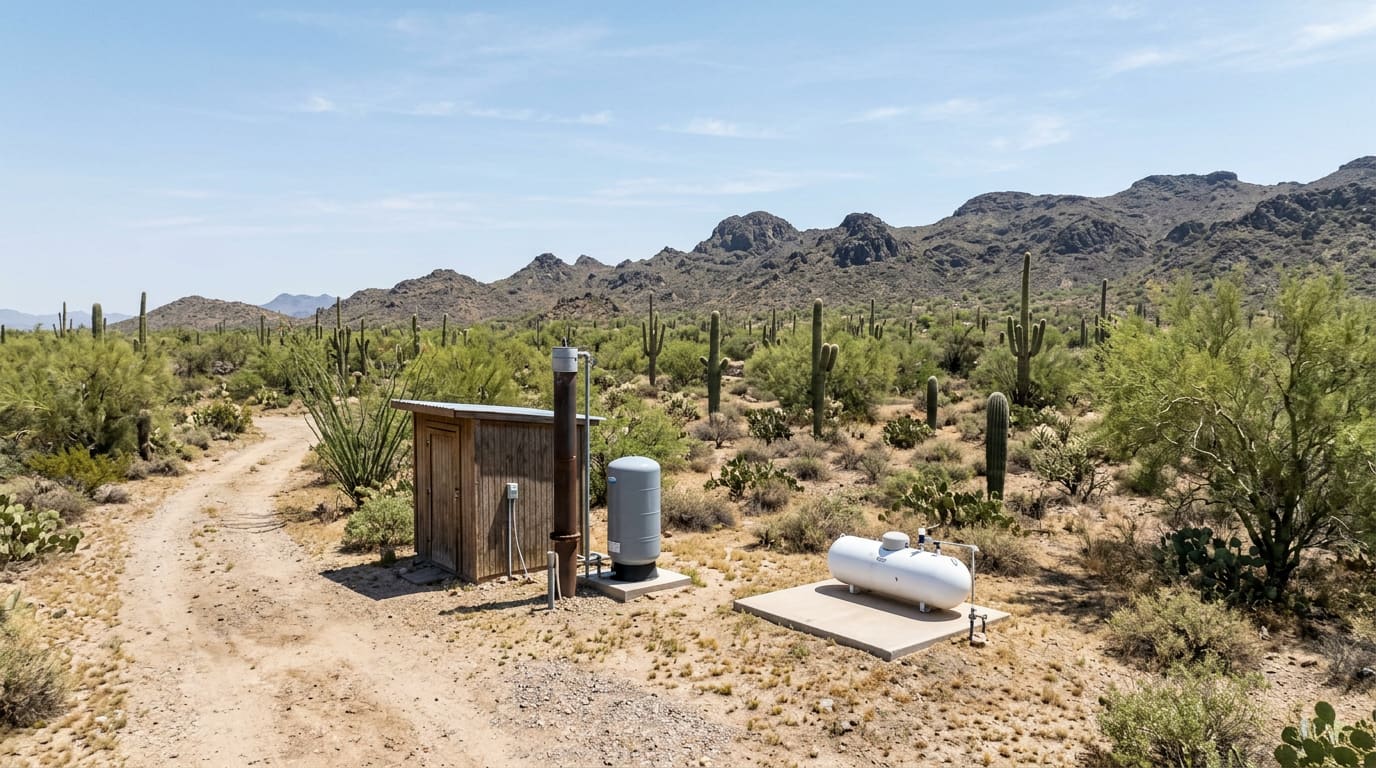
Picture Rocks is a community in unincorporated Pima County, in the Avra Valley on the far northwest edge of the Tucson area near the Tucson Mountains, with Picture Rocks Road running southeast to Cortaro Farms Road and Interstate 10. Building there started in the 1960s and 1970s and stayed slow. Most of the area has no master HOA. Lots are large and often unsubdivided, zoning allows horses, and the housing mixes manufactured and modular homes on acreage with custom Southwest, territorial and ranch-style houses. This site's Picture Rocks page lists private wells, septic systems and LP gas as the standard setup rather than the exception.
That changes how a purchase there runs. A buyer is taking on a water supply, a wastewater system and a fuel tank, along with the house. Plan the inspection period around all three. Schedule a well flow test and a water test with the home inspection. Read the septic report before the contingency runs out, not after. Ask the seller whether the propane tank is owned outright or leased from a supplier, and if it is leased, get the supplier's terms in writing. On a split lot, find out whether the well is shared and whether the sharing agreement is written down. None of this is unusual in Picture Rocks. It only goes wrong when a buyer assumes a city-style closing.
For what homes in Picture Rocks cost and how the area has changed, see this site's Picture Rocks page.
Three Records to Pull Before Writing an Offer
Before writing an offer, look up the well in ADWR's imaged records and see whose name is on it. Ask Pima County for the septic system's permit file, or ask the seller's inspector to pull it. And ask who owns the propane tank. With those three answers in hand, a Picture Rocks property is no harder to buy than a house on a sewer line.
Sources
University of Arizona Cooperative Extension — "An Arizona Guide to Domestic Well Registration and Record-keeping" (AZ1663, May 2015) — https://extension.arizona.edu/sites/extension.arizona.edu/files/pubs/az1663-2015.pdf — accessed November 1, 2026
University of Arizona Cooperative Extension — "What You Should Know When You're Having Your Septic System Inspected for the Transfer of Ownership Program" (AZ1554, revised June 2018) — https://www.extension.arizona.edu/sites/default/files/2024-08/az1554-2018.pdf — accessed November 1, 2026
Cornell Law School Legal Information Institute — "Ariz. Admin. Code § R18-9-A316, Transfer of Ownership Inspection for On-site Wastewater Treatment Facilities" — https://www.law.cornell.edu/regulations/arizona/Ariz-Admin-Code-SS-R18-9-A316 — accessed November 1, 2026
Pima County — "Transfer of Property Septic Inspection" — https://www.pima.gov/471/Transfer-of-Property-Septic-Inspection — accessed November 1, 2026
Rules, forms and fees are as published by the sources above and can change; confirm current requirements with ADWR and Pima County before relying on them. Community details are from this site's Picture Rocks page. This post is for informational purposes only and is not an offer to sell or a solicitation of an offer to purchase real estate.
Topics
- Local Insights
- Picture Rocks
- Private Wells
- Septic Systems
- Buying a Home
- Pima County
- Avra Valley