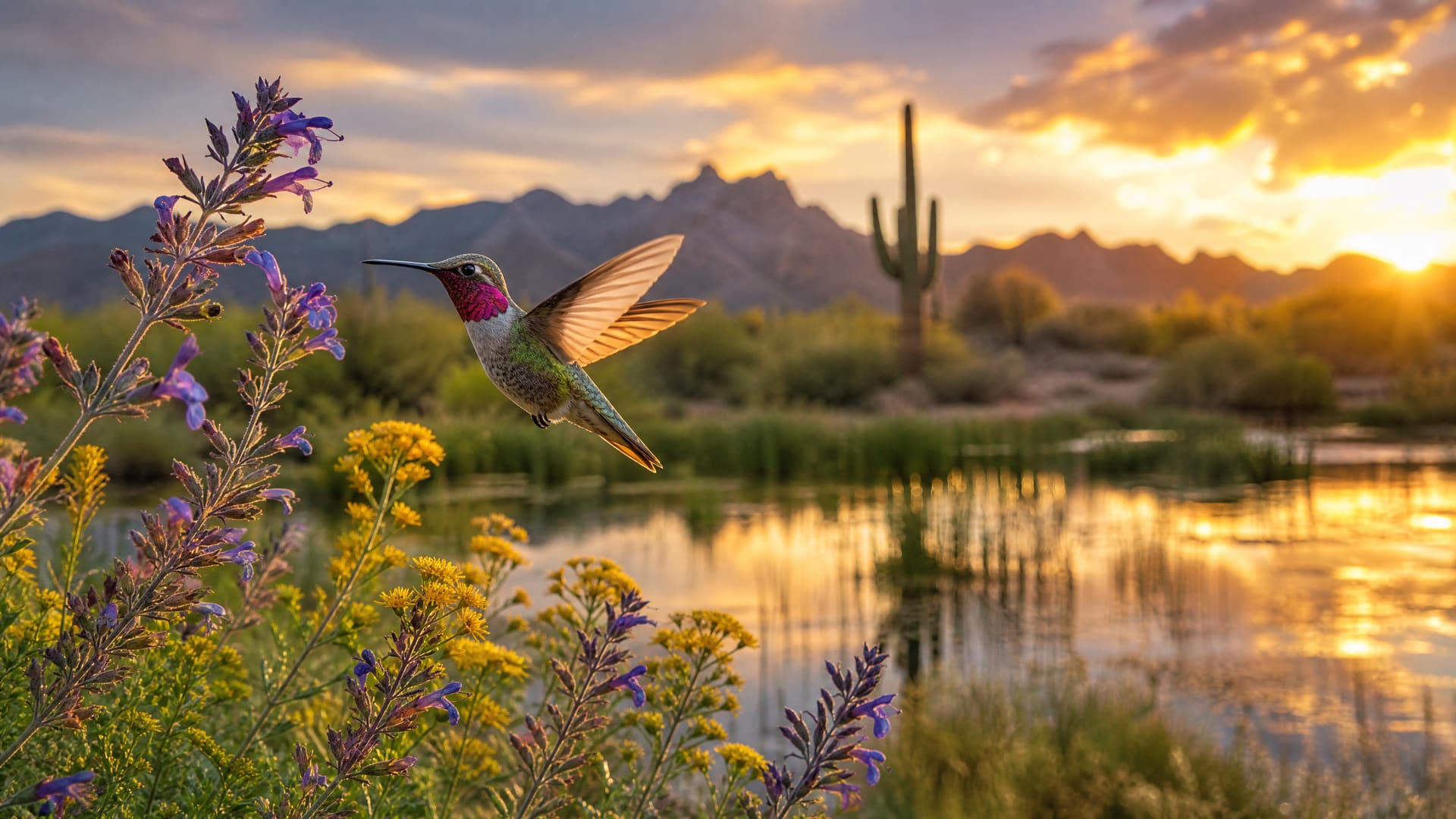
Tucson's Best Bird List Belongs to a Water Utility
A 60-acre Tucson Water recharge site on Sweetwater Drive carries a 338-species eBird list. Free admission, 2.5 miles of trail, and August timing.
Sweetwater Wetlands was built in 1996 to polish treated wastewater. Three decades on, eBird's checklist for the site runs to 338 species, admission is still nothing, and the August walks start at 6 a.m.
There is a 60-acre patch of open water on Tucson's west side that exists because a water utility needed somewhere to polish treated wastewater. The City of Tucson built Sweetwater Wetlands in 1996 for exactly that: settle the solids, polish the effluent through marsh vegetation, then sink it into the aquifer. Nobody drew it up as a park. It became one anyway — eBird's checklist for the hotspot at 2511 W. Sweetwater Drive now runs to 338 species, on a site with free parking, a restroom, a drinking fountain and no admission fee.
- 1996
- Year the wetlands were built, to polish treated wastewater
- 338
- Bird species on eBird's checklist for the hotspot
- 60 acres
- Site size at 2511 W. Sweetwater Drive, 85745
- $0
- Admission and parking; gates open at dawn, 8:30 a.m. Mondays
The Plumbing Is the Point
The water here was never doing a lap for show. As built, effluent from the treatment plant was piped first into settling basins, then into two large wetland ponds where it moved slowly through vegetation — a process that could take weeks and pulled out solids, pathogens and heavy metals through microbial transformation. From there it reached the recharge basins, filtered down through soil sediments and joined the groundwater. Per Tucson Water, Pima County's Agua Nueva plant began delivering Class A water in 2013, which made that treatment step unnecessary; the ponds were kept for wildlife and the community. In the reclaimed system, extraction wells pull it back during periods of high demand, and it comes out of sprinklers on parks, golf courses, schoolyards and street medians across Tucson. Sweetwater was the first of the three recharge sites in that reclaimed system. The birds are a byproduct of the engineering, which is the part worth knowing before you walk it.
Why August Is Better Here Than It Sounds
August is the month most of us write off outdoors, and it is quietly one of the better ones at this site. Fall migration is already moving through, monsoon rain greens up the vegetation along the paths, and shaded benches sit at intervals around the loop. The water itself is not weather-dependent: pond and basin levels come from the reclaimed flow piped in from the treatment plant, so a dry stretch does not empty them and a wet one does not fill them — the rain changes what is growing, not what is holding water. Tucson Bird Alliance runs guided walks here rated easy — roughly 1.5 miles over about three hours, on groomed gravel with no real elevation change. In August those Wednesday walks start at 6 a.m., which tells you everything you need to know about what time to set an alarm. Registration is free for members and $5 for everyone else, and the rain has cooperated: through mid-July, Tucson had logged 1.36 inches of monsoon rainfall against a 0.92-inch average pace for the date.
- The Origin (1996, Treated effluent, Tucson Water): Built by the City of Tucson in 1996 to polish treated wastewater effluent before recharge, and the first of three recharge sites in the city's reclaimed system.
- The Bird List (338 species, Migration, Marsh habitat): eBird's checklist for the Sweetwater Wetlands hotspot lists 338 species. Waterfowl, resident and migrant warblers and marsh species are the draw; Tropical Kingbirds nest in the cottonwoods in summer.
- The Trails (2.5+ miles, Quarter-mile paved, Packed granite): More than 2.5 miles of pathways: a 0.25-mile paved loop, a wider network of packed-granite path, and short dirt spurs into riparian cover. The west end meets the paved Loop path along the Santa Cruz River.
- Plan Your Visit (2511 W. Sweetwater Dr., Free, No pets; walk bikes): No entrance fee and free parking. Gates open at dawn Tuesday through Sunday and 8:30 a.m. Monday, locking about an hour after dusk. Pets and horses are not allowed, and bicycles must be walked inside the wetlands. Restrooms and drinking water are at the entrance.
There Is a Reason to Go This Week
The Southeast Arizona Birding Festival runs August 12 through 16, 2026, based out of the DoubleTree by Hilton Tucson–Reid Park at 445 S. Alvernon Way. The paid side is guided field trips and photography and bird-identification workshops. The part that costs nothing is the Nature Expo in the hotel's Grand Ballroom — vendors, optics, nature art and trip leaders you can ask where they actually go, plus a daily raffle drawn between 4:30 and 6 p.m. If you have been meaning to work out whether this is a thing you would do, a free expo across town and a free wetland fifteen minutes from downtown is about as low as the barrier gets.
What Sits Around It
Sweetwater is in 85745, off Sweetwater Drive west of I-10 near Silverbell Road, and its west end connects to the paved Chuck Huckelberry Loop along the Santa Cruz River — so the wetland doubles as a stop for anyone already riding that corridor. That pairing is a specific physical asset: a car-free path connection plus a free open-space amenity with restrooms and water. For current closed-sale figures across the Tucson area, see the market stats page on this site, where the numbers come from LiveBy and are refreshed there. None of this is investment advice.
Quick reference (August 8, 2026): Sweetwater Wetlands is at 2511 W. Sweetwater Drive, Tucson, 85745, operated by Tucson Water. No entrance fee, free parking, restrooms and drinking water at the entrance. Gates open at dawn Tuesday through Sunday, 8:30 a.m. Monday, and lock roughly an hour after dusk. Pets are prohibited, and bicycles must be walked. More than 2.5 miles of path, including a 0.25-mile paved loop. The Southeast Arizona Birding Festival runs August 12–16, 2026, at the DoubleTree by Hilton Tucson–Reid Park, 445 S. Alvernon Way; the Nature Expo is free. Hours, closures and event details change — confirm before relying on any single one.
Infrastructure That Became a Park
Tucson has a habit of building infrastructure that turns into public space by accident and then never mentioning it. This one has a quarter-mile of level pavement, more than two miles of packed granite beyond it, water and restrooms at the entrance, and a 338-species list on a parcel a water utility uses to refill the aquifer. Leave the dog at home, plan to walk the bike once inside, and be through the gate before the sun clears the Rincons.
Sources
City of Tucson, Tucson Water — "Sweetwater Wetlands" and "About Sweetwater Wetlands and Access" — tucsonaz.gov/Departments/Water/Community-Relations/Sweetwater-Wetlands — accessed August 8, 2026 (for the 2511 W. Sweetwater Drive address, the 1996 construction to treat Pima County's wastewater effluent before recharge, the 2013 Agua Nueva plant that made that treatment role unnecessary, the pet and horse ban, and the rule that bicycles be walked). Santa Cruz Valley National Heritage Area — "Sweetwater Wetlands Park" — santacruzheritage.org/sweetwater-wetlands-park — accessed August 8, 2026 (for the 60-acre site size, the more than 2.5 miles of pathways, the 0.25-mile paved loop, the packed-granite paths and the short dirt trails through riparian habitat). WateReuse Association — "Sweetwater Recharge Facilities: Serving Tucson for 20 Years" — watereuse.org — accessed August 8, 2026 (for Sweetwater as the first of the three recharge sites in Tucson's reclaimed water system). Rainwater Harvesting for Drylands and Beyond, Brad Lancaster — "Sweetwater Wetlands Reclamation Facility" — harvestingrainwater.com/tour_location/sweetwater-wetlands-reclamation-facility — accessed August 8, 2026 (for the multi-week polishing process, the removal of solids, pathogens and heavy metals through microbial transformation, the soil-sediment filtration into the aquifer, the recovery by extraction wells during high demand, and the reuse on parks, golf courses, schoolyards and street medians). eBird, Cornell Lab of Ornithology — "Sweetwater Wetlands" hotspot checklist (L208918) — ebird.org/printableList?regionCode=L208918 — accessed August 8, 2026 (for the 338 species recorded at the hotspot). Birding Hotspots — "Sweetwater Wetlands, Pima, Arizona" — birdinghotspots.org/hotspot/L208918 — accessed August 8, 2026 (for the dawn-to-an-hour-after-dusk gate hours, the 8:30 a.m. Monday opening, and the prohibition on dogs). Visit Tucson — "Sweetwater Wetlands Park" — visittucson.org/listing/sweetwater-wetlands-park/25919 — accessed August 8, 2026 (for the 85745 ZIP code, free admission, free parking and on-site restroom). Tucson Bird Alliance — Sweetwater Wetlands field trip listings and "Field Trips" — tucsonbirds.org/field-trips — accessed August 8, 2026 (for the 6 a.m. August Wednesday start time, the easy rating, the 1.5-mile distance over about three hours on groomed gravel, the free member registration and the $5 non-member fee, and the summer Tropical Kingbird nesting note). Tucson Bird Alliance — "Southeast Arizona Birding Festival" and "Nature Expo" — tucsonbirds.org/festival — accessed August 8, 2026 (for the August 12–16, 2026 dates, the DoubleTree by Hilton Tucson–Reid Park base at 445 S. Alvernon Way, the guided field trips and photography and bird-identification workshops, and the free Nature Expo in the Grand Ballroom with a daily raffle drawn between 4:30 and 6 p.m.). Arizona Daily Star / tucson.com — "Tucson's 2026 monsoon season arrives on schedule" — tucson.com — accessed August 8, 2026 (for the 1.36 inches of monsoon rainfall through mid-July against a 0.92-inch average pace). All figures are current as of August 8, 2026; hours, closures, event schedules, species totals and home values change, so confirm current details before relying on any single figure. This post is for informational purposes only and is not an offer to sell or a solicitation of an offer to purchase real estate. Kyle Berglund and Tierra Antigua Realty fully support and comply with the Fair Housing Act and the Equal Opportunity Act.
Related reading
Posts about the same places, or in the same category, nearest in time. Each carries its own sources and revision date.
- Where Ansel Adams Left His Life's Work — July 31, 2026 · Hidden Gems
- The Ghost Town That Takes Reservations — August 16, 2026 · Hidden Gems
- A World-Class Gem Museum Inside the Old Courthouse — July 23, 2026 · Hidden Gems
- It Was Almost 300 Acres of Houses — August 24, 2026 · Hidden Gems
Topics
- Hidden Gems
- Sweetwater Wetlands
- Tucson Water
- Birding
- Parks
- Reclaimed Water
- Chuck Huckelberry Loop
- West Tucson
- Tucson
- 85745