$1.4 Million Bought 9 Acres on Tanque Verde. Now Comes the Hard Part.
A buyer paid $1.4 million for about 9.31 acres at Tanque Verde and Woodland roads, with a 60-stall barn planned. What zoning and floodplain rules decide next.
Buying the dirt is the easy part. On Tucson's northeast side, two separate agencies decide what actually gets built on it — and you cannot tell from a mailing address which one you are dealing with.
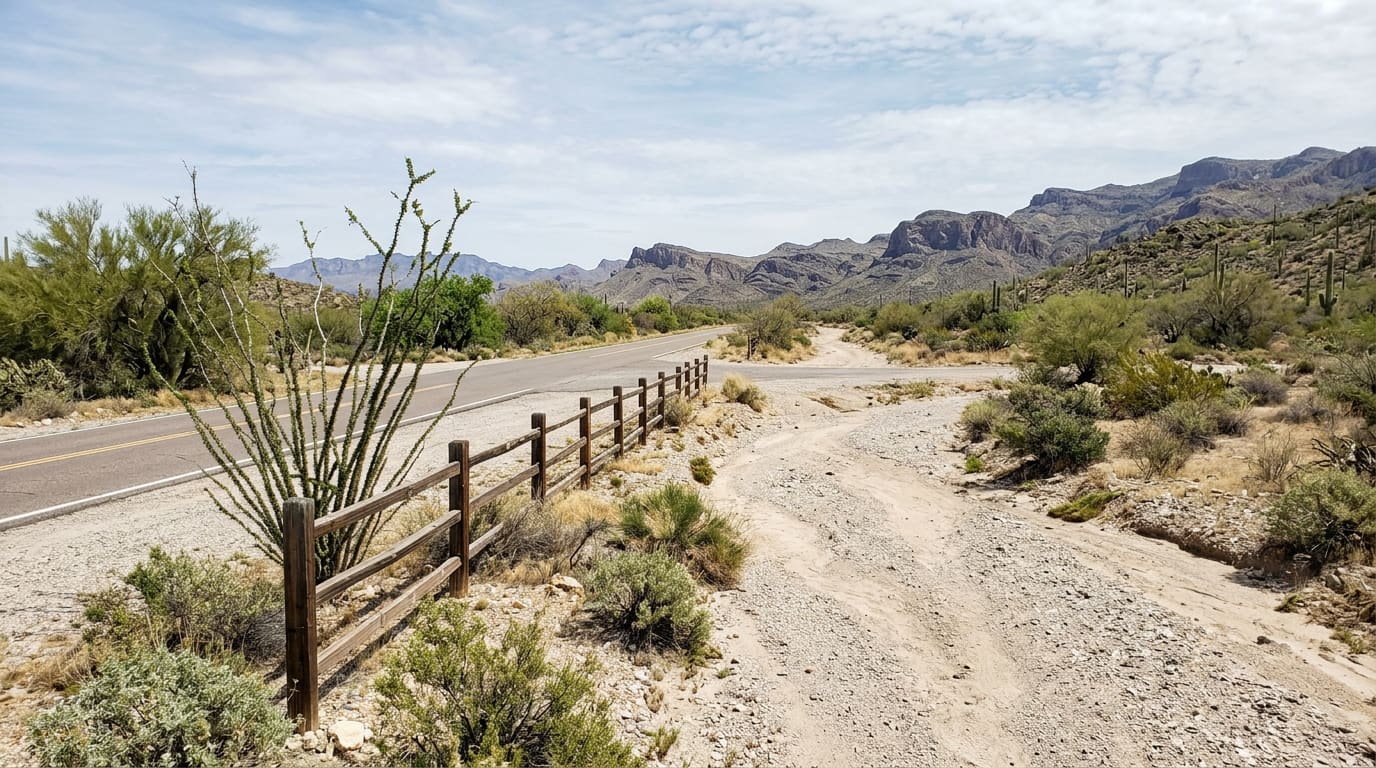
Nine and a third acres near the mouth of the Tanque Verde Valley just traded for $1.4 million, and the buyer wants to put sixty horse stalls on it. Real Estate Daily News reported the sale on September 3: approximately 9.31 acres at 8050 E. Tanque Verde Road, closed August 25, bought by Sonoran Equestrian Center, LLC from the Francis E. Hawke, Jr. Trust, with Craig Finfrock of Commercial Retail Advisors representing the seller and the buyer representing itself. The plan, as described, is a 60-stall covered open-air barn, a covered open-air dressage arena, an open-air jumping area and a covered exercise arena.
- $1.4M
- Reported price for the Tanque Verde Road parcel
- 9.31
- Acres, in a sale reported to have closed August 25, 2026
- ~$150K
- Price per acre, computed from those two figures
- 60
- Stalls in the covered open-air barn the buyer describes
A Deed Is Not a Permit
Divide $1.4 million by 9.31 acres and you get roughly $150,000 an acre — arithmetic rather than an appraisal, and a price for this parcel on the day it sold with whatever constraints came attached. What it does not tell you is whether the described facility can be built. Out here, that gets answered by two agencies most buyers never think about until they are standing at a counter.
A 60-stall barn is only a large version of the question a homeowner asks in miniature every time they want a block wall, a pool, an addition or a second garage on acreage near a wash. Same two gates.
Gate One: Whose Code Is It
The Tanque Verde corridor is not uniformly city or county, and you cannot read the answer off a mailing address — a Tucson address is a postal fact, not a jurisdictional one. Pima County says as much to agents directly: its Regional Flood Control District regulates the unincorporated portions of the county and communities not served by other agencies, and for property inside the City of Tucson, the City of South Tucson, or the towns of Oro Valley, Marana and Sahuarita, you are told to ask those jurisdictions instead.
The zoning abbreviation does not settle it either, which surprises people. "SR" means Suburban Ranch in the Pima County zoning code and also in the City of Tucson's Unified Development Code. Two governments, one abbreviation, different rulebooks. So the first thing to establish on any large-lot parcel out here is not what it is zoned but who zoned it.
On unincorporated SR land, Pima County's code is specific about horses. Keeping them is permitted outright at a fixed density — no more than one head of cattle, horse, sheep, goat or similar animal over six months of age per ten thousand square feet of lot area (18.17.020.A.6). Nine and a third acres is about 405,500 square feet, so that lands near 40 animals. Running a stable as a business is a different section. A commercial riding stable or school is conditionally permitted under a Type II procedure with a twenty-acre minimum site area and a hundred-foot setback for stables, barns, animal sheds or shelters (18.17.030.C.1). A community stable is also Type II, with a ten-acre minimum, a five-hundred-foot setback from subdivision boundaries, and that same one-horse-per-ten-thousand-square-feet ceiling (18.17.030.C.4).
Those are published standards, not a prediction about this project. How any plan gets reconciled with them — a conditional use permit, a variance, more land, a different use classification — is decided in public, on a hearing calendar. No application for this address had been publicly announced as of September 6, 2026.
Gate Two: Which Floodplain
The northeast side is organized around drainages, and this is the gate people underestimate. Pima County's guidance to agents is blunt: the FEMA disclosure requirement is only a small portion of making flood-smart decisions, because local hazard areas cover substantially larger ground than the federal maps do. The county's regulatory floodplain reaches any wash carrying a base flood discharge of 100 cubic feet per second or more, plus areas subject to sheet flooding and mapped riparian habitat. A parcel can clear FEMA and still be regulated locally.
Inside that regulatory floodplain, the county requires a Floodplain Use Permit before construction, and the list of what counts is longer than most people expect: structures, additions, fencing, walls, pools, drainage improvements or modifications, erosion control measures and some temporary construction. The District reviews the application against the county's Floodplain and Erosion Hazard Management Ordinance, and its own guidance warns the review may take several weeks, with other county departments potentially reviewing after that. Fencing, drainage work and barns are most of what a stable physically is.
Moving land off the federal map is a separate two-step process, and the first step is routinely misread. A Conditional Letter of Map Revision is FEMA's comment on a proposed project that would, once built, change a flooding source's behavior and therefore modify the regulatory floodway, the base flood elevations or the Special Flood Hazard Area. FEMA then draws the line: "The letter does not revise an effective NFIP map, it indicates whether the project, if built as proposed, would be recognized by FEMA." Only after the work is done and as-built certification is submitted does the community request the Letter of Map Revision that changes the map. A CLOMR is an answer in advance, not a new map.
- Establish Jurisdiction First (City vs. county, Same zone abbreviations, Different rulebooks): Tucson city limits and unincorporated Pima County interleave along the Tanque Verde corridor, and both governments use "SR" for a Suburban Ranch zone. Pima County directs inquiries for property inside Tucson, South Tucson, Oro Valley, Marana or Sahuarita to those jurisdictions instead. Confirm which one governs a parcel before reading any code section against it.
- Check Both Floodplains (FEMA SFHA, County regulatory floodplain, Elevation certificates): Pima County publishes a Flood Hazard Information Form, a Flood Hazard Map and Parcel Search, and a search of completed elevation certificates for unincorporated property, and staffs hydrologists weekdays from 8 a.m. to 4 p.m. to answer floodplain questions. The county's local hazard areas are larger than FEMA's mapped areas, so a clean FEMA answer is not the whole answer.
- Price the Two Line Items (Flood insurance, Floodplain Use Permit, Review timeline): A mapped Special Flood Hazard Area plus federal financial assistance triggers a flood insurance requirement, which belongs in the monthly payment before an offer rather than after an appraisal. Inside the county's regulatory floodplain, a future wall, pool, addition, fence or drainage change is a permit application the District says may take several weeks to review.
The Version of This That Applies to a House
The same two gates decide much smaller things on the large-lot ground that makes this side of town what it is. Under the Flood Disaster Protection Act of 1973, buyers, builders and owners improving property in identified areas of special flood hazard within participating communities must carry flood insurance as a prerequisite for federal financial assistance — which in practice reaches most mortgages. That premium is a monthly-payment input, not a closing-table surprise.
A regulated parcel is not a defective one. The washes are why this ground has the mature vegetation, the open space and the horse-property character people move out here for in the first place. They are a reason to pull the floodplain answer by parcel rather than by neighborhood, early enough that it can still shape the offer — and to find out which government you would be asking, before you ask it.
Quick reference (September 6, 2026): Real Estate Daily News reported on September 3, 2026 that Sonoran Equestrian Center, LLC purchased approximately 9.31 acres at 8050 E. Tanque Verde Road from the Francis E. Hawke, Jr. Trust for $1.4 million in a sale that closed August 25, 2026, with Craig Finfrock of Commercial Retail Advisors representing the seller and the buyer self-represented, and that the buyer intends to build a 60-stall covered open-air barn, a covered open-air dressage arena, an open-air jumping area and a covered exercise arena. Those transaction details are reported by that outlet and are described above as reported. The per-acre figure is arithmetic from the reported price and acreage, not an appraisal. This post makes no claim about the parcel's jurisdiction, current floodplain status, or whether any application has been filed. Zoning standards, floodplain mapping and permit requirements change — confirm anything you intend to rely on with the governing jurisdiction and, for unincorporated property, the Pima County Regional Flood Control District. General information only, not legal, engineering, insurance, tax or investment advice.
Sources
Real Estate Daily News — "New Equestrian Center Planned for Northeast Tucson Following $1.4M Land Sale" — realestatedaily-news.com/new-equestrian-center-planned-for-northeast-tucson-following-1-4m-land-sale — published September 3, 2026, accessed September 6, 2026 (for the buyer Sonoran Equestrian Center, LLC, the seller the Francis E. Hawke, Jr. Trust, the $1.4 million price, the approximately 9.31 acres, the 8050 E. Tanque Verde Road address, the August 25, 2026 closing, Craig Finfrock of Commercial Retail Advisors representing the seller with the buyer self-represented, and the described 60-stall covered open-air barn, covered open-air dressage arena, open-air jumping area and covered exercise arena; these transaction details are single-sourced to this trade outlet, which is why every reference to them above is attributed rather than stated flatly). Pima County Regional Flood Control District — "Floodplain Resources for Real Estate Professionals" — pima.gov/1720/Floodplain-Resources-for-Real-Estate-Pro — accessed September 6, 2026 (for the statement that the FEMA floodplain disclosure requirement is only a small portion of making flood-smart decisions and that local hazard areas cover substantially larger areas than the federal maps; for the District regulating the unincorporated portions of Pima County and communities not served by other agencies, with inquiries for the City of Tucson, City of South Tucson and the towns of Oro Valley, Marana and Sahuarita directed to those jurisdictions; for the Flood Hazard Information Form, the Flood Hazard Map and Parcel Search and the completed elevation certificates search; and for hydrologists available Monday through Friday, 8 a.m. to 4 p.m.). Pima County Regional Flood Control District — "Floodplain Use Permit (FPUP) Application Guide" — pima.gov/1452/Floodplain-Use-Permit-FPUP-Application-G — accessed September 6, 2026 (for the requirement that structures, additions, fencing, walls, pools, drainage improvements or modifications, erosion control measures and some temporary construction obtain floodplain approval; for the regulatory floodplain covering areas along any wash with a base flood discharge equal to or exceeding one hundred cubic feet per second, areas subject to sheet flooding, and mapped riparian habitat; and for review against the county's Floodplain and Erosion Hazard Management Ordinance taking several weeks, with other county departments potentially reviewing before construction). FEMA — "Conditional Letter of Map Revision (CLOMR)" glossary entry — fema.gov/about/glossary/conditional-letter-map-revision-clomr — accessed September 6, 2026 (for the definition of a CLOMR as FEMA's comment on a proposed project affecting the hydrologic or hydraulic characteristics of a flooding source and modifying the regulatory floodway, base flood elevations or Special Flood Hazard Area; for the quoted statement that the letter does not revise an effective NFIP map and indicates whether the project, if built as proposed, would be recognized by FEMA; and for the requirement that the community request a Flood Insurance Rate Map revision supported by as-built certification once the project is complete). FEMA — "Letters of Map Revision and Conditional Letters of Map Revision" — fema.gov/flood-maps/change-your-flood-zone/lomr-clomr — accessed September 6, 2026 (for the LOMR defined as a letter from FEMA officially revising the current NFIP map to show changes to floodplains, regulatory floodways or flood elevations). FEMA — "Mandatory Purchase" glossary entry — fema.gov/about/glossary/mandatory-purchase — accessed September 6, 2026 (for the Flood Disaster Protection Act of 1973 requirement that individuals, businesses and others buying, building or improving property located in identified areas of special flood hazard within participating communities purchase flood insurance as a prerequisite for receiving any type of direct or indirect federal financial assistance). Pima County Code of Ordinances, Title 18 Zoning, Chapter 18.17 SR Suburban Ranch Zone — published code text read at zoneomics.com/code/pima-county-unincorporated-AZ/chapter_11 — accessed September 6, 2026 (for the permitted grazing and raising of livestock at no more than one head of cattle, horse, sheep, goat or other animal more than six months of age per ten thousand square feet of lot area at section 18.17.020.A.6; for the uses conditionally permitted under a Type II procedure at section 18.17.030.C, including the commercial riding stable or school with a twenty-acre minimum site area and a one-hundred-foot minimum setback for stables, barns, animal sheds or shelters at 18.17.030.C.1, and the community stable with a ten-acre minimum site area, a five-hundred-foot minimum setback from subdivision boundaries and a limit of one horse per ten thousand square feet of land area at 18.17.030.C.4; the official code is published by Pima County through its own code library). Per-acre arithmetic above is computed from the reported $1.4 million price and 9.31 acres. The jurisdiction governing this specific parcel, its current floodplain status, and whether any conditional use permit, floodplain use permit or map revision has been applied for were not independently established for this post and are deliberately not asserted. Nothing here is legal, engineering, insurance or tax advice. This post is for informational purposes only and is not an offer to sell or a solicitation of an offer to purchase real estate. Kyle Berglund and Tierra Antigua Realty fully support and comply with the Fair Housing Act and the Equal Opportunity Act.
Topics
- Local Real Estate News
- Tanque Verde
- Land Sales
- Floodplain
- Pima County
- Zoning
- Northeast Tucson
- Horse Properties