Tucson's Newest Historic District Is a Neighborhood of Carports
Windsor Park joined the National Register on April 30, 2026 — 128 mid-century houses east of Camino Seco, and what the listing changes for an owner.
The 1960s subdivision north of Speedway Boulevard and east of Camino Seco was listed on April 30, 2026. Ninety-eight of its 128 houses contribute, and the designation changes less for an owner than most people assume.
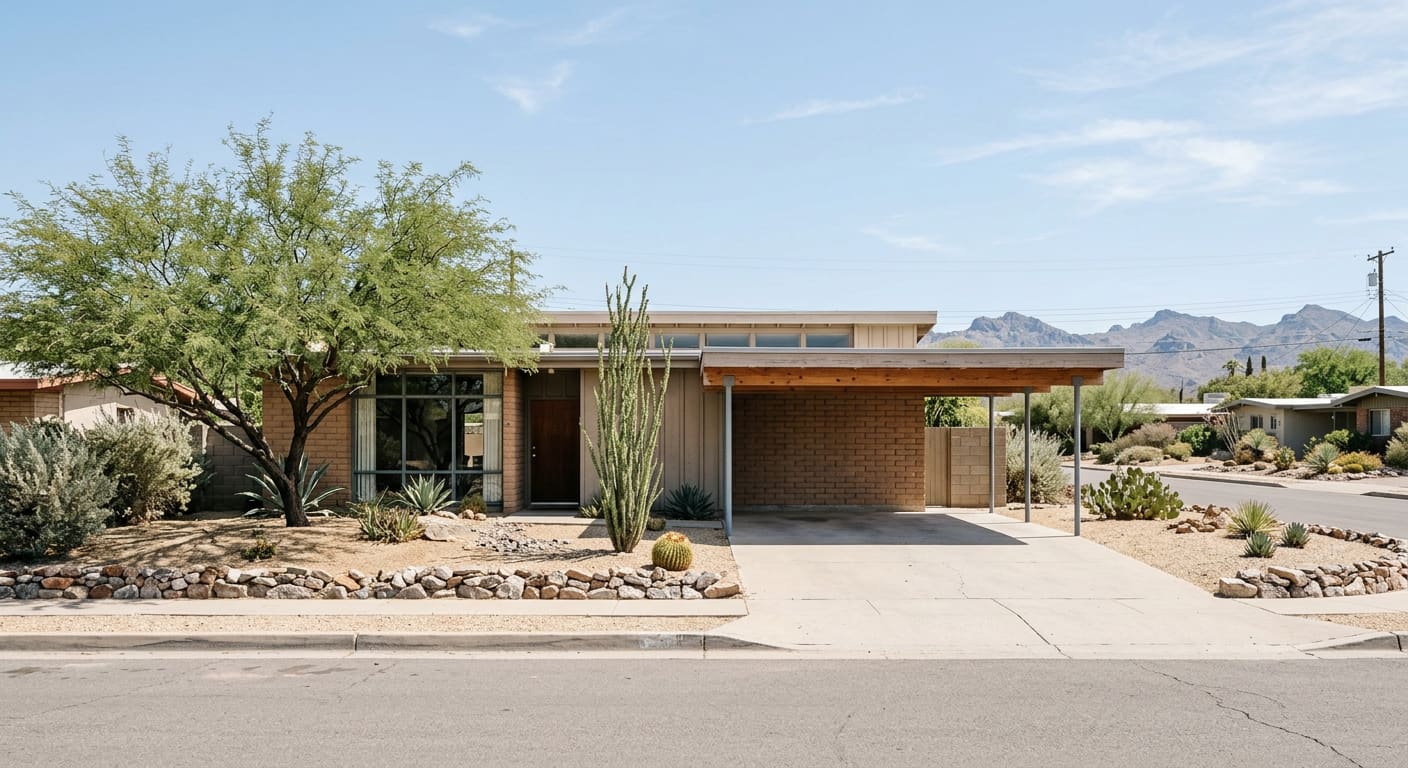
Turn north off Speedway Boulevard at Camino Seco and the houses change. Rooflines drop to a low horizontal line, walls turn to burnt adobe and slump block masonry, and two-car carports push forward from the front of the house instead of hiding behind a garage door. On April 30, 2026 the National Park Service listed those streets as the Windsor Park Historic District: 128 houses built between 1961 and 1969, and Tucson's newest National Register neighborhood.
- 128
- Residences inside the district boundary
- 98
- Of them counted as contributing properties
- 1961-1969
- Period of significance, built in three phases
- April 30, 2026
- Date the National Park Service listed the district
A Builder Hired an Architecture Firm, Not a Plan Book
In 1961 builder Herbert Oxman hired Ambrose, Swanson and Associates to design the models for a new subdivision in east Tucson. The nomination calls the firm one of the most prominent architecture firms of production housing in Tucson's post-World War II development, and credits the jump in quality to the price point: Oxman was aiming at a mid-priced buyer, which let the architects work above the level of their earlier commissions. Its verdict is that this is perhaps the best example of Modern production housing in Tucson. Oxman expanded with Windsor Park II in 1965 and Windsor Park III in 1968, David Swanson designing the later models after the partnership ended in 1963. Original houses ran 1,600 to 2,500 square feet across a small set of plans, one sold as the Camelot.
The Details That Make the Streetscape
The character-defining features, in the nomination's own list: asymmetrical forms, burnt adobe and slump block masonry, window walls, carports, flat and low-slope gable roofs, and board-and-batten sheathing. First-phase houses got wood-framed window walls with clear-anodized aluminum sliders, and many had an egg-crate trellis over an entry court, most of which are gone. Houses sit near the center of quarter-acre to half-acre lots and, in the first phase, were rarely placed parallel to the street, which is why the streetscape has an irregular rhythm rather than a repeating one. Those blocks began as dirt streets, compacted and oiled to hold down dust, and still have no curbs or sidewalks; phases two and three have rolled curbs. Most streets run east to west, which is how the layout keeps its view of the Santa Catalinas.
- Desert Palms Park (Directly east, Platted 1960): Quarter-acre lots sold off to a range of builders rather than built to one firm's models — the contrast that makes Windsor Park's consistency visible.
- Eastern Hills (South of Speedway, Platted 1962): Same era, opposite side of the arterial. Windsor Park's front facades deliberately face away from Speedway and its commercial strip.
- Hidden Hills (West of Camino Seco, Platted 1969): Platted as Windsor Park's third phase finished — a marker of how fast this part of the east side filled in.
What the Listing Changes for an Owner
Less than most people assume. The National Park Service is explicit that listing places no federal restrictions or requirements on a private property owner, and that an owner may do with the property as they wish within the framework of local laws or ordinances. No design review arrives with the certificate. Local law is the separate question: the City of Tucson administers its own historic designations and design review, so a specific parcel is a question for the city's historic preservation office.
What listing does open is Arizona's State Historic Property Tax Reclassification. A National Register property — listed individually or as a contributor to a district — that is owner-occupied and not income-producing can apply through the county assessor. The program reduces property taxes between 35 and 45 percent, the exact figure depending on local special assessments. The trade is a 15-year agreement to maintain the property's historic features and to contact the State Historic Preservation Office before work that changes the public appearance, reviewed against the Secretary of the Interior's Standards for Rehabilitation. Applications reach the assessor by June 30 to enroll for the following tax year, so the next window for a Windsor Park owner closes June 30, 2027.
Thirty Houses Did Not Make the Cut
Of the 128 residences, 30 are non-contributing, and the nomination's reasons read like a maintenance checklist in reverse: carports converted to garages or enclosed as living space, paint applied over masonry, original windows replaced with vinyl frames, stucco laid over burnt adobe. The document lists every address with its build year, model plan and contributing status — so anyone weighing a remodel here can look up a specific house, and see which alterations cost a neighbor its standing.
Quick reference: the district sits north of Speedway Boulevard and east of Camino Seco, bounded by Wrightstown Road and the Desert Palms Park subdivision. 128 residences, 98 contributing, platted 1962, built 1961-1969, annexed by the City of Tucson in 1971, listed April 30, 2026 under reference number SG100012950.
The Post-War Survey Is Producing Districts
None of this came out of nowhere. A 2016 City of Tucson Historic Preservation Office assessment of post-World War II subdivisions evaluated nearly 400 of them and named Windsor Park a top-tier National Register candidate and a highest-priority subdivision for the city's preservation work. That pipeline is now delivering: Wilshire Heights, east of Craycroft Road between Broadway Boulevard and 22nd Street, was listed on July 8, 2025, and Windsor Park followed less than ten months later. Tucson's historic districts used to mean adobe rows downtown. The ones being added now are 1960s subdivisions on the east side — houses people bought new, with carports out front and mountains at the end of the street.
Sources
National Park Service — "Weekly List of Actions Taken on Properties: 4/27/2026 through 5/1/2026" — nps.gov/subjects/nationalregister/weekly-list-2026-05-01.htm — accessed August 30, 2026 (for the Windsor Park Historic District listing on April 30, 2026, its Pima County location north of Speedway Blvd. and east of Camino Seco, and reference number SG100012950). City of Tucson Historic Preservation Office / Arizona SHPO — "Windsor Park Historic District, Pima County, AZ: National Register of Historic Places Registration Form" (final form, signed by the Arizona State Historic Preservation Officer, March 13, 2026) — tucsonaz.gov/files/sharedassets/public/v/1/city-services/planning-development-services/historic-preservation/documents/az_pimacounty_windsorparkhistoricdistrict_form.pdf — accessed August 30, 2026 (for the 128 residences and 98 contributing properties, the 1961-1969 period of significance and three phases, the 1962 plat, the 1971 annexation into the City of Tucson, the district boundaries at Speedway Boulevard, Camino Seco, Wrightstown Road and Desert Palms Park, the architects Ambrose, Swanson and Associates and David Swanson, builder Herbert Oxman, Windsor Park II in 1965 and Windsor Park III in 1968, the 1,600-2,500 square foot original houses and the Camelot model, the character-defining features and materials, lot sizes, alleys, street paving, curbs and east-west orientation, the reasons houses were classed non-contributing, and the 2016 post-World War II subdivision assessment of nearly 400 subdivisions). National Park Service — "National Register of Historic Places: Frequently Asked Questions" — nps.gov/subjects/nationalregister/faqs.htm — accessed August 30, 2026 (for federal listing placing no restrictions or requirements on a private property owner, within the framework of local laws or ordinances). Arizona State Parks and Trails, State Historic Preservation Office — "State Historic Property Tax Reclassification (SPT) for Owner-Occupied Homes" — azstateparks.com/state-historic-property-tax-reclassification-spt-for-owner-occupied-homes — accessed August 30, 2026 (for eligibility as an individually listed or contributing National Register property, the 35-45 percent reduction, the 15-year maintenance agreement, SHPO review under the Secretary of the Interior's Standards for Rehabilitation, and the June 30 application deadline to the county assessor for the following tax year). National Park Service — "Weekly List of Actions Taken on Properties: 7/7/2025 through 7/11/2025" — nps.gov/subjects/nationalregister/weekly-list-2025-07-11.htm — accessed August 30, 2026 (for the Wilshire Heights Historic District, listed July 8, 2025, east of Craycroft Road between Broadway Boulevard and 22nd Street, reference number SG100011979). Program rules, district boundaries and local review requirements change, so confirm current information with the Arizona State Historic Preservation Office, the Pima County Assessor and the City of Tucson Historic Preservation Office before relying on any single figure. This post is for informational purposes only and is not an offer to sell or a solicitation of an offer to purchase real estate. Kyle Berglund and Tierra Antigua Realty fully support and comply with the Fair Housing Act and the Equal Opportunity Act.
Topics
- Local Insights
- Windsor Park
- Historic Districts
- Mid-Century Modern
- East Tucson
- National Register
- Tucson