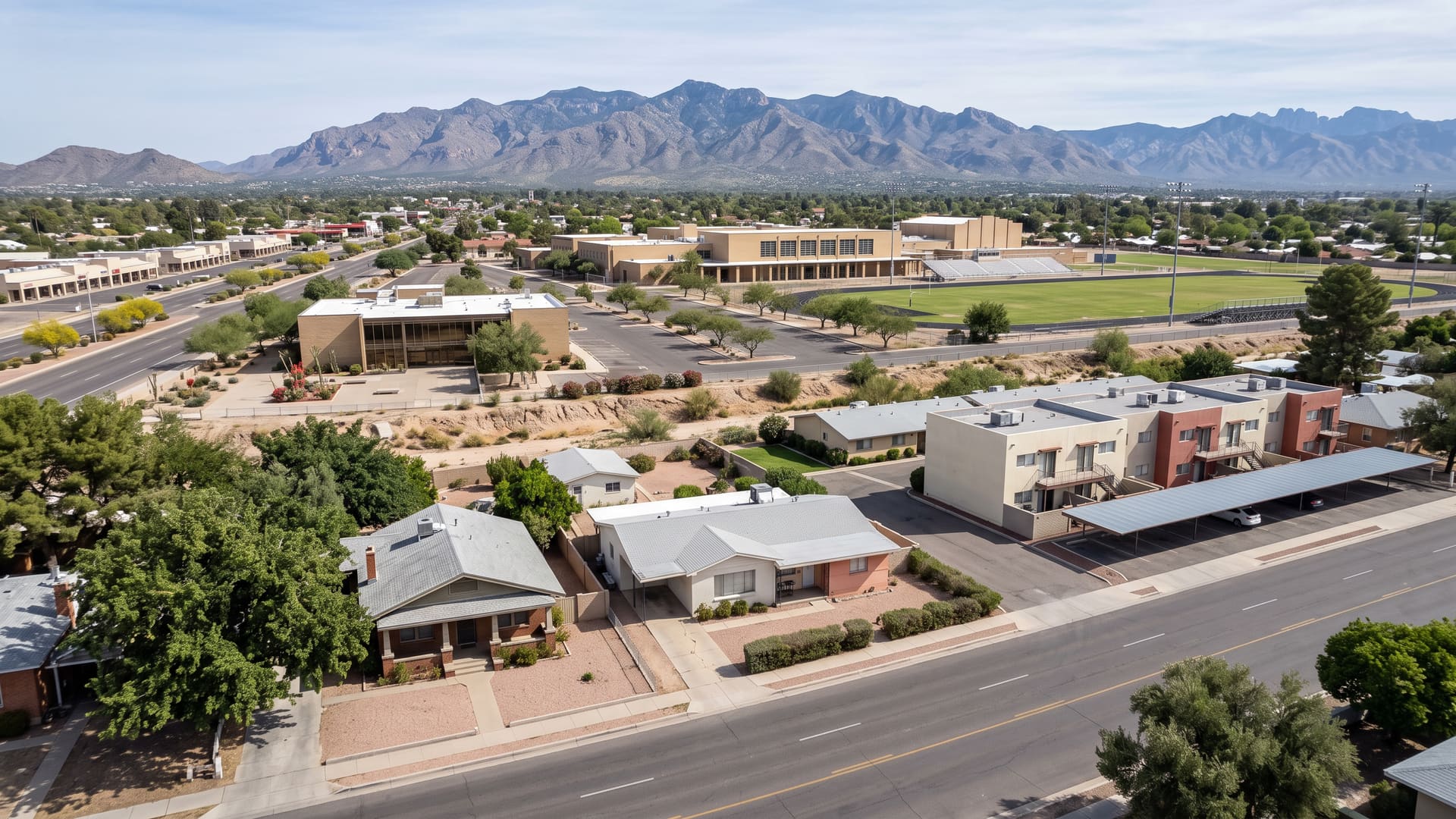
Amphi Homes for Sale — Tucson, AZ
Amphi is one square mile of north-central Tucson, dead flat, 636 acres inside four arterial streets and almost entirely ZIP 85705. What makes it worth reading closely is that it holds three different kinds of home at three different prices.
Key facts
- Jurisdiction
- Tucson, Arizona — incorporated city, Pima County
- Average sale price
- $245,000
- Price range
- $150K – $300K
- School district
- Amphitheater USD (Prince Elementary, Amphitheater High)
- Approximate population
- ~7,000
- Approximate number of homes
- ~3,800 homes
What defines this area
- Detached houses, townhouses and condominiums inside one square mile
- A $235,000 median across 59 closings in three years
- Nine school campuses inside the square mile
- Amphitheater Acres Addition, 124 lots recorded in May 1928
- Catalina Subdivision, 94 lots recorded in August 1919
- A 1974-1994 wave of townhouse, condominium and patio-home plats
- Roger Road north, Fort Lowell Road south, Oracle Road west
- North First Avenue east, with Prince Road down the middle
- One square mile inside four arterial streets, 636 acres
- Woods Memorial Library on North First Avenue
- Build years running 1932 to 2003, with a 1960 median
- Price banded by floor area rather than by age
- Nine zoning districts and no R-1 anywhere inside the line
- 1,319 county parcels, every one City of Tucson
- Eight HOAs, all of them on attached-housing plats
- No airport overlay and no public park inside the boundary
- Annexed in one act, Ordinance 1895, effective April 1959
- Ward 3, ZIP 85705, about 3.4 miles north of downtown
About Amphi
Amphi is one square mile of north-central Tucson, dead flat, 636 acres inside four arterial streets and almost entirely ZIP 85705. What makes it worth reading closely is that it holds three different kinds of home at three different prices. Over the three years to September 2026, fifty-nine homes changed hands inside the line: forty-one detached houses, fifteen townhouses and three condominiums. Buying newer here has meant buying smaller and paying more for each square foot of it, and the rest of this page is where that comes from. East and West Roger Road close it on the north, East and West Fort Lowell Road on the south, North Oracle Road — a state route — on the west and North First Avenue on the east, with Prince Road running straight through the middle of it. The name is the short form of Amphitheater, and it belonged to the school district before it belonged to the neighborhood: Amphitheater Public Schools says on its own site that it has been teaching in Tucson and Oro Valley for more than 130 years, which puts the district well ahead of the 1928 plat here that took its name. Its high school stands inside this square mile on Yavapai Road, and that school's own site describes more than eighty years of its own. The recorded plats run in three clear waves, and the closed-sale record reads as those three waves. The first is detached and old: Catalina Subdivision, 94 lots, recorded on 7 August 1919; Sawtelle Place in 1925; Amphitheater Acres Addition, 124 lots, on 7 May 1928; Garden Homes in 1932; La Mesa, 120 lots, in 1948; Glover Addition in 1954; and Pastime Estates, 65 lots, in 1959. The second is attached and falls inside one twenty-year stretch: Pastime Terrace Townhouses in 1974, Victoria Manor in 1978, Roger Road Townhouses and 2nd Avenue Condominiums and Pasatiempo Patio Homes in 1980, North Midtown Condos in 1984, King Road Townhouses and Cornerstone in 1985, France Terrace Townhomes in 1986, Navajo Place in 1987 and Fontana Place in 1994. The third is still running and is very small-grained — Early Bird Subdivision in 2004, three separate condominium and duplex plats in 2007, then Minton Court in 2018 and a run of two-to-seven-lot splits recorded in 2020, 2023, 2024, 2025 and 2026. Thirty-eight recorded plats sit inside the line and not one of them crosses it. Those three waves are what the closed-sale record returns, one for one: the forty-one detached houses, the fifteen townhouses and the three condominiums above. The three groups separate cleanly, and in a way worth understanding before setting a price filter. The detached houses are the oldest and the largest: a median build year of 1956 across a 1932-to-2003 range, a median of 1,311 square feet, and a median closing price of $260,000. The townhouses are a generation younger and smaller: a median build year of 1982 across 1976 to 2000, a median of 1,044 square feet, and a median closing price of $209,900. The three condominiums are younger again at a median 1984, smaller again at a median 754 square feet, and closed at a median $190,000. So the order by total price and the order by price per square foot run opposite ways. The detached houses cost the most per house and the least per square foot, at a median $186.12; the townhouses ran $203.64; the condominiums, the newest and smallest of the three, ran the most per square foot at a median $251.99. That is the inversion, and it is why the cheapest square foot in this boundary belongs to its oldest houses — and why build year is the wrong thing to read a price band by here. Sorted into bands, the record puts 3 closings under $150,000 at a median build year of 1940, 12 from $150,000 to $200,000 at 1977.5, 17 from $200,000 to $250,000 at 1976, 18 from $250,000 to $300,000 at 1959.5, 3 from $300,000 to $350,000 at 1956, 4 from $350,000 to $400,000 at 1956.5 and 2 above $400,000 at 1956. The four bands from $250,000 up all sit in the middle 1950s while the two bands below them sit in the middle and late 1970s, because the upper bands are the older detached houses and the ones under them are the 1970s and 1980s attached stock. Floor area is what the money actually tracks: a median 1,019 square feet in the $150,000s, 1,046 in the $200,000s, 1,301 in the $250,000s, 1,511 in the $300,000s, 1,993 in the $350,000s and 2,065 above $400,000, climbing without a break. So the range printed at the top of this page is drawn around the body of that record rather than around its ends: 47 of the 59 closed between $150,000 and $300,000, three below and nine above. These are closed sales, not homes currently for sale. Whole-record figures, for completeness. Closing prices ran $125,000 to $425,000 around a median of $235,000, on an average of $244,927. List price ran $135,000 to $420,000 with a $239,000 median, and original list price a $250,000 median. Build years ran 1932 to 2003 with a median of 1960 — nothing built after 2003 closed inside the line in three years, which is the one place the sale record and the plat record part company, since the small infill splits recorded from 2018 onward have not reached it. Living areas ran 754 to 2,453 square feet with a 1,162 median, and price per square foot $82.55 to $303.30 with a $201.25 median. The median listing went under contract 41 days after coming to market and took 50 days from contract to close, with a median 48 days on market, a 0.97 sale-to-list ratio, 10 of the 59 closing above asking and 33 taking a price reduction first. Days on market rest on 57 of the 59 records rather than all of them. Homeowners associations here are a question about which of the three housing forms you are buying, and the answer is unusually clean. The City's homeowners-association layer records eight inside this boundary — Pastime Terrace Townhouses Improvement Association, Victoria Manor, Pasatiempo Townhomes, North Midtown Condominium Homeowners, King Road Townhouses, Cornerstone, France Terrace Townhomes and Minton Court — and every one of them sits on an attached-housing or small-lot plat recorded in 1974 or later. Not one covers any part of the detached grid platted between 1919 and 1959. In practice that means a townhouse or condominium here is very likely to carry an association and a house in the old grid is very likely not to, which is the reverse of the way many buyers expect a property's age to work. No dues figure appears in any of those records, so none is stated here; ask for the resale disclosure package and the current assessment before writing an offer on anything attached. The association called Amphi is a different thing again: a voluntary neighborhood association registered with the City of Tucson, active, in Ward 3 and registered on 1 September 1997, with no assessment power and no covenant authority over anyone's title. Its outline and this boundary are the same object to within half a per cent — 638 acres against 636, with 99.9 per cent of this line falling inside the association and 99.6 per cent of the association falling inside this line. Zoning is the other thing to check before planning anything. The county records 1,319 parcels wholly inside the line, every one of them under City of Tucson jurisdiction with no unincorporated pocket anywhere, on 534 acres — so roughly 102 acres of this square mile is street right-of-way, which is what a 1920s grid and four arterials cost. Nine zoning districts appear and R-1 is not one of them. R-2, the City's medium-density residence zone, is the largest at 708 parcels on 254 acres; R-3, which permits more again, covers 382 parcels on 126 acres and is where most of the attached housing sits; C-2 takes 172 parcels on 106 acres along the Oracle Road and Stone Avenue frontages; then O-3 on 35 acres, C-1 on 8, MH-1 on 2, PAD-50 on 1, C-3 on 1 and O-1 on a third of an acre. Read that as what the ground is permitted to hold rather than as an account of what stands on it: most of the housing here predates the current code, and Tucson's middle housing amendment, adopted in December 2025 and effective 1 January 2026, widened what is allowed again. Schools are Amphitheater Unified throughout, and the assignment is almost uniform across the boundary. Pima County's attendance-area polygons return the same elementary school and the same high school at every one of 81 sample points — Prince Elementary at 125 East Prince Road and Amphitheater High School at 125 West Yavapai Road, both inside the line — and split only at middle school, where 54 of the 81 points take Amphitheater Middle School at 315 East Prince Road and the other 27 take La Cima Middle School, which is outside the boundary. Two further Amphitheater campuses return at every point and neither is an address assignment: Rillito Center on Pastime Road, which the district describes as a programme for students from preschool to age 22 with the highest needs, and Innovation Academy, which is in Oro Valley. Assignments are drawn by address and they change, so confirm a specific address with the district rather than with a neighborhood map. Four more campuses sit inside the same square mile without being assigned to it: Tucson Preparatory School and Envision High School, both charter high schools on Prince Road, Desert Rose Academy, a charter high school on Fort Lowell Road, and Satori School on North First Avenue, which runs a private preschool-to-first-grade programme alongside a charter school for grades two to eight. That is nine campuses inside one square mile. The civic record inside the line is short, and the gap in it matters more than the entries. The City owns fifteen properties here, among them three Tucson Water wellsites and the ground under Woods Memorial Library at 3455 North First Avenue — a Pima County Public Library branch with two meeting rooms seating 66 and 30, study rooms, public computers and printing, an electric-vehicle charging station and a seed library. What there is not is a park. Pima County's parks layer records no public park of any kind inside this boundary while returning 39 within two miles of it, so the nearest open space is over one of the four edges rather than inside them: Limberlost Family Park, Keeling Desert Park, Balboa Heights Park and La Madera Park all sit just outside, and the Rillito River Park path is about a mile and a half north. If open space within walking distance is part of what you are shopping for, that is the thing to check on a map before anything else on this page. Two records that often complicate a Tucson purchase are simply empty here. None of this boundary falls inside any airport overlay the county maps — not the Tucson Airport Authority's avigation easement and disclosure area, not the Davis-Monthan Air Force Base Vicinity that Arizona Revised Statutes section 28-8461 defines and section 28-8484 attaches a written seller disclosure to, and not the noise, height or compatible-use overlays belonging to either field. All six of those layers return nothing at all 81 sample points while returning features over both airfields, so the blank is an answer rather than a missing dataset. Water is nearly as short: Pima County maps the Navajo Wash across the boundary at a 75-foot regulated setback, plus one short unnamed reach at 25 feet, and nothing else. A setback is measured outward from the mapped channel rather than from any lot line, so whether one reaches a given property is a parcel-level question for a survey and a title search. The rest of the record. The county addresses 1,568 official address points inside the boundary across 30 street names — Pastime carries the most at 212, then Navajo, Stone, Mohave, Geronimo, Prince, Oracle, King, Fort Lowell and Yavapai. All but 65 of them are ZIP 85705; the exceptions are a strip along North First Avenue, Woods Memorial Library among them, which the post office puts in 85719. The whole square mile came into the City of Tucson in a single act: Ordinance 1895, effective 26 April 1959, at all 81 sample points, with no deannexation anywhere — so the 1919 and 1928 plats were laid out and largely built on as unincorporated Pima County, and the city arrived afterwards. The whole boundary sits in Ward 3. Hedrick Acres, which has its own page here, is the registered neighborhood immediately adjoining and reads usefully alongside this one. Measured from the middle of the boundary, Tucson Mall is about 1.2 miles, the Rillito River path about 1.5, Banner-University Medical Center Tucson about 2.6, the University of Arizona about 2.9, downtown Tucson about 3.4, the Tucson Convention Center about 3.7, the Reid Park Zoo about 5.2 and Tucson International Airport about 10.6.
Amphi is an affordable neighborhood in the City of Tucson, on the central side of metro Tucson, Arizona, served by Amphitheater USD (Prince Elementary, Amphitheater High). Homes trade in the $150K – $300K range, with an average sale price of $245,000 across roughly 3,800 homes and a population of about 7,000. Kyle Berglund, REALTOR® at Tierra Antigua Realty, represents buyers and sellers here — call (520) 250-8904.
Compare nearby Tucson neighborhoods
- Hedrick Acres — Urban, average $242,000
- Rita Ranch — Affordable, average $370,000
- Downtown Tucson — Urban, average $400,000
- Sahuarita — Affordable, average $360,000
- Madera Highlands — Affordable, average $400,000
- Midtown Tucson — Urban, average $350,000
- Sam Hughes — Urban, average $650,000
- Barrio Viejo — Urban, average $590,000
Frequently asked questions
What city is Amphi in?
Amphi is in the City of Tucson, Arizona. Jurisdiction: Tucson, Arizona — incorporated city, Pima County.
What is the average home price in Amphi, Tucson?
The average sale price in Amphi is approximately $245,000, with homes generally ranging from $150K – $300K. These are rounded, long-run estimates aggregated from MLSSAZ closed sales through the LiveBy data connection, over this neighborhood's own boundary, for general orientation — not a current-month figure. Averages are means and can be skewed by a small number of high-value sales, so individual home values vary materially.
What school district serves Amphi?
Amphi is served by Amphitheater USD (Prince Elementary, Amphitheater High). Confirm exact school assignments by specific address, as boundaries can change.
Is Amphi a good place to live?
Amphi is an affordable neighborhood in the City of Tucson, on the central side of metro Tucson, Arizona, known for Detached houses, townhouses and condominiums inside one square mile, a $235,000 median across 59 closings in three years, Nine school campuses inside the square mile, Amphitheater Acres Addition, 124 lots recorded in May 1928. Amphi is one square mile of north-central Tucson, dead flat, 636 acres inside four arterial streets and almost entirely ZIP 85705. It has an approximate population of ~7,000 across roughly ~3,800 homes.
What kind of homes are for sale in Amphi?
Amphi is an affordable submarket where homes generally trade between $150K – $300K, with an average sale price of $245,000.
Who can help me buy or sell a home in Amphi?
Kyle Berglund, a licensed Arizona REALTOR® (License #SA668710000) at Tierra Antigua Realty, specializes in Amphi and the greater Tucson area. Call (520) 250-8904 or email contact@kyleberglund.com for a free consultation.