Tucson Doubled Its PFAS Treatment. The Water Still Isn't for Drinking.
Tucson Water opened a $27 million ion-exchange system at TARP on September 1. It roughly doubles daily PFAS capacity, and the output still irrigates parks.
The ribbon was cut September 1 on a $27 million pretreatment system at 1110 W. Irvington Road. It pulls PFAS out before the 1994 plant runs, and the water director says it can treat about twice as much daily.
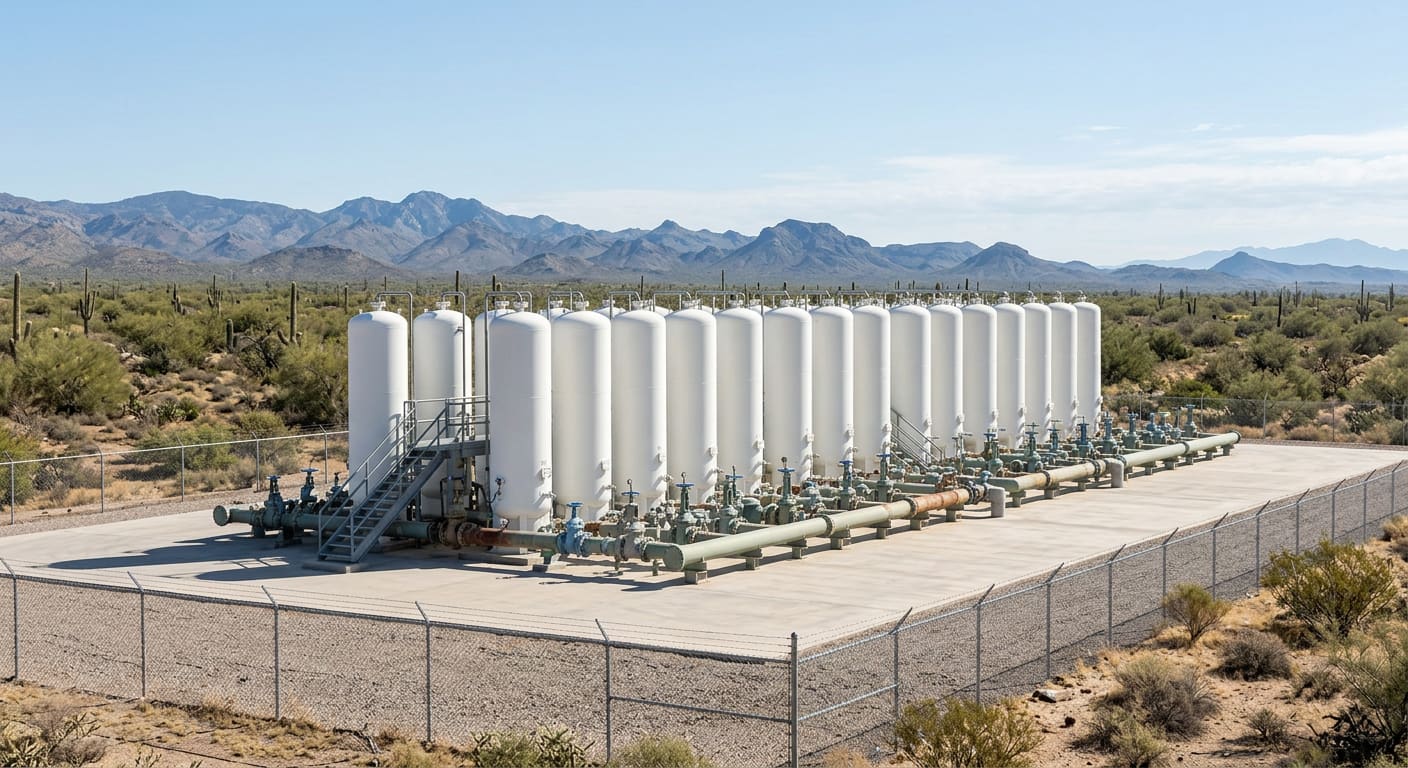
On Tuesday, September 1, a governor, a mayor and a community advisory board that has been meeting since 1995 cut a ribbon in front of nearly two dozen white steel vessels on West Irvington Road. Each tank holds 20,000 gallons and a bed of resin engineered to do one job: catch PFAS molecules as contaminated groundwater passes through. Tucson Water director John Kmiec calls the resin a chemical magnet. It is the newest stage of a cleanup older than most of the subdivisions around it. None of what it produces will reach a kitchen tap for years.
- $27M
- Total cost: a $25 million ADEQ award of federal ARPA funds plus about $2 million from the city
- Sept. 1, 2026
- Ribbon-cutting, 1110 W. Irvington Road
- 40
- Tucson Water wells affected by PFAS; 30 shut down or on emergency standby
- 64 billion gal.
- Treated at TARP since 1994 by the city's count, removing roughly 6,800 pounds of TCE
- 2029-2030
- When Tucson Water expects the public conversation about returning this water to taps
A 1994 Plant With a New Front Door
The Tucson Airport Remediation Project exists because eleven groundwater wells were shut down in 1981 after trichloroethylene turned up in them. TCE is an industrial solvent, used in the aircraft and electronics manufacturing around the airport — including Air Force Plant 44, run by Hughes Aircraft from the 1950s — and disposed of improperly into the 1980s. The EPA added the Tucson International Airport Area to the Superfund list in September 1983, and the plant that gave the cleanup its name was finished in September 1994. A second contaminant, 1,4-dioxane, got its own step in February 2014, when an advanced oxidation facility using ultraviolet light came online.
Then came the third contaminant. PFAS levels rose in the TARP wells, and in 2021 the city stopped sending that water into the drinking system; in 2023 it was routed into the reclaimed water system instead. The new vessels sit ahead of everything else, pulling PFAS out before the water reaches the older equipment. That ordering has a second payoff: the granular activated carbon downstream lasts considerably longer once it is no longer removing PFAS too, stretching out how often that media has to be replaced.
- Ion exchange (new, 2026) ($27 million, Resin vessels, PFAS): Nearly two dozen steel vessels, each holding 20,000 gallons, packed with resin that PFAS molecules bind to. Construction started January 2025.
- Advanced oxidation (2014) (Ultraviolet light, 1,4-dioxane): An advanced oxidation facility that began operating in February 2014 to handle 1,4-dioxane, a contaminant the original plant was not built for.
- The original plant (1994) (Granular activated carbon, TCE, 10 wells): Completed September 1994 to treat TCE from the airport-area plume. Ten remediation wells feed it; the city puts the total treated since then at about 64 billion gallons.
What Doubled Capacity Actually Buys
The new method will let the plant treat more contaminated water every day — perhaps twice as much, Kmiec has said — and the utility hopes to have it fully online by the end of September. What it does not do — not yet, and not for years — is put that water back in anyone's kitchen. Treated TARP water is discharged into the Santa Cruz River and the city's reclaimed system, which irrigates golf courses and parks. It has not gone to drinking-water customers since June 2021.
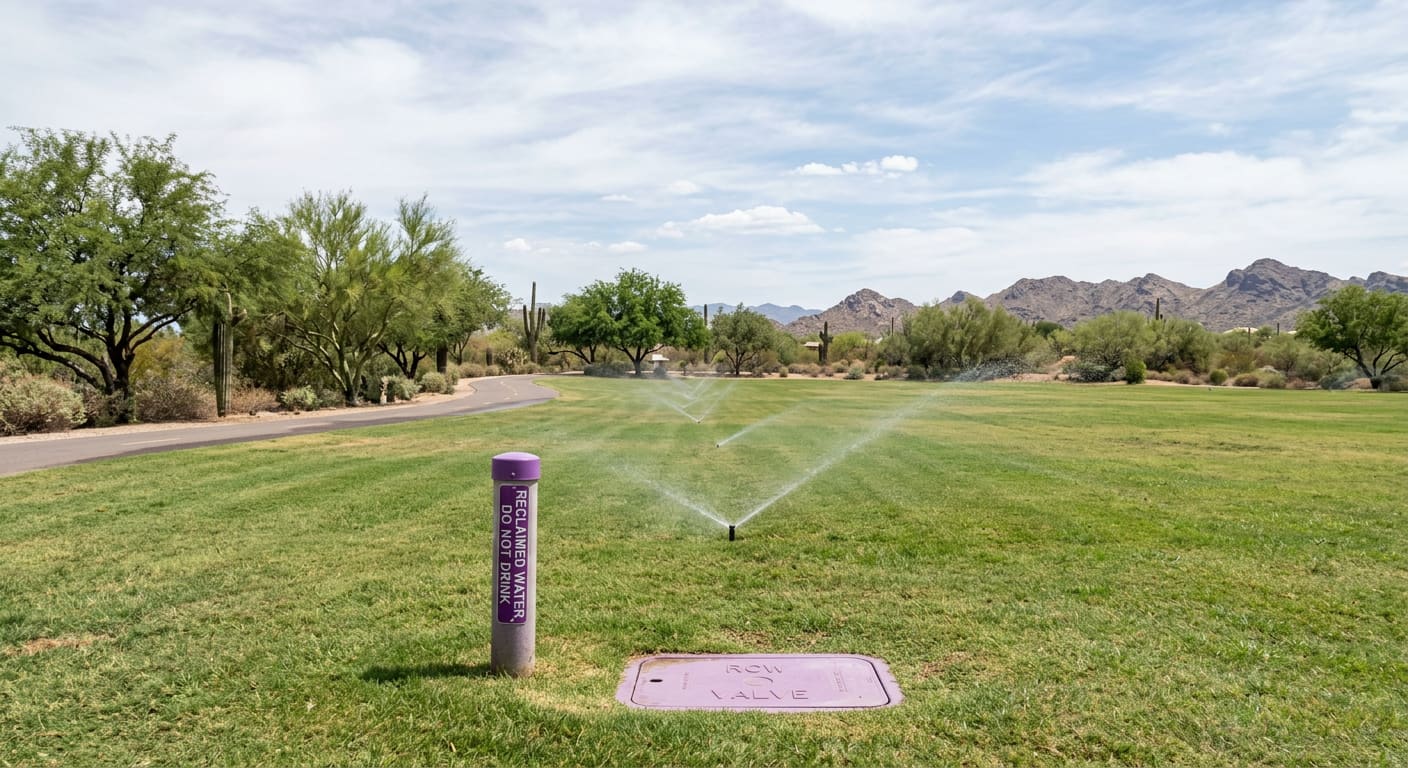
The path back is testing. Kmiec has framed it as several years of results, after which Tucson Water could take them to the mayor and council and ask whether the treated water should rejoin the potable system — a conversation he expects around 2029 and 2030, with the community weighing in rather than staff deciding alone. Until then the argument for the spending is the one he made at the ribbon-cutting: the expansion protects local groundwater and diversifies a supply portfolio that a Colorado River state has reason to diversify.
Who Pays When the Federal Money Runs Out
The $25 million came from the American Rescue Plan Act, awarded through the Arizona Department of Environmental Quality in 2022. That is a finite pot, and the question of what happens afterward already has a partial answer. In 2024 the EPA ordered the U.S. Air Force and the Arizona Air National Guard to address PFAS contamination at the site; the Air Force subsequently agreed to cover half of past water treatment plant costs and half of future pretreatment plant costs once the federal ARPA funds are exhausted.
The regulatory target is less settled. The EPA set the first enforceable national drinking water standard for PFAS in 2024, announced plans in May 2026 to roll back parts of it, and has proposed extending the PFOA and PFOS compliance dates to 2031. In July 2026 Arizona Attorney General Kris Mayes joined 18 other attorneys general in opposing that rollback. Tucson built against the stricter reading; whether the federal floor moves under it is being decided somewhere other than Irvington Road.
The Superfund Question, Answered Specifically
A Superfund site near a house is a question buyers ask, and it gets answered badly when the only available information is the word Superfund. What is on the record here is unusually specific: a named plant at a published address, a well count, three treatment stages with dates attached, a volume of water processed, a mass of solvent removed, a funding split with the Air Force, and a stated timeline for the drinking-water decision. That is more documentation than most pending neighborhood changes offer, and it is all public.
The other point is narrow and worth stating plainly, because it is what people get wrong: water treated at this plant has not been part of Tucson's drinking supply since June 2021. Anyone comparing houses on the south and southwest sides can look up which wells serve an address and what Tucson Water's most recent quality report says, rather than reasoning from a plume map drawn in the 1980s. Whether any of this moves a price is not something anyone can honestly put a number on.
Quick reference (September 8, 2026): Tucson Water held a ribbon-cutting Tuesday, September 1, 2026 for a new PFAS pretreatment system at the Tucson Airport Remediation Project, 1110 W. Irvington Road. It cost about $27 million — a $25 million Arizona Department of Environmental Quality award of federal American Rescue Plan Act funds, awarded in 2022, plus roughly $2 million from the city — and uses nearly two dozen 20,000-gallon vessels of ion-exchange resin ahead of the existing treatment train. Construction began January 2025; the utility hopes to have it fully online by the end of September 2026. Treated water goes to the Santa Cruz River and the reclaimed system serving parks and golf courses, not to drinking-water customers, and has not since June 2021. Schedules, costs and federal PFAS standards change — confirm current details with Tucson Water and ADEQ before relying on any single figure.
Sources
Arizona Public Media (AZPM) — "Tucson completes major expansion to treat forever chemicals" (September 4, 2026) — news.azpm.org/s/104008-tucson-completes-major-expansion-to-treat-forever-chemicals/ — accessed September 8, 2026 (for the $25 million federally funded project awarded in 2022 by ADEQ from American Rescue Plan Act money, the September 1, 2026 ribbon-cutting, the roughly 40 Tucson Water wells affected by PFAS and the 30 shut down or on emergency standby, the 10 TARP wells discharging to the reclaimed system on the Santa Cruz River, TARP's 1994 establishment, the TCE contamination from Hughes Aircraft at Air Force Plant 44, the 2014 start of 1,4-dioxane treatment, the 64 billion gallons treated and 6,800 pounds of TCE removed, the John Kmiec and Yolanda Herrera quotes, the 2024 federal PFAS standard, the May 2026 rollback plan and proposed 2031 compliance dates, the July 2026 opposition by Attorney General Kris Mayes and 18 other attorneys general, and the Air Force agreement to cover half of past treatment plant costs and half of future pretreatment costs after ARPA funds are exhausted)
Arizona Daily Star (tucson.com) — "New technology will speed PFAS removal from Tucson groundwater" (September 2, 2026, updated September 5, 2026) — tucson.com/news/local/environment/article_55a482fc-ed1f-443b-9840-eb3650b9e172.html — accessed September 8, 2026 (for the $27 million total cost split as a $25 million federal grant plus $2 million in city funding, the ion-exchange resin described as a chemical magnet, the nearly two dozen steel vessels holding 20,000 gallons each, Kmiec's statement that the system can treat about twice as much water daily, the 1110 W. Irvington Road address, the end-of-September operational target, the discharge to the Santa Cruz River and the reclaimed system serving golf courses and parks, the June 2021 removal from drinking-water service, and the longer granular activated carbon life)
City of Tucson, Tucson Water — "Tucson Airport Remediation Project" — tucsonaz.gov/Departments/Water/Water-Quality/TARP — accessed September 8, 2026 (for the eleven wells shut down in 1981 after TCE detection, the September 1983 Superfund listing, the 1995 mobilization of the Unified Community Advisory Board, the September 1994 completion of the treatment plant, the February 2014 start of advanced oxidation operations, the June 2022 tenth remediation well, the 2021 removal of treated water from the potable system and 2023 connection to the reclaimed system, the January 2025 start of construction on the PFAS pretreatment system, the granular activated carbon and ion exchange resin treatment train, and the $25 million ADEQ allocation)
U.S. Environmental Protection Agency — "Per- and Polyfluoroalkyl Substances (PFAS): Drinking Water" — epa.gov/sdwa/and-polyfluoroalkyl-substances-pfas — accessed September 8, 2026 (for the April 10, 2024 final national primary drinking water regulation, the maximum contaminant levels of 4 parts per trillion for PFOA and PFOS, and the May 18, 2026 proposals to extend PFOA and PFOS compliance to 2031 and to rescind the limits for PFHxS, PFNA, HFPO-DA and the hazard-index mixture)
U.S. Environmental Protection Agency — "Tucson International Airport Area, Superfund Site Profile" — cumulis.epa.gov/supercpad/SiteProfiles/index.cfm?fuseaction=second.cleanup&id=0900684 — accessed September 8, 2026 (for the contamination sources of former aircraft and electronics manufacturing, aircraft maintenance, fire-drill training and unlined landfills; Air Force Plant 44; the 5 micrograms per liter TCE maximum contaminant level; and the February 2014 advanced oxidation process facility)
AZ Luminaria — "New facility, more wells offline as Tucson intensifies PFAS cleanup efforts" (June 23, 2025) — azluminaria.org/2025/06/23/new-facility-more-wells-offline-as-tucson-intensifies-pfas-cleanup-efforts/ — accessed September 8, 2026 (for the January 2025 construction start on the pretreatment facility and the $25 million ADEQ funding)
KOLD News 13 — "Tucson Water opens PFAS treatment facility" (September 1, 2026) — kold.com/2026/09/02/tucson-water-opens-pfas-treatment-facility/ — accessed September 8, 2026 (for the opening event, the Yolanda Herrera and John Kmiec remarks, and Kmiec's statement that treated groundwater could become drinking water after several years of testing with community conversations expected in 2029 and 2030)
KGUN 9 — "Arizona governor, Tucson mayor cut ribbon on expanded PFAS water treatment facility" — kgun9.com/news/community-inspired-journalism/westside-news/arizona-governor-tucson-mayor-cut-ribbon-on-expanded-pfas-water-treatment-facilit — accessed September 8, 2026 (for Governor Katie Hobbs and Mayor Regina Romero attending the ribbon-cutting, the $27 million American Rescue Plan Act funding context, and the treated water going to parks and golf courses)
All figures are current as of September 8, 2026; construction schedules, costs, funding agreements and federal drinking water standards change, so readers should confirm current information before relying on any single figure. This post is for informational purposes only and is not an offer to sell or a solicitation of an offer to purchase real estate. Kyle Berglund and Tierra Antigua Realty fully support and comply with the Fair Housing Act and the Equal Opportunity Act.
Topics
- New Development
- Infrastructure
- Tucson Water
- PFAS
- TARP
- Superfund
- Water
- Tucson