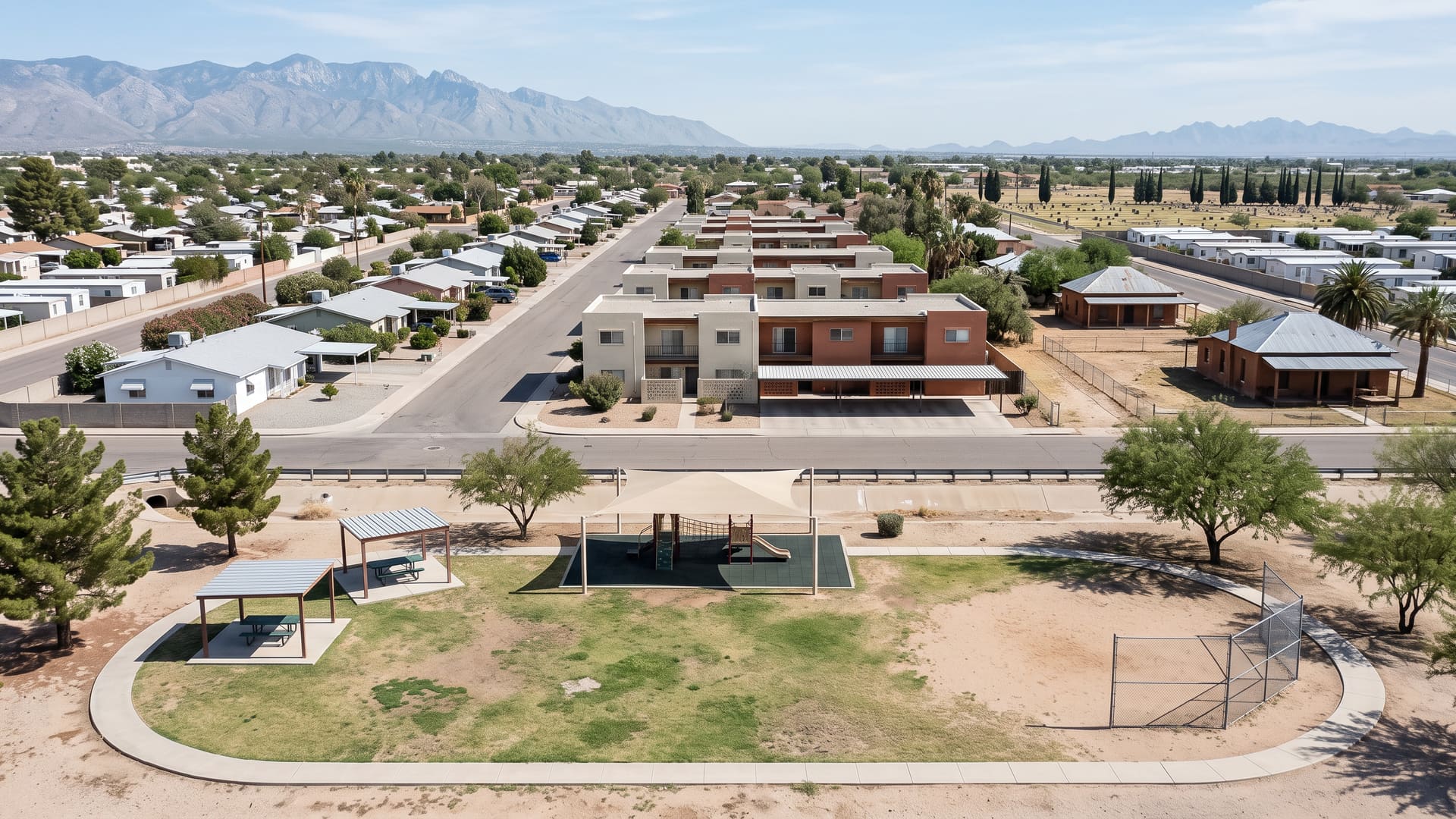
Cherry Avenue Homes for Sale — Tucson, AZ
Cherry Avenue is a square mile and a quarter on Tucson's south side — a mile deep between East Irvington Road and East Drexel Road, and a mile and a quarter wide between South Park Avenue and South Tucson Boulevard, with South Campbell Avenue running the full length of the middle.
Key facts
- Jurisdiction
- Tucson, Arizona — incorporated city, Pima County
- Average sale price
- $248,000
- Price range
- $125K – $325K
- School district
- Sunnyside USD (Rivera & Esperanza Elementary, Apollo Middle or Sierra K-8, Sunnyside High)
- Approximate population
- ~9,600
- Approximate number of homes
- ~3,100 homes
What defines this area
- Cherry Avenue Park and the Cherry Avenue Recreation Center
- Rivera and Esperanza Elementary Schools inside the boundary
- A paved accessible path for walking, cycling and dogs
- Desert Shadows Park toward the north-east corner
- Inside Tucson International's mapped avigation disclosure area
- Campbell Avenue running the full length of the middle
- Irvington Road north, Drexel Road south, Park Avenue west, Tucson Boulevard east
- Homes built 1940-2006 to a median year of 1976
- Living areas 604-2,015 sq ft, median 1,212
- Thirty-two townhouses among 125 recent closings
- Townhouses built between 1963 and 1981, every one of them
- Seventeen of 28 plats recorded between 1973 and 1986
- Emery Park, platted in 1928 and the oldest filing here
- Desert Shadows platted across four filings, 1973-1978
- Summerfield platted across three filings, 1975-1977
- Mira Loma Townhouses, two filings recorded the same day in 1980
- Nearly half the housing stock dating from the 1970s
- 1,496 of 2,335 parcels in R-2, a medium-density zone
- South Lawn Cemetery, about an eighth of the ground
- Rodeo, Desert Shadows, Canada and Calle Faena Washes
- No Davis-Monthan noise district over any of it
- Wholly inside the City of Tucson, entirely in Ward 5
About Cherry Avenue
Cherry Avenue is a square mile and a quarter on Tucson's south side — a mile deep between East Irvington Road and East Drexel Road, and a mile and a quarter wide between South Park Avenue and South Tucson Boulevard, with South Campbell Avenue running the full length of the middle. The name is on the street, the park and the recreation center alike: South Cherry Avenue runs north from the middle of that block to the Irvington edge, a little west of centre, and Cherry Avenue Park, the Cherry Avenue Recreation Center and Rivera Elementary School all stand on it. The City of Tucson registers an active neighborhood association here under the same name, in Ward 5, over the same ground, and no other registered association covers any part of the interior. Every parcel inside is City of Tucson. One thing to look into before making an offer here: the whole of this boundary falls inside the Avigation Easement and Disclosure Area that the Tucson Airport Authority draws around Tucson International and Ryan Airfield, off the FAA's traffic pattern airspace. Pima County and the City of Tucson both carry that layer, every vertex of this boundary and every interior point tested falls inside it, and the airport's mapped grounds come within about a mile and a quarter with its terminal about a mile and three-quarters out. What the area means is narrower than its name suggests, and worth being precise about. It is the ground over which the Airport Authority asks for avigation easements and noise disclosure statements as a condition of new development and rezoning. It does not mean an easement is recorded against any particular parcel, and Arizona's mandatory written seller disclosure for airport proximity applies to military airports, which Tucson International is not. So the things to check on a specific house are the title report, for an easement actually recorded against that parcel, and the Airport Authority's own current mapping, which is the live version — Pima County documents its copy of the layer as no longer maintained. Davis-Monthan Air Force Base is the other side of that question and the answer there is different: the county's base vicinity polygon stops about nine-tenths of a mile short of this boundary, and neither its Davis-Monthan noise control districts nor its Air Installations Compatible Use Zones mapping reaches any of it. What sells here is mostly 1970s housing. The 125 closings recorded inside this boundary over the last three years ran $125,000 to $325,000 against a $261,000 median and a $247,808 average, on a $259,000 list median. The homes behind them were built between 1940 and 2006 to a median year of 1976, and they took a median 18 days on market against 21 counting relists, at a sale-to-list ratio of 0.99. Forty of the 125 closed above asking and 43 took a price reduction first. Living areas ran 604 to 2,015 square feet with a 1,212-square-foot median, and the median price per square foot was $202.53. What makes this market unusual is its attached half. Thirty-two of the 125 sales — a quarter of them — were townhouses, where ten miles east at Harrison East-South the comparable share is eight percent. Ninety-two were detached houses and one was a condominium. And the townhouses are the dearer ground by the foot: the detached houses closed at a $274,250 median on 1,295 square feet, or $202.52 a square foot, while the townhouses closed at $206,750 on 971.5 square feet — three-quarters of the floor area — at $211.53 a square foot, nine dollars more. Every one of those 32 townhouses was built between 1963 and 1981, to a median year of 1969, so the attached stock here belongs entirely to the first two decades of the record while the detached stock runs on to 2006. Across the price bands, age barely moves at all: the median year built reads 1969, 1970, 1978, 1978 and 1976 from the bottom of the market to the top. Floor area is what separates them, climbing with every band from 684 to 1,014, 1,058, 1,358 and 1,519 square feet. The zoning is unusual for a Tucson neighborhood of this age. Of the 2,335 parcels inside the boundary, 1,496 — 64 percent — are in R-2, which the City's Unified Development Code describes as a medium-density residence zone and which permits single-family, middle housing and multifamily development alike. Another 727 are in R-1, the low-density residence zone — which is not a detached-only district either, having long allowed a second unit on a large enough lot. Thirty are C-1 and 19 are C-2, the low-intensity and general commercial zones; 26 are R-3, the high-density residence zone; 23 are MH-1, the mobile home zone; and 14 are O-3, the mid-rise office zone. Almost everywhere else this site covers is R-1 by a wide margin. Read any of that as what the ground is permitted to hold rather than as an account of what was built on it: most of the housing here predates the current code, and Tucson's middle housing amendment — adopted in December 2025 and effective 1 January 2026 — now permits townhomes across essentially every residential zone in the city, R-1 included. The building went up in one long wave. Pima County records 28 separate plats wholly inside, running from Emery Park in March 1928 and the Tucson Memorial Park South Lawn cemetery plat in April 1939 through Irvington Park in 1952, Verde Meadows and South Manor in 1960 and International Mobile Home Park in April 1968 — and then seventeen of the 28 land between April 1973 and September 1986: Garden Park, The Bantam, Desert Shadows in four filings, Farrell Park, Summerfield in three, Mira Loma Townhouses in two recorded on the same day in May 1980, Centre Pointe Plaza and Amherst South among them. After that the record thins to Park Avenue Estates in January 2000, Sierra Breeze in April 2007 and two cremation garden additions to the cemetery in 2013 and 2014. The census estimate over the same ground says the same thing from the other side: of the 3,138 housing units it counts, 311 predate 1970, 1,557 — very nearly half — date from the 1970s, 610 from the 1980s, and then 311, 285, 60 and four. Public ground is scarce and specific. There are two parks, both inside the boundary: Cherry Avenue Park at 4.99 acres in the northern half and Desert Shadows Park at 5.98 acres toward the north-east corner, which is 10.97 acres between them, 1.4 percent of the whole. Beside the first run 1,397 feet of six-foot paved path at the Cherry Avenue Recreation Center, open and marked for walking, bicycles and dogs, and recorded as accessible. The largest single piece of open ground is not a park at all: South Lawn Cemetery at 5401 South Park Avenue takes up about 100 acres in the south-west, running back from the Park Avenue edge, and is roughly an eighth of the boundary. Its oldest plat was recorded in April 1939 under the name Tucson Memorial Park South Lawn, covering 54.51 acres, with cremation garden additions following in 2013 and 2014. Seven mapped wash reaches cross the ground under four names, and the setbacks they carry are the ones a builder or a buyer would have to work around: Rodeo Wash at a 75-foot setback in the county's 2,000-to-5,000-cubic-feet-per-second class and a second reach at 50 feet, Desert Shadows Wash in three reaches at 50 and 25 feet, Canada Wash at 25 feet and Calle Faena Wash at 25 feet. Rodeo Wash is channelized here — the county records its banks as soil cement rather than natural. The City of Tucson is the recorded owner of 40 parcels inside the boundary, and 32 of them belong to its Housing and Community Development department. Eight of those were bought under the federal Neighborhood Stabilization Program, HUD's response to the mortgage foreclosure crisis, seven in 2009 and one in 2010, for $698,718 in total across a $63,665 to $100,300 range — three in Summerfield, three in Amherst South and two in Desert Shadows. Three have since been sold and five are still recorded as held. Four more City parcels are Parks holdings, two belong to Tucson Water, one is a drainageway and one is held by the Convention Center. School assignment is Sunnyside Unified throughout, and it divides three ways inside the boundary. Campbell Avenue is the line: Rivera Elementary serves the ground west of it and continues to Apollo Middle School, Esperanza Elementary serves the ground east of it and continues to Sierra K-8, and a pocket in the south-west is assigned to the Ocotillo early-learning center and then to Sierra as well. Sunnyside High School and Star Academic High School cover the whole boundary, as do the Gallego primary and intermediate fine arts magnet schools. Three campuses stand inside it: Esperanza Elementary on East Bantam Road, Rivera Elementary on South Cherry Avenue, and Alta Vista High School — a charter, and the one school here that is not one of Sunnyside's — on South Campbell Avenue. The county's attendance mapping labels two of these schools in ways the district itself does not, and where they differ this page follows the district: Sierra is K-8 rather than the county layer's 2-8, and Ocotillo is an early-learning center for the district's youngest children rather than carrying the county's PK-1 span. Assignments are drawn by address and they change, so confirm the assignment for a specific address with the district before relying on it. Note too that the county's association register carries a school-district field on this ground reading TUSD, which the county's own attendance-area mapping contradicts everywhere inside the boundary.
Cherry Avenue is an affordable neighborhood in the City of Tucson, on the south side of metro Tucson, Arizona, served by Sunnyside USD (Rivera & Esperanza Elementary, Apollo Middle or Sierra K-8, Sunnyside High). Homes trade in the $125K – $325K range, with an average sale price of $248,000 across roughly 3,100 homes and a population of about 9,600. Kyle Berglund, REALTOR® at Tierra Antigua Realty, represents buyers and sellers here — call (520) 250-8904.
Compare nearby Tucson neighborhoods
- Rita Ranch — Affordable, average $370,000
- Sahuarita — Affordable, average $360,000
- Rancho Sahuarita — New Build, average $370,000
- Madera Highlands — Affordable, average $400,000
- Green Valley — 55+, average $315,000
- Corona de Tucson — Affordable, average $380,000
- Picture Rocks — Affordable, average $300,000
- South Tucson — Urban, average $192,000
Frequently asked questions
What city is Cherry Avenue in?
Cherry Avenue is in the City of Tucson, Arizona. Jurisdiction: Tucson, Arizona — incorporated city, Pima County.
What is the average home price in Cherry Avenue, Tucson?
The average sale price in Cherry Avenue is approximately $248,000, with homes generally ranging from $125K – $325K. These are rounded, long-run estimates aggregated from MLSSAZ closed sales through the LiveBy data connection, over this neighborhood's own boundary, for general orientation — not a current-month figure. Averages are means and can be skewed by a small number of high-value sales, so individual home values vary materially.
What school district serves Cherry Avenue?
Cherry Avenue is served by Sunnyside USD (Rivera & Esperanza Elementary, Apollo Middle or Sierra K-8, Sunnyside High). Confirm exact school assignments by specific address, as boundaries can change.
Is Cherry Avenue a good place to live?
Cherry Avenue is an affordable neighborhood in the City of Tucson, on the south side of metro Tucson, Arizona, known for Cherry Avenue Park and the Cherry Avenue Recreation Center, Rivera and Esperanza Elementary Schools inside the boundary, a paved accessible path for walking, cycling and dogs, Desert Shadows Park toward the north-east corner. Cherry Avenue is a square mile and a quarter on Tucson's south side — a mile deep between East Irvington Road and East Drexel Road, and a mile and a quarter wide between South Park Avenue and South Tucson Boulevard, with South Campbell Avenue running the full length of the middle. It has an approximate population of ~9,600 across roughly ~3,100 homes.
What kind of homes are for sale in Cherry Avenue?
Cherry Avenue is an affordable submarket where homes generally trade between $125K – $325K, with an average sale price of $248,000.
Who can help me buy or sell a home in Cherry Avenue?
Kyle Berglund, a licensed Arizona REALTOR® (License #SA668710000) at Tierra Antigua Realty, specializes in Cherry Avenue and the greater Tucson area. Call (520) 250-8904 or email contact@kyleberglund.com for a free consultation.