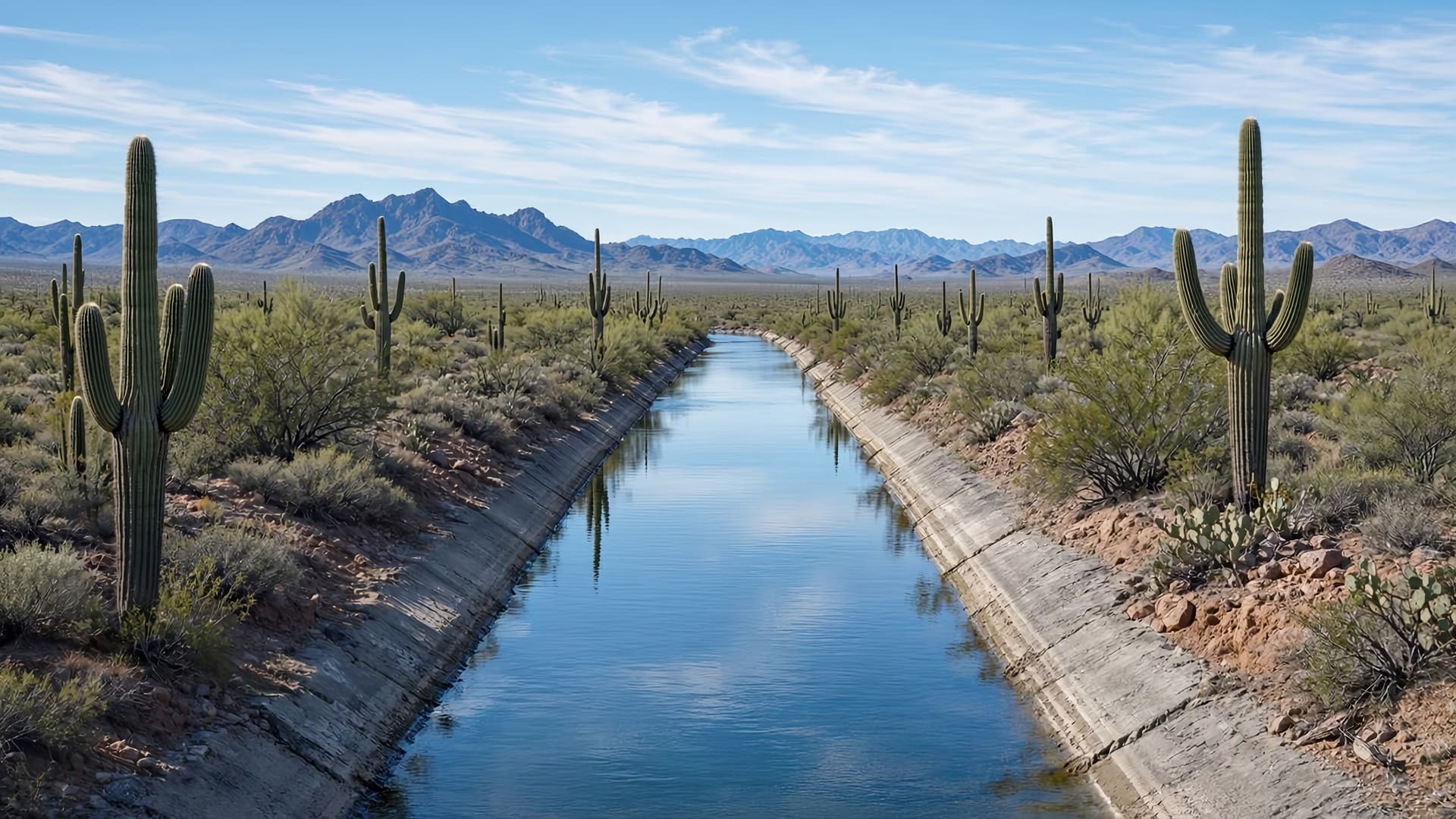
Oro Valley's Colorado River Share Drops 14% in 2027. What Owners Will Notice.
Oro Valley gets 14% less Colorado River water in 2027. How the town covers the gap, where water rates are headed, and what it means in Rancho Vistoso.
A federal shortage takes 1,443 acre-feet out of the town's canal allocation in 2027. Where the replacement water comes from, what bills are set to do, and what Rancho Vistoso owners should check.
One slide carried the whole story. On Wednesday, November 18, 2026, Oro Valley Water Utility Director Peter Abraham put two numbers in front of the Town Council: 10,305 acre-feet a year allocated from the Central Arizona Project canal, and 8,862 acre-feet delivered in 2027. The slide's own label for the difference reads "represents a 14% cut." That is 1,443 acre-feet of Colorado River water the town holds a contract for and will not receive in 2027.
Then came the sentence most owners will care about. "That means in calendar years 2027 and 2028, from a water resource perspective, our customers don't notice anything," Abraham told the council, according to Tucson Daily Brief's report on the meeting. Both statements hold at once, and the reason is underground.
- 14%
- Cut to Oro Valley's 2027 canal delivery, per the utility's slide
- 1,443 acre-feet
- The gap between 10,305 allocated and 8,862 delivered
- 21,609
- Customer connections on the utility at the end of June 2025
- 3% to 5%
- Yearly rate increases the director told the council to expect
Where the 14% Comes From
The cut starts on the river. On August 21, 2026, the Interior Department issued its Record of Decision for Colorado River operations after 2026, along with operating guidelines for 2027 and 2028. Its announcement says deliveries to the three Lower Basin states will be reduced by 1.25 million acre-feet in calendar year 2027. Under a sharing proposal among those states, Arizona gives up 760,000 acre-feet, California 440,000 and Nevada 50,000.
Arizona's share of that reduction lands mostly on the canal. Nolie Templeton, who manages Colorado River policy and analysis for the Central Arizona Project, presented at the same council meeting. Her slides show how the loss falls by priority: the lowest-priority water, including the agricultural pool, is cut entirely, tribal priority water by an estimated 10%, and municipal and industrial priority water by an estimated 14%. Oro Valley's 14% is that last figure applied to its own contract. The slide is marked "Preliminary data and analysis; for illustrative purposes only."
This is new for the town. The utility's April 2026 annual report says the Tier 1 shortage in place on the river "has no effect on Oro Valley's CAP allocation." The 2027 rules reach a priority level the earlier shortages did not. The canal's slides show why: as of November 1, 2026, Lake Mead and Lake Powell were each 26% full, and the water year that ended in September brought Lake Powell 39% of its average inflow.
Why the Tap Does Not Change in 2027
Oro Valley does not pipe its canal water straight to houses. According to the annual report, the utility sends its entire 10,305 acre-feet to recharge basins in the Tucson Active Management Area, where the water sinks into the aquifer. Some of it is pumped back out and moved through Tucson Water's pipes to four connection points on the Oro Valley system. Some offsets the groundwater the town's own 18 wells pump, which state rules require the utility to replace. What is left stays underground as long-term storage credits.
The report's 2025 figures show how much room that leaves. The utility produced 4,629 acre-feet from its wells and delivered 2,863 acre-feet of recovered canal water, for 7,492 acre-feet of drinking water in all. Reclaimed water, which runs in a separate system, added 1,982. So even the reduced 2027 delivery of 8,862 acre-feet is more than the town's drinking-water system used in 2025. In that year about 2,500 acre-feet went into storage, and Abraham's slide projects another 2,305 acre-feet stored in 2027, cut included.
The missing 1,443 acre-feet is covered by what the slide calls shortage firming. The Arizona Water Banking Authority, a state agency, has spent decades storing water underground for exactly this case. The annual report says it holds more than 600,000 acre-feet in the Tucson area, to be made available to municipal providers when canal deliveries are curtailed. Tucson Daily Brief reported that under an agreement the council approved earlier, the Authority will make up Oro Valley's shortfall. Behind that sit the town's own storage credits and its groundwater. Abraham told the council the town has roughly 150 years of groundwater as a backup, the Brief reported, and that it tries not to lean on it.
The Fine Print on "Through 2028"
The council packet carries its own caveats, and they are worth reading before treating two years as settled. The first is the Water Bank policy itself. The canal's slide describes it as a one-year extension of a 2019 firming policy, "through 2027," based on water orders for 2027 and "contingent upon Lower Basin agreement to share reductions." That agreement among Arizona, California and Nevada was still being negotiated when the slides were shown.
The second is a lawsuit. Nevada sued over the federal plan on August 24, 2026, according to a Central Arizona Project presentation to the Pima Association of Governments. The slides shown in Oro Valley say the canal's operator is entering that litigation and that the State of Arizona has moved to intervene.
The third is the calendar. The federal guidelines cover two years at a time, and the slides say the decision process for 2029 and 2030 begins no later than October 2027. Abraham told the council he could not predict whether deeper cuts follow 2028, the Brief reported. One number on the canal's slides points the other way: the November forecast for water year 2027 inflow moved up to 104% of average.
What Bills Are Set to Do
Receiving less water does not make it cheaper. Asked at the meeting whether the cut would save money, Abraham said probably not, because the canal's costs do not shrink and each acre-foot ends up costing more, according to the Brief. He told the council to expect rate increases of 3% to 5% every year, and said the utility aims to stay the lowest-priced water provider in Southern Arizona.
Start with today's bill. The rate schedule posted on the utility's page, labelled effective July 4, 2026, charges a home on a 5/8-inch meter a base rate of $25.17 a month. Water is then billed in four tiers: $3.02 per 1,000 gallons for the first 7,000 gallons, $5.02 up to 16,000, $8.17 up to 32,000 and $12.32 above that. A groundwater preservation fee adds $1.00 per 1,000 gallons. The annual report says 84% of customers are on that meter size, and it uses 7,000 gallons a month as its benchmark. That bill works out to $53.31 before tax, and the report put this year's change at $1.86 a month, or 3.6%.
Carry the director's range forward five years and the same 7,000 gallons costs about $61.80 at 3% a year and about $68.04 at 5%. That is this post's arithmetic on his range, not a town forecast. The council sets rates one year at a time.
What a Smaller Canal Share Changes for Rancho Vistoso Owners
Rancho Vistoso is the master-planned community across the north end of Oro Valley, built out from the 1990s through the 2010s. Its villages range from townhomes to custom lots, with golf, community pools, association-maintained parks and a trail network. Association terms vary by village, under the Vistoso Community Association as the master association.
At the tap, nothing changes in 2027 if the director's read holds. The council item was a presentation with no action attached, and nothing in the packet proposes a limit on household use. Confirm the provider named on the water bill before assuming any of this applies to a given address.
On the bill, the tiers matter more than the base rate. A house with desert landscaping that stays under 7,000 gallons pays the lowest rate on every gallon. A lot with turf and a pool can run into the third tier in June, where each 1,000 gallons costs $8.17 before the preservation fee. A percentage increase lands hardest on the accounts that use the most, so the cheapest hedge an owner has is the irrigation timer.
The association pays a water bill too. The town's schedule puts irrigation accounts on the same four tiers as houses, and common-area landscaping in a community with parks and medians is an irrigation account that owners fund through assessments. A buyer can see that number. Under A.R.S. 33-1806, in a planned community with 50 or more properties the association must deliver its current operating budget, and its most recent reserve study if it has one, within ten days of written notice of a pending sale. Read the water line, and ask what the board assumed for rate increases.
Golf is a separate question from the canal. The utility's annual report says its reclaimed system irrigates four 18-hole golf courses, the athletic fields at Naranja Park and one elementary school field, and that the drinking-water system is "completely isolated" from it. Reclaimed water is treated wastewater the town owns. Abraham's slide lists it on its own line, with an estimated entitlement of 1,800 acre-feet, apart from the canal allocation the 14% applies to. If a fairway view is part of why you are buying, ask the course or the association which system waters it.
New supply next door is the last piece. Abraham told the council the town has enough water for everything it expects to build inside its current boundaries, the Brief reported. If Oro Valley annexes large areas that have no water service, developers will have to "bring the water with you." Separately, the annual report expects the Northwest Recharge, Recovery and Delivery System to be finished in fiscal year 2027. That pipeline lets the town deliver up to 4,000 more acre-feet of recovered canal water a year, and every acre-foot it carries is one the town's wells do not have to pump.
For what homes in Rancho Vistoso cost and how the community has changed, see this site's Rancho Vistoso page.
Before the 2029 Rules Get Written
The short version for an owner: the cut is real, the tap is covered for now, and the bill keeps climbing a few percent a year either way. Pull a year of statements and see which tier your summer use reaches. If you are buying, read the association's budget for its water line. And watch October 2027, when the next round of river rules starts. That is the date that decides whether "our customers don't notice anything" still holds in 2029.
Sources
Town of Oro Valley — Town Council Regular Session agenda packet, November 18, 2026 (Presentation 1: "Update and discussion on Bureau of Reclamation Record of Decision for the Management of the Colorado River for the next 10-years"; Central Arizona Project and Water Utility slides) — https://public.destinyhosted.com/orovadocs/2026/TC/20261118_1140/AGENDApacket_11-18-26_0332_1138.pdf — accessed November 28, 2026
Tucson Daily Brief — "Oro Valley's Colorado River water will be cut in 2027; stored water will cover the gap for two years" by Nicholas De Leon (November 18, 2026) — https://tucsondailybrief.com/news-reports/orovalley-2026-11-18.html — accessed November 28, 2026
Town of Oro Valley — Water Utility Annual Report, April 2026 — https://www.orovalleyaz.gov/files/assets/public/v/1/documents/water-utility/water-utility-commission-reports/2026-annual-report.smt.paa.mv.wuc.da.pdf — accessed November 28, 2026
Town of Oro Valley Water Utility — Water Rates and Groundwater Preservation Fee Schedule, effective July 4, 2026 — https://www.orovalleyaz.gov/files/assets/public/v/1/documents/water-utility/rates-and-fees/water-rates-2026.pdf — accessed November 28, 2026
U.S. Department of the Interior — "Interior Department Finalizes Plans for 2027-2028 Colorado River Operations" (August 21, 2026) — https://www.doi.gov/pressreleases/interior-department-finalizes-plans-2027-2028-colorado-river-operations — accessed November 28, 2026
Central Arizona Project — "Colorado River Water Supply Report & Post-2026 Update," presentation to the Pima Association of Governments Environmental Planning Advisory Committee (September 3, 2026) — https://pagregion.com/wp-content/docs/pag/2026/09/PAG-EPAC-2026-09-03-Item-4-Presentation-Colorado-River-Allocations-and-Impacts.pdf — accessed November 28, 2026
Arizona State Legislature — A.R.S. 33-1806, resale disclosure in planned communities — https://www.azleg.gov/ars/33/01806.htm — accessed November 28, 2026
This post is for informational purposes only and is not an offer to sell or a solicitation of an offer to purchase real estate. Water allocations, rates and policies change; confirm current figures with the Oro Valley Water Utility before relying on them.
Related reading
Posts about the same places, or in the same category, nearest in time. Each carries its own sources and revision date.
- Innovation Park Land Sold: 333 Acres, $21.25 Million — August 29, 2026 · Local Real Estate News · also about Rancho Vistoso
- Catalina Foothills Estates CC&Rs: Check Every Lot — November 19, 2026 · Local Insights
- Pima Canyon Estates and Pima County's Hillside Rules — November 19, 2026 · Local Insights
- Downtown Links Puts Sixth Street Under the Railroad — November 12, 2026 · Local Insights
Topics
- Local Insights
- Oro Valley
- Rancho Vistoso
- Oro Valley Water Utility
- Colorado River
- Central Arizona Project
- Water Rates