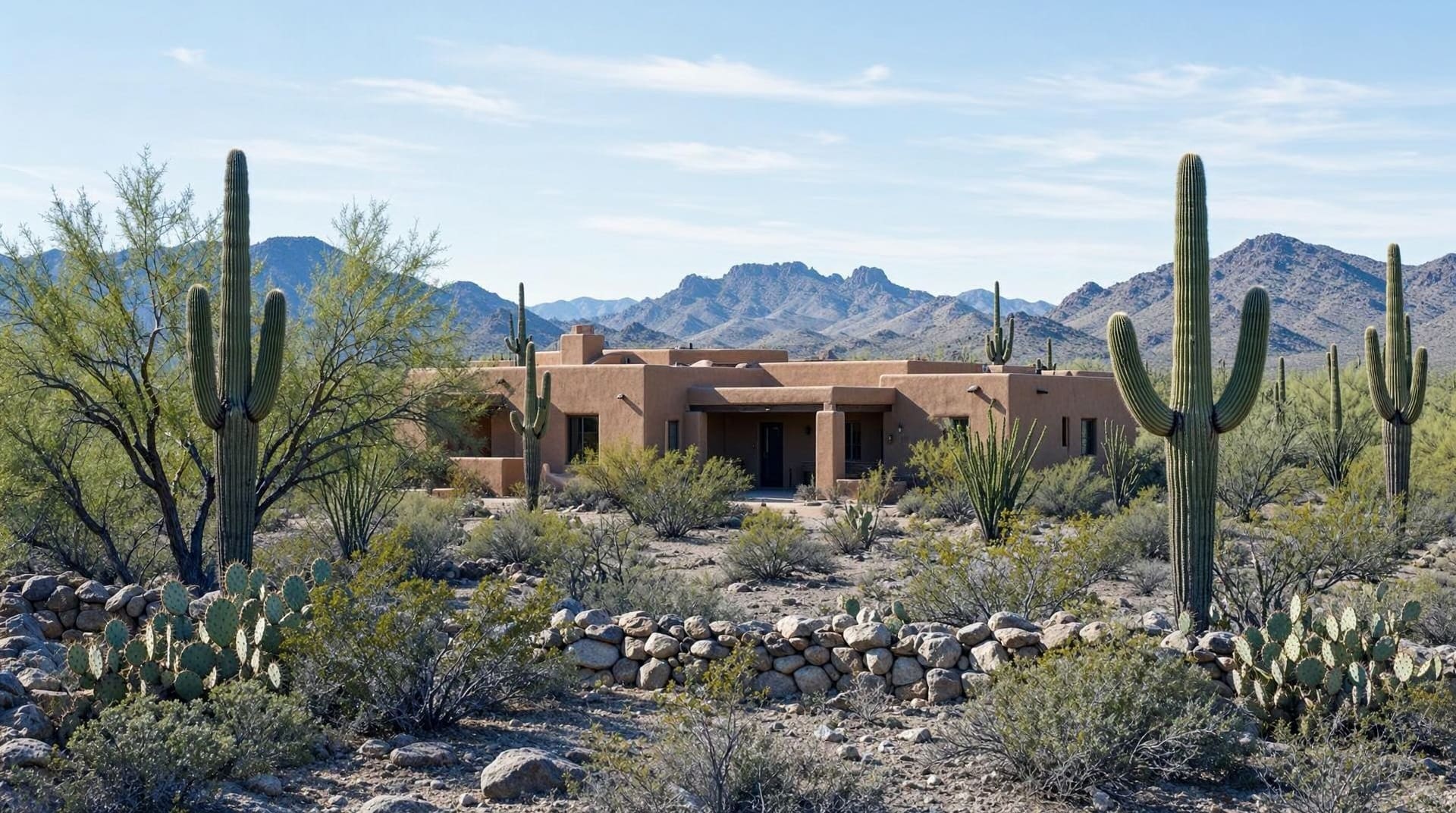
In Catalina Foothills Estates, the Lot Next Door May Follow Different Rules
In Catalina Foothills Estates, deed restrictions bind some lots and not others. The 30-foot setback, 18-foot height cap, plan review, and how to check a lot.
Areas 5 and 6 still carry recorded restrictions that renew every ten years. In Areas 1 through 4, a lot is bound only if an owner recorded a reinstatement, and only those lots go through the association's plan review.
The form the Catalina Foothills Association gives owners in Areas 1 through 4 opens with an admission. Its recitals say the first four numbered subdivisions of Catalina Foothills Estates were once covered by covenants, conditions and restrictions, and that those original restrictions "subsequently expired in the 1980s." What replaced them is not a blanket rule over the neighborhood. It is a declaration that each owner can choose to sign, notarize and record against their own lot.
So in the oldest part of the Foothills, the answer to "what can I build here?" depends on the lot, and sometimes on whoever owned it before you. The association's own page puts it plainly: the majority of properties in Areas 5 and 6 are subject to CC&Rs, and "many" properties in Areas 1 through 4 have reinstated theirs. Many is not all, and the page tells owners to email the association's secretary to find out whether a given property has restrictions.
- 30 feet
- Minimum distance from any property line for a house, garage or accessory building under the restrictions
- 18 feet
- Height cap above adjacent natural grade in the reinstated Areas 1–4 declaration
- 6 feet
- Maximum height of a wall, coping or hedge in Areas 5 and 6
- 2030
- Year the reinstated Areas 1–4 restrictions first come up for automatic renewal
Two Sets of Rules Inside One Subdivision
The association enforces the deed restrictions for Areas 1 through 6 and any other covenants in areas that have no board of their own. Areas 7 through 9 are reviewed by their own homeowners associations. Within Areas 1 through 6, though, there are two different documents, and they work differently.
Areas 5 and 6 are Catalina Foothills Estates No. 5 and No. 6, recorded in Book 14 of Maps and Plats at page 22 and Book 16 at page 36. Their declaration did not lapse. It ran to the start of 1989 and continues automatically for successive ten-year periods, and the record owners of 51% of the front footage it covers can release, change or modify the restrictions during each period. It is detailed. Every dwelling, garage, building, swimming pool, wall or coping, overhangs included, has to sit at least 30 feet from every property line. A wall or coping may not exceed six feet, and a hedge planted to act as one is held to the same setback and height. Trees and other plantings have to be kept trimmed so they do not materially interfere with the principal views from neighboring building sites. Tennis courts are prohibited unless the approving agent waives the restriction, and a house damaged by fire has to be repaired, replaced or removed within six months.
The enforcement clause in the Areas 5 and 6 declaration is the one to read twice. An owner in breach gets ten days' written notice to fix it. If it is not fixed, a Notice of Violation of Covenants is recorded with the Pima County Recorder, and the declaration itself warns that the notice "may place a cloud on the title" that can limit the owner's ability to convey full legal title. In other words, an unresolved violation does not stay between neighbors. It shows up when the house is sold.
What a Reinstated Lot in Areas 1 Through 4 Agrees To
The reinstatement declaration for Areas 1 through 4 is four pages long, and most of it is about building. A building site has to be at least 43,500 square feet where there is no sewer service and 36,000 square feet where there is. No house, garage or accessory building may sit closer than 30 feet to any property line, and none may stand more than 18 feet above the adjacent natural grade, with fences and similar structures excluded from both limits. Geodesic, prefabricated, relocated and modular buildings are barred. New construction has to be approved by the association's architectural review board, and owners are to keep the native vegetation on the lot except where construction requires clearing it.
Two clauses change how a buyer should read it. First, the restrictions apply to new construction, modifications and uses from the date the declaration is recorded, and "shall not affect existing structures and uses." A house that already sits 20 feet from a line is not made to move. An addition that would push closer is a different matter. Second, enforcement is not reserved to the association. Any property owner covered by the declaration, or the association, can sue to enforce it. The prevailing party is awarded its reasonable costs and attorney's fees, and that award becomes a lien on the lot. Failing to enforce a restriction once is not a waiver of the right to enforce it later.
The duration clause is what makes each lot's status worth checking, not assuming. The restrictions run until midnight on December 31, 2030, then extend automatically in ten-year periods unless the owner of a lot records an instrument terminating them as to that lot. Amending them takes owners of 75% of the covered land. A lot can therefore move in either direction over time: an owner can opt in by recording the declaration, and an owner can record their way back out at a renewal. What a seller remembers about the lot is a starting point. The recorded documents are the answer.
How Plan Review Works on a Bound Lot
Every owner with CC&Rs in Areas 1 through 6 has to submit construction plans to the association's Architectural Review Committee before starting, and the committee has to approve any change made to those plans during the project. The submittal covers new construction, additions, exterior remodeling and other improvements, with drawings that meet the association's Design Standards and Revegetation Standards. The association recommends surveying the lot first, noting that boundaries can differ from what a title company assumed, and asks owners to schedule a final site review when the work is done.
Approval from the association is architectural only. Plans still need Pima County's zoning and building approvals, and the association's guidance has owners take ARC-approved plans to the county for permitting. Timing matters as well: the board does not meet in July or August, so review of submissions made after June 1 may be delayed, and variance requests made after May 1 may wait. A variance request has to be justified by a physical condition of the property, the association says, not by the owner's needs.
Solar is the one place where state law draws a line around all of this. A.R.S. § 33-439 makes void any covenant in a deed or similar instrument, entered into after April 17, 1980, that effectively prohibits installing or using a solar energy device. The association publishes its own Solar Energy Devices Guidance for owners in Areas 1 through 6, and an owner planning panels should read it with the statute beside it.
What the Patchwork Means for Buying in Catalina Foothills Estates
Catalina Foothills Estates is the original Foothills subdivision, in unincorporated Pima County, laid out on the bajada north of River Road roughly between First Avenue and Hacienda del Sol Road. Construction began on the first numbered area in 1935, and this site's page for it describes oversized lots planned to keep the surrounding desert intact and an architectural character shaped by Josias Joesler. There is no master association or amenity club.
For a buyer, the practical consequence is that two lots on the same street can carry different obligations. If the lot you are buying is bound, an addition, a new wall or an exterior remodel goes through the committee before it goes to the county, and the 30-foot setback and 18-foot height cap shape what can be added. If it is not bound, the county's zoning code is the limit. Either way, the neighbors' status matters to you: the reinstatement declaration lets any covered property owner enforce it, so whether the lots around yours are bound affects what you can hold a neighbor to, and what a neighbor can hold you to. The association's own guidance adds that a view can be blocked even by a design that respects every setback, so a recorded restriction is not a guarantee about the view.
Whether the statutory HOA resale packet under A.R.S. § 33-1806 comes with the sale depends on whether the lot sits in a planned community as A.R.S. § 33-1802 defines one, which turns on the association's powers and when it was formed. Deed restrictions recorded against the lot arrive another way, through the title commitment, whether or not a packet does. For what homes in Catalina Foothills Estates have sold for and how the area has changed, see the Catalina Foothills Estates page below, which is where this site keeps those figures current.
Four Records to Pull Before an Offer
Read Schedule B of the title commitment and pull every recorded document it lists as an exception, not just the one-line descriptions. Search the Pima County Recorder's records for the parcel, looking for a recorded reinstatement declaration or a termination. Ask the association's secretary whether the lot is bound, as its own page invites. And if an addition is part of the plan, order a survey before you rely on where the setback line falls.
This post describes recorded documents and published association guidance. It is not legal advice. Whether a particular restriction binds a particular lot, and who can enforce it, is a question for a title company or an Arizona real estate attorney reading that lot's records.
Sources
Catalina Foothills Association — "CC&Rs and Standards" — https://www.cfatucson.org/ccrs-and-standards — accessed November 19, 2026
Catalina Foothills Association — "Declaration of Covenants, Conditions and Restrictions (Areas 1–4 reinstatement form)" — https://www.cfatucson.org/s/CCRs-for-Areas-1-4.pdf — accessed November 19, 2026
Catalina Foothills Association — "CC&Rs for Areas 5 and 6" — https://www.cfatucson.org/s/CCRs-for-Areas-5-6.pdf — accessed November 19, 2026
Catalina Foothills Association — "Review Process" — https://www.cfatucson.org/arch-review-process — accessed November 19, 2026
Catalina Foothills Association — "Building or Remodeling" — https://www.cfatucson.org/building-or-remodeling — accessed November 19, 2026
Catalina Foothills Association — "Variance Request" — https://www.cfatucson.org/variance-request — accessed November 19, 2026
Arizona State Legislature — "A.R.S. § 33-439, Restrictions on installation or use of solar energy devices invalid" — https://www.azleg.gov/ars/33/00439.htm — accessed November 19, 2026
Arizona State Legislature — "A.R.S. § 33-1802, Definitions (planned communities)" — https://www.azleg.gov/ars/33/01802.htm — accessed November 19, 2026
Arizona State Legislature — "A.R.S. § 33-1806, Resale of units; information required" — https://www.azleg.gov/ars/33/01806.htm — accessed November 19, 2026
Pima County Recorder — "Recorded document search" — https://pimacountyaz-web.tylerhost.net/web/ — accessed November 19, 2026
Restriction terms are quoted from the documents the association publishes; the recorded instrument for a specific lot controls. Community details are from this site's Catalina Foothills Estates page. This post is for informational purposes only and is not an offer to sell or a solicitation of an offer to purchase real estate.
Related reading
Posts about the same places, or in the same category, nearest in time. Each carries its own sources and revision date.
- Joesler Kitchen and Frida: New Dining Rooms in the Foothills — November 6, 2026 · New Business · also about Catalina Foothills Estates
- Pima Canyon Estates and Pima County's Hillside Rules — November 19, 2026 · Local Insights
- Downtown Links Puts Sixth Street Under the Railroad — November 12, 2026 · Local Insights
- Picture Rocks Wells and Septic: The Paperwork a Deed Skips — November 1, 2026 · Local Insights
Topics
- Local Insights
- Catalina Foothills Estates
- Catalina Foothills
- CC&Rs
- Deed Restrictions
- Buying a Home
- Pima County