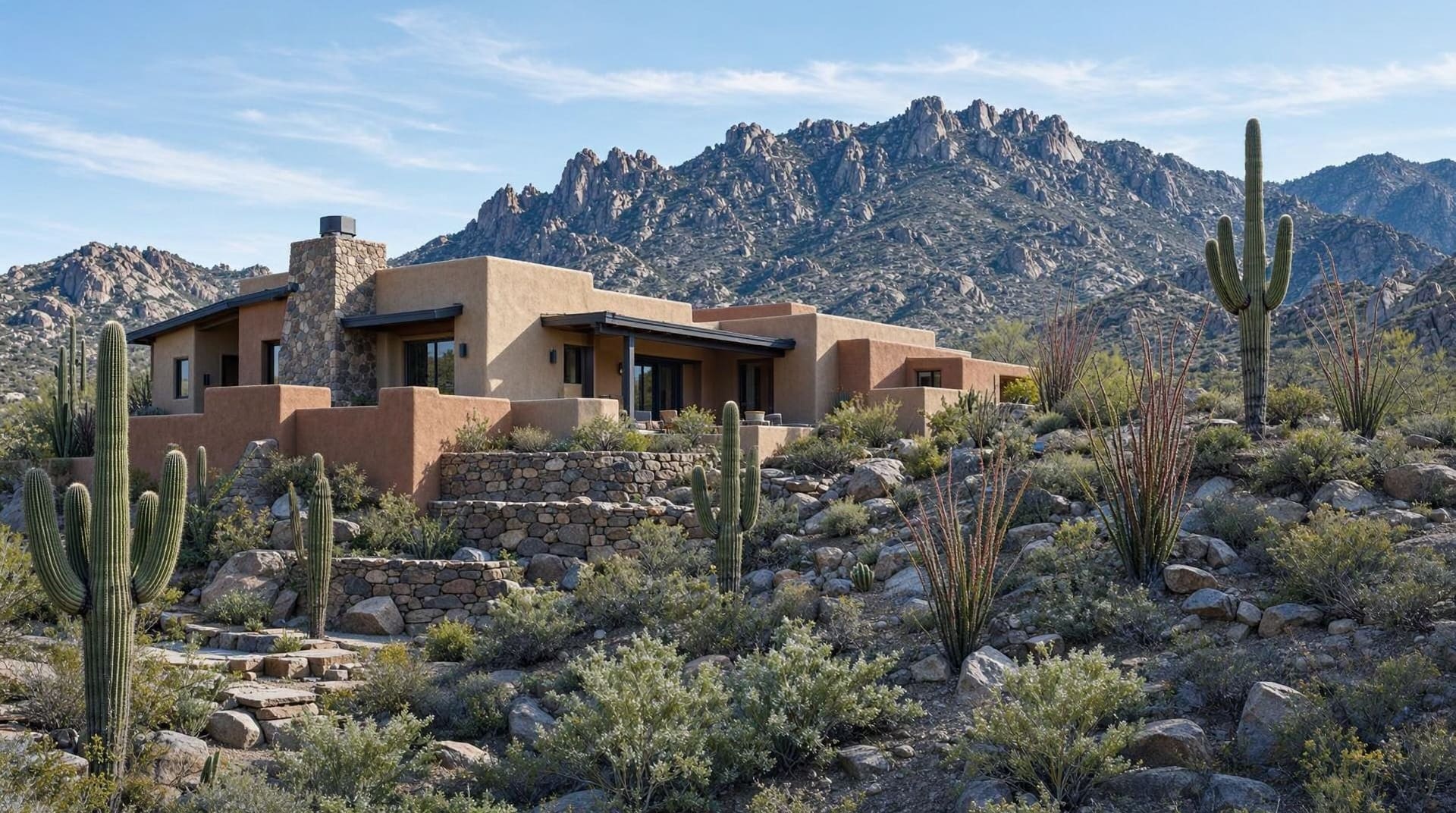
Building on a Pima Canyon Estates Lot Starts With the Slope
Building in Pima Canyon Estates: when Pima County's hillside overlay applies, what triggers a grading permit, and the native plant plan larger lots need.
Pima County's hillside overlay applies wherever a lot has enough 15% slope. It limits grading, adds a design review, and on a lot this size brings in the native plant ordinance as well.
Pima County's hillside ordinance does not start with a map. It starts with a measurement. Chapter 18.61 of the county code applies to any lot containing slopes of 15% or greater that are both longer than 50 feet in any horizontal direction and higher than seven and a half feet vertically. A lot that meets that test is in the Hillside Development Overlay Zone, and building on it involves a different set of plans, fees and limits than building on flat ground a mile away.
On the upper Foothills bajada, at the foot of Pusch Ridge, many lots meet it. That makes the ordinance the first document to read before buying a lot or a house you plan to add to there, ahead of the floor plan.
- 15%
- Slope that, over at least 50 feet and 7.5 vertical feet, puts a lot under the hillside overlay
- 14,000 sq ft
- Graded area on a single residential lot that requires a grading permit
- 36,000 sq ft
- Lot size above which Pima County requires a native plant preservation plan
- 30%
- Share of a lot set aside as natural open space under the county's set-aside method
What the Overlay Triggers
Pima County requires a Type I grading permit for a single home on a single lot when any one of several things is true: the graded area is 14,000 square feet or more, the work grades a slope of 15% or greater, a permanent cut or fill slope will be more than five feet tall and steeper than 3:1, or the project adds more than 3,000 square feet of new pavement. A hillside lot meets the second test almost by definition. The county's exemptions mostly say "non-hillside lot": clearing under 14,000 square feet, a small expansion of an approved graded area, an access easement. The exemption for excavating a basement, foundation, wall or swimming pool under a building permit still applies, and a driveway needs no permit only when it is not in the hillside zone and needs no work in the right of way.
The hillside submittal is more involved than an ordinary site plan. The county's checklist requires a designer thoroughly familiar with the ordinance, a completed hillside worksheet, and grading plans with at least two-foot contours across the disturbed area, the proposed and allowable grading calculated, finished floor elevations, and every proposed structure located, down to fences, walls, the pool and the septic system. It also asks for cross sections through the site showing building height and the combined exposed slopes, the method used to stabilize each graded slope by steepness, any dedicated natural area surveyed and recorded, and a color palette with light reflectivity values for exposed structures. Incomplete or incorrect submittals are charged a minimum of $232 on top of the base fee.
The ordinance also protects designated peaks and ridges. As the county's hillside manual sets it out, grading or development is not permitted within 150 feet of a protected peak point or ridge line, measured horizontally, or within 300 feet on land rezoned after August 11, 1998. Not every ridge is designated, and the county determines which are, so a buyer should ask whether a protected peak or ridge is near the lot rather than guess from the view.
When the Plat Decides Which Version Applies
The hillside chapter was substantially amended effective July 7, 2000, and the amended applicability section carves out a narrow group of subdivisions. A lot in a subdivision whose complete tentative plat was filed between August 11, 1998 and July 7, 2000, with the final plat recorded within 18 months after July 7, 2000, follows the grading requirements in effect before the amendment. The county's manual adds a related rule for lots whose recorded plat already describes a grading or building envelope: those lots are not subject to the grading table, but they are held to a six-foot grading limit beyond walls, curbs and paved areas.
The dates matter because they are exactly the kind of detail a lot listing leaves out. The recorded plat for the subdivision, and any envelope drawn on it for the specific lot, is what tells a designer which rules the house has to meet.
What the Rules Mean for Building in Pima Canyon Estates
Pima Canyon Estates is a guard-gated enclave in the northern Catalina Foothills, in unincorporated Pima County, set at the foot of Pusch Ridge against the Coronado National Forest boundary. This site's page for it describes roughly 330 custom home sites platted on one- to five-acre desert lots, with development by Diamond Ventures beginning in 1999 and homes built mostly from the early 2000s on, almost all of them single-story. That combination puts nearly every lot under at least two county ordinances at once.
The first is the hillside overlay, wherever the slope test is met. The second is the Native Plant Preservation Ordinance, Chapter 18.72. Pima County requires a native plant preservation plan when existing and proposed disturbance on a lot exceeds 14,000 square feet, when the lot is larger than 36,000 square feet, or when the subdivision plat requires one. Every lot of an acre or more clears the second test. Under the county's set-aside method, the only one a single-lot owner can use without certification by a plant professional, 30% of the property is set aside permanently as undisturbed natural open space, including its highest-value areas such as washes and dense vegetation. Saguaros, ironwoods and listed protected species outside that set-aside have to be inventoried, given a disposition (preserved in place, transplanted on site or removed) and mitigated.
For an owner planning an addition, a pool or a new driveway, the sequence is grading plan, hillside review where it applies, native plant plan, then building permit. Any community architectural review comes on top of the county's. For what homes in Pima Canyon Estates have sold for and how the area has changed, see the Pima Canyon Estates page below, which is where this site keeps those figures current.
Before You Buy a Lot to Build On
Get a topographic survey and have the designer run the slope test before you commit. Pull the recorded plat and look for a grading or building envelope on the lot. Ask Pima County whether a protected peak or ridge is nearby. Count the saguaros and ironwoods in the area you expect to disturb. And ask whether the community's own design review applies, and how long it takes.
This post summarizes Pima County's published hillside, grading and native plant requirements. The ordinance text in force for a specific permit controls; confirm with Pima County Development Services and a designer familiar with Chapter 18.61 before relying on it.
Sources
Pima County Development Services — "Hillside Development Manual (HDZ General Information and Chapter 18.61 text)" — https://oldcms.pima.gov/UserFiles/Servers/Server_6/File/Government/Development%20Services/Building/HDZ%20Manual.pdf — accessed November 19, 2026
Pima County — "Hillside Development Checklist" — https://www.pima.gov/hillside-development-checklist — accessed November 19, 2026
Pima County — "Grading Requirements" — https://www.pima.gov/grading-requirements — accessed November 19, 2026
Pima County — "Do I Need a Permit?" — https://www.pima.gov/do-i-need-a-permit — accessed November 19, 2026
Pima County Development Services — "Native Plant Preservation, Set Aside Method: Submittal Guidelines for Single Residential Lots" — https://oldcms.pima.gov/UserFiles/Servers/Server_6/File/Government/Development%20Services/Building/Native%20Plant%20Preservation.pdf — accessed November 19, 2026
Requirements are summarized from Pima County's published guidance; the county's hillside manual reflects the ordinance as amended in 2000, and later amendments may apply. Community details are from this site's Pima Canyon Estates page. This post is for informational purposes only and is not an offer to sell or a solicitation of an offer to purchase real estate.
Related reading
Posts about the same places, or in the same category, nearest in time. Each carries its own sources and revision date.
- Catalina Foothills Estates CC&Rs: Check Every Lot — November 19, 2026 · Local Insights
- Downtown Links Puts Sixth Street Under the Railroad — November 12, 2026 · Local Insights
- Picture Rocks Wells and Septic: The Paperwork a Deed Skips — November 1, 2026 · Local Insights
- December-February Water Use Sets Your 2027-28 Sewer Bill — October 22, 2026 · Local Insights
Topics
- Local Insights
- Pima Canyon Estates
- Catalina Foothills
- Hillside Development
- Building a Home
- Pima County