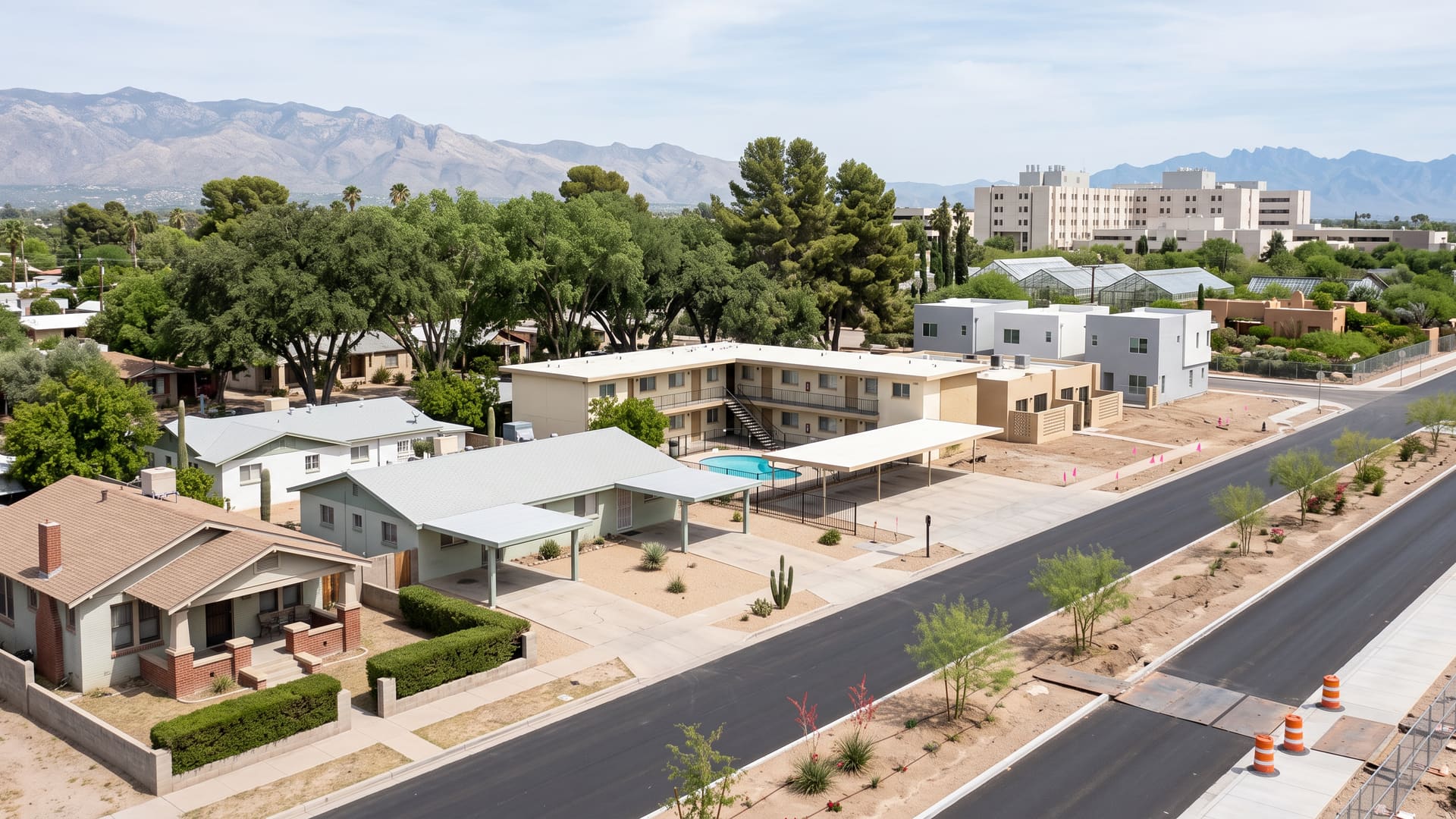
Oak Flower Homes for Sale — Tucson, AZ
Oak Flower is a half-mile rectangle of midtown Tucson in ZIP 85712, bounded by Alvernon Way on the west, Columbus Boulevard on the east, Grant Road on the south and East Monte Vista Drive on the north, where 746 parcels stand on 201 acres and the last three years carried 74 closings at a $233,500 median.
Key facts
- Jurisdiction
- Tucson, Arizona — incorporated city, Pima County
- Average sale price
- $233,000
- Price range
- $140K – $350K
- School district
- TUSD (Wright or Davidson Elementary, Doolen, Catalina High)
- Approximate population
- ~1,500
- Approximate number of homes
- ~1,100 homes
What defines this area
- The Tucson Botanical Gardens an eighth of a mile off the south-west corner
- McCormick Park, fourteen acres of City parkland across East Monte Vista Drive
- Tucson Medical Center nine tenths of a mile east along Grant Road
- Plaza Palomino half a mile north-east at Swan and Fort Lowell
- Alvernon Way west, Columbus Boulevard east, Grant Road south, Monte Vista Drive north
- The west half of a survey section, 201 acres in all
- Eighteen recorded plats spanning 1923 to 2025, none of them crossing the line
- R-2 zoning on 615 of its 746 parcels, and no R-1 at all
- Fifty-one of 74 recent closings detached, 19 condominium, four townhouse
- Detached closings built to a median year of 1956
- Living areas 550-2,513 sq ft, median 948
- A $233,500 median across the 74, with three distinct tiers beneath it
- Alvernon Wash and Columbus Wash mapped along the west and east edges, neither inside
- Inside the Davis-Monthan Air Force Base Vicinity disclosure territory
- Wholly inside the City of Tucson, in Ward 6 and in ZIP 85712
About Oak Flower
Oak Flower is a half-mile rectangle of midtown Tucson in ZIP 85712, bounded by Alvernon Way on the west, Columbus Boulevard on the east, Grant Road on the south and East Monte Vista Drive on the north, where 746 parcels stand on 201 acres and the last three years carried 74 closings at a $233,500 median. What that buys is small and old: the median home to close here measured 948 square feet and was built in 1962, and the record splits three ways — detached houses, a 1964 condominium tier and a handful of townhouses — whose medians sit $106,000 apart. Three of those four edges are survey lines as well as streets. Grant Road on the south is the township line between Township 13 South and Township 14 South, Alvernon Way on the west is the section line, and Columbus Boulevard on the east runs down the north-south centre line of Section 34 itself. Each of the three geocodes to within a few metres of the survey line it shares. The fourth edge is the ordinary one. East Monte Vista Drive is a residential street about five eighths of a mile up from Grant, so the boundary takes the west half of Section 34, Township 13 South, Range 14 East and stops short of the section's north line. Measured off the mapped outline that is 201.1 acres, in a box a little over half a mile wide and five eighths of a mile tall which it fills to 97.9 per cent — near enough to a true rectangle that the only departure is a small step on the east edge. The boundary and the neighborhood association are the same polygon. Oak Flower registered with the City of Tucson in February 1999 and is listed as active in Ward 6, and the outline the City holds measures 201.0 acres against the 201.1 above. Tested cell by cell the two outlines agree across 99.5 per cent of the box, and every disagreeing cell sits on a boundary line rather than inside it: the City draws its polygon with 59 corners and LiveBy draws this one with six. Put an even 81-point grid over the interior and all 81 come back Oak Flower alone. The other four associations the query returns each graze the line without covering a single interior point. Those four are what lies on the other side of each edge, and the association's own published limits — Grant to Monte Vista, Alvernon to Columbus — say the same thing the mapped outline does. Directly south across Grant Road is the Garden District, which runs on to Speedway Boulevard and is a page on this site. West across Alvernon Way is Dodge Flower; north-west is North Dodge; east across Columbus Boulevard is Vista Del Monte. None of those three has a page here. Two streets inside the line carry the halves of the name. East Flower Street runs the full width of the boundary about a third of the way up from Grant, and North Fair Oaks Avenue runs north from Grant to the top edge; Dodge Flower, the association immediately west, has North Dodge Boulevard through its middle and the same East Flower Street through it. No first-party record consulted says the association was named for those streets, so that is a correspondence rather than an origin — but it is the same correspondence the neighbour to the west carries, and both associations registered within nine days of each other in February 1999. What is on the ground is a grid of tree names — Walnut, Sycamore, Fair Oaks and Los Robles among them — and mature shade trees to match. The plat record spans more than a century and it has not closed. Eighteen recorded subdivision plats lie inside the boundary and not one of them crosses it, which is itself unusual; the filings run from May 1923 to August 2025, a hundred and two years end to end, and they cover about three quarters of the ground. Catalina Farms Annex came first, in May 1923, and is far the largest at roughly 77 acres in two mapped pieces. El Pasadena Tract followed in 1932, then Desert View in 1946, Bonita Vista Addition in 1947 and Los Nidos in 1948. Catalina Farms Addition Resubdivision and Glenn Vista Addition were both filed in 1955, Warner Addition in 1957 and Wright Addition in 1958. Fair Oaks Terrace arrived in 1970 and North Gate Town Houses in 1971. Then a long gap, and then infill: Columbus Blvd Condos in 1986, Prince-Monte Vista in 1995, Crow Creek in 2004, Columbus Park Condominiums in 2006, a five-lot filing on East Glenn Street in 2015, Cornerstone Homes on Monte Vista in 2018 and a two-lot duplex filing on North Columbus in August 2025. Read the county's recorded lot counts as what each filing recorded rather than as what stands there now. Three of the later plats carry a lot count of one or two against twelve, twenty-two and thirty-five parcels on the ground today, because a condominium or townhouse filing counts the parcel it was cut from and not the units built on it. What that century of filing produced is a denser place than the arterial grid around it suggests, and the zoning says so plainly. All 746 parcels answer to the City of Tucson, and not one of them is zoned R-1. R-2, the City's next density up, covers 615 of them, or 82.4 per cent; behind it come 79 R-3, 24 O-3, 23 C-1, four C-2 and a single O-2. In practice that means an interior block here is not uniformly detached houses. Duplexes and small multi-unit buildings sit on the same streets as single houses and were allowed to from the beginning, and the office and commercial parcels front Grant Road and Alvernon Way rather than sitting inside. What sells here is three distinct kinds of housing, and the blended figure describes none of them on its own. Across the three years to September 2026, 74 homes closed: 51 detached, 19 condominium and four townhouse. Detached houses ran to a median build year of 1956 across a record reaching from 1934 to 2019, measured 1,175 square feet at the median, and closed at $257,000 — $217.84 a square foot. The 19 condominiums were every one of them built in 1964, ran 799 square feet at the median and closed at $151,000, or $183.98 a square foot, inside a band just $25,500 wide from $139,500 to $165,000, narrow enough that the tier effectively prices itself. The four townhouses went up in 1971 and 1972, ran 787 square feet and closed at a $182,500 median. At four sales that is a reading rather than a tier, and the page treats it as one. Blend all 74 and they span $120,000 to $479,000, with a $233,500 median and a $233,277 average. Those two sit a tenth of one per cent apart, which on a single uniform market would be worth something and here is not: this record holds three tiers whose medians are $106,000 apart, and it is coincidence that they average out onto the middle one. Use the tier that matches the house. Not much of it lingered. The median listing went under contract in 20 days, 24 once relists are counted, and the record closed at 99 cents on the list dollar; 21 of the 74 beat their asking price and 27 cut it first. Those two day figures rest on 71 listings rather than all 74 — a field the feed left blank on three records, not a narrower set of sales. As for the band printed at the top of this page, it is drawn around the body of the record and not around its extremes: 64 of the 74 landed between $140,000 and $350,000, with two below, eight above, and $479,000 at the top. East Glenn Street is the most consequential line inside the boundary and nothing about it looks that way. It runs the full width about two thirds of the way up, it is the east-west centre line of Section 34 to within three metres, and it is where the assigned elementary school changes. Everything south of Glenn is assigned to John B Wright Elementary School and everything north of it to Davidson Elementary School, both Tucson Unified; the county's attendance polygons and LiveBy's own assignment query name the same four campuses and no others. Doolen Middle School and Catalina High School take the whole boundary. All four campuses stand outside the line: Wright is about a quarter of a mile south-east, Catalina High about four tenths of a mile south-west, Davidson about seven tenths north, and Doolen about eight tenths west. Assignments are drawn by address and they change, so confirm the assignment for a specific address with the district before relying on it. The water runs along the edges of this place rather than through it, and two separate public records say so independently. Pima County's flood control layer maps a 100-foot regulated setback on Alvernon Wash, which follows the western boundary for about half a mile, and a 50-foot setback on Columbus Wash, which clips the north-east corner along Columbus Boulevard. Both are rated at 1,000 to 2,000 cubic feet per second. A third mapped wash, Midway, reaches that same corner to within about five metres without ever crossing the line. The City of Tucson's adopted Grant-Alvernon Area Plan describes the same three the same way. Alvernon Wash begins at 5th Street and flows north along Alvernon Way to the Rillito. Columbus Wash turns west to flow along Columbus Boulevard, and Midway Wash runs west along Glenn Street to meet it there. Note what is not mapped: the county's bank-protection layer returns nothing at all inside this boundary, so none of the three is recorded here as a lined or stabilised open channel the way Arcadia Wash is a mile east. Because a setback is drawn outward from the mapped channel and not from any lot line, whether one reaches a given property is a parcel-level question — a survey and title answer rather than a neighborhood one. A military airport disclosure reaches this ground from nearly four miles away, and the reason is in how the statute draws its territory. Davis-Monthan Air Force Base has its mapped perimeter 3.8 miles due south of the south-west corner, and Pima County's Davis-Monthan Air Force Base Vicinity layer still covers all 81 sample points. Arizona Revised Statutes section 28-8461 lays that territory out as a set of legs rather than a circle and measures them outward from the runway, not from the fence, so distance to the base perimeter is not what decides membership. The duty itself is in section 28-8484: a seller of residential real estate inside the territory owes the purchaser a written disclosure before the transfer of title, against a map the State Land Department draws under section 37-102. That state map, and not the county layer, is what settles a particular address; the county layer's job here is to say that the question applies at all. Six other mapped layers do not reach this ground — the base's noise control districts, its Air Installation Compatible Use Zone, the Tucson Airport Authority's avigation easement and disclosure area, and Pima County's three airport environs overlays for height, land use and noise. All six were re-run over the base and again over Tucson International and returned features at both, so their silence here is a genuine absence rather than a query that failed. There is no public park inside the boundary and no mapped trail, and the nearest green space is barely outside it. McCormick Park — a City of Tucson neighborhood park at 2950 North Columbus Boulevard, 14.2 acres on the City's own page and 14.4 by the county polygon — begins about fifty-five metres north-east of the boundary's corner across East Monte Vista Drive, and sits in Ward 3 rather than this boundary's Ward 6. The Tucson Botanical Gardens is about an eighth of a mile off the south-west corner at 2150 North Alvernon Way. The adopted area plan records how it got there. Bernice and Rutger Porter started Desert Gardens Nursery on that corner in 1931, when it was the corner of Grant and Maple Boulevard — Alvernon Way's earlier name. Bernice later gave the property to the City, and the Gardens opened in 1983. Seneca Park is three tenths of a mile south, the Old Fort Lowell Cemetery three tenths north-east, the Martha Cooper Branch Library three quarters of a mile west and the Rillito River Park's shared-use path about three quarters of a mile north. Pima County's points-of-interest layer maps nothing at all inside the line, but the adopted area plan lists two community facilities here: Our Family Services at 2590 North Alvernon Way and Big Brothers Big Sisters of Southern Arizona at 2552 North Alvernon Way. Both front Alvernon at even-numbered addresses, which is what puts them inside — the county's address points place the odd numbers on the far side of the street. The south edge is a construction site as this is written, and that is worth planning around. The Grant Road Improvement Project's phases three and four run Sparkman Boulevard to Swan Road, taking in the whole of this boundary's Grant Road frontage. The work widens Grant to six lanes and rebuilds what sits beside it: landscaped median islands, five-foot bike lanes with a two-foot buffer, five to eight foot sidewalks on both sides, protected bike and pedestrian crossings, bus pullouts with shelters and benches, and landscaping and public art. The City reported in late August 2026 that those phases were expected to finish in October 2026. Check the project's own current status before viewing — lane restrictions, traffic shifts and limited driveway access have moved week to week along this stretch. The land-use policy over this ground is current rather than historic, and it names this neighborhood specifically. Tucson's Mayor and Council adopted the Grant-Alvernon Area Plan on 27 September 1999 by Resolution 18396 and amended it six times — in November 2000, June 2004, March and November 2007, September 2009 and December 2017 — then adopted a full update on 6 August 2025 by Resolution 23960. That update carries an Oak Flower Neighborhood section of its own and its own Oak Flower future land use concept map, and the neighborhood sat on the committee that wrote it. Read the adopted plan before assuming what a parcel here can become; it is the document a rezoning request is measured against. Everyday logistics are simple and undivided. All 791 county address points inside the line read 85712, and Ward 6 comes back at all 81 sample points. Tucson Medical Center is nine tenths of a mile east on Grant Road and Plaza Palomino about half a mile north-east. Further afield: El Con Center 1.6 miles, Banner - University Medical Center Tucson 2.2, the University of Arizona 2.3, Park Place 2.8, the Reid Park Zoo 2.9, Pima Community College's Downtown Campus 3.7, downtown Tucson about 3.9 and Tucson International Airport 8.2.
Oak Flower is an affordable neighborhood in the City of Tucson, on the central side of metro Tucson, Arizona, served by TUSD (Wright or Davidson Elementary, Doolen, Catalina High). Homes trade in the $140K – $350K range, with an average sale price of $233,000 across roughly 1,100 homes and a population of about 1,500. Kyle Berglund, REALTOR® at Tierra Antigua Realty, represents buyers and sellers here — call (520) 250-8904.
Compare nearby Tucson neighborhoods
- Garden District — Urban, average $310,000
- St. Cyrils — Urban, average $303,000
- Rita Ranch — Affordable, average $370,000
- Downtown Tucson — Urban, average $400,000
- Sahuarita — Affordable, average $360,000
- Madera Highlands — Affordable, average $400,000
- Midtown Tucson — Urban, average $350,000
- Sam Hughes — Urban, average $650,000
Frequently asked questions
What city is Oak Flower in?
Oak Flower is in the City of Tucson, Arizona. Jurisdiction: Tucson, Arizona — incorporated city, Pima County.
What is the average home price in Oak Flower, Tucson?
The average sale price in Oak Flower is approximately $233,000, with homes generally ranging from $140K – $350K. These are rounded, long-run estimates aggregated from MLSSAZ closed sales through the LiveBy data connection, over this neighborhood's own boundary, for general orientation — not a current-month figure. Averages are means and can be skewed by a small number of high-value sales, so individual home values vary materially.
What school district serves Oak Flower?
Oak Flower is served by TUSD (Wright or Davidson Elementary, Doolen, Catalina High). Confirm exact school assignments by specific address, as boundaries can change.
Is Oak Flower a good place to live?
Oak Flower is an affordable neighborhood in the City of Tucson, on the central side of metro Tucson, Arizona, known for the Tucson Botanical Gardens an eighth of a mile off the south-west corner, McCormick Park, fourteen acres of City parkland across East Monte Vista Drive, Tucson Medical Center nine tenths of a mile east along Grant Road, Plaza Palomino half a mile north-east at Swan and Fort Lowell. Oak Flower is a half-mile rectangle of midtown Tucson in ZIP 85712, bounded by Alvernon Way on the west, Columbus Boulevard on the east, Grant Road on the south and East Monte Vista Drive on the north, where 746 parcels stand on 201 acres and the last three years carried 74 closings at a $233,500 median. It has an approximate population of ~1,500 across roughly ~1,100 homes.
What kind of homes are for sale in Oak Flower?
Oak Flower is an affordable submarket where homes generally trade between $140K – $350K, with an average sale price of $233,000.
Who can help me buy or sell a home in Oak Flower?
Kyle Berglund, a licensed Arizona REALTOR® (License #SA668710000) at Tierra Antigua Realty, specializes in Oak Flower and the greater Tucson area. Call (520) 250-8904 or email contact@kyleberglund.com for a free consultation.