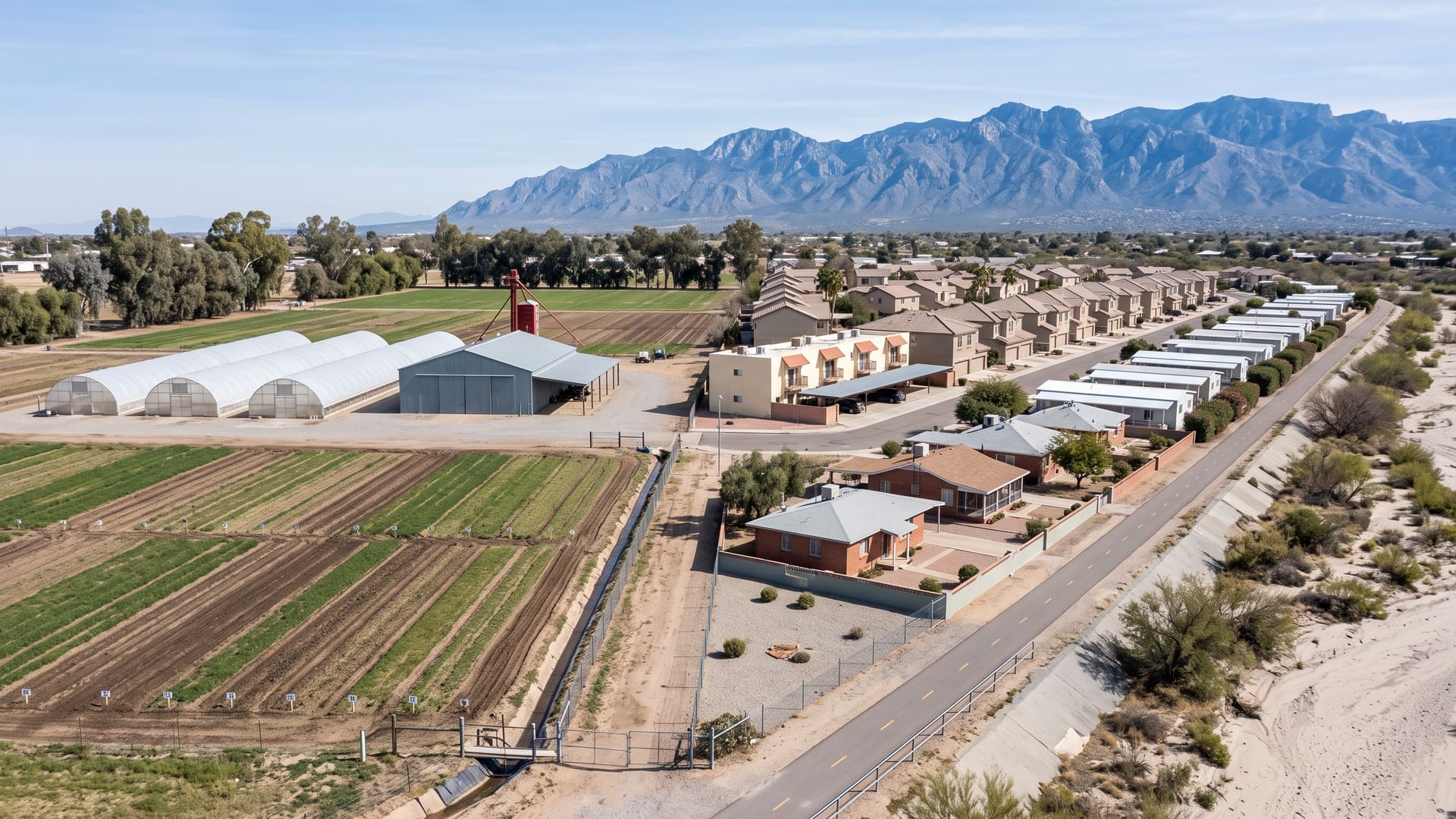
Campus Farm Homes for Sale — Tucson, AZ
Campus Farm is the piece of north-central Tucson wrapped around a university farm, and the farm is not a relic in the name — it is a research station the University still runs, and the largest single thing inside the boundary.
Key facts
- Jurisdiction
- Tucson, Arizona — incorporated city, Pima County
- Average sale price
- $339,000
- Price range
- $200K – $500K
- School district
- Amphitheater USD & TUSD
- Approximate population
- ~6,700
- Approximate number of homes
- ~3,800 homes
What defines this area
- The University of Arizona's Campus Agricultural Center
- The Rillito River and the Chuck Huckelberry Loop along its north-east side
- Houses platted in every decade from the 1920s to the 2020s but the 1930s and 1960s
- An unusually even mix of detached and attached homes
- Bounded by 1st Avenue, Prince Road, Campbell Avenue and the Rillito River
- 731.0 acres, 1.142 square miles
- A 73.8-acre Arizona Board of Regents research-farm parcel inside the boundary
- 117 detached houses, 41 townhouses and 19 condominiums in the last 177 closings
- Fifty-one recorded plats carrying 1,044 lots, 1925 to 2022
- Catalina Subdivision No. 2, recorded 31 January 1925
- Houses built to a median year of 1984, range 1930–2026
- Living areas about 695–2,493 sq ft, median near 1,425
- 1,657 parcels at a 0.165-acre median, 1,121 of them zoned R-2
- Eight Chuck Huckelberry Loop access points inside the boundary
- The UA Farms Campbell Avenue trailhead and Rio Vista Park trailhead
- Rio Vista Elementary School on East Limberlost Drive inside the boundary
- An active City-registered neighborhood association in Ward 3
- Amphitheater USD west of Campbell Avenue and Tucson Unified east of it
About Campus Farm
Campus Farm is the piece of north-central Tucson wrapped around a university farm, and the farm is not a relic in the name — it is a research station the University still runs, and the largest single thing inside the boundary. The University of Arizona's Campus Agricultural Center sits at 4101 North Campbell Avenue on land the University's own Arizona Experiment Station says was originally acquired in 1909, and which it describes on one of its pages as 160 acres and on another as 170 — a difference this page reports rather than picks between, since both are first-party. Its west block lies inside this boundary as a single 73.8-acre parcel held by the Arizona Board of Regents and zoned RX-1, running from Roger Road up to the river between Mountain and Campbell: the largest landholding in the polygon by a factor of two, and about a tenth of the neighborhood's ground. That the name follows the farm is the obvious reading of the two sitting together, and it is worth saying plainly that no source here states it outright. What the record does establish is the tie itself: the bylaws of the neighboring RillitoBend association, filed with the City of Tucson, draw their own west edge at Campbell Avenue "except for the properties owned by the Arizona Board of Regents (ABOR), which are in the Campus Farm Neighborhood" — a civic charter that names this neighborhood and puts the farm's land inside it. The origin of the name is an inference from that; the containment is not. The City registers a Campus Farm association of its own, active and filed under Ward 3, and its polygon and this one describe very nearly the same ground: a grid integration puts 99.5 percent of this boundary — 727.7 of its 731.0 acres — inside the association's 779.3, the closest agreement between an aggregation polygon and a civic one that any page here has recorded. The outline is North 1st Avenue down the west side, East Prince Road across the south-west, North Campbell Avenue and East Roger Road stepping in to cut a rectangle out of the south-east corner, and — in place of a fourth street — the Rillito River, which takes the whole north-east side on a diagonal. A geodesic integration of the boundary gives 731.0 acres, 1.142 square miles, in a block about 1.51 miles wide and 1.17 deep. All four of those streets check against Pima County's street-centerline layer to within a couple of metres. A fifth side does not, and the reason is worth knowing: the 0.18-mile east edge north of Roger Road runs on the North Tucson Boulevard alignment, but the mapped street stops at Roger, so that side is a line rather than a road. Pima County's flood-control layer carries the river reaches along the fourth side as the Rillito River in its largest class, over 10,000 cubic feet per second, with soil-cement banks and a 500-foot standard setback, and two smaller mapped channels run inside the boundary to meet it — the North Mountain Avenue Wash up the Mountain Avenue alignment and a soil-cement reach of Christmas Wash in the eastern strip.The whole of it is in the City of Tucson: all 1,657 parcels lying wholly inside read Tucson on the county's jurisdiction field, with no exception, and every interior point tested returns council Ward 3. What the parcel record then says about those 1,657 is the thing a buyer used to Tucson's outer tract squares should read twice, because it is the opposite of them: this is not a neighborhood of detached houses on quarter-acre lots. Only 252 of the 1,657 parcels are zoned R-1. The dominant district is R-2 at 1,121 parcels over 200.4 acres at a 0.162-acre median, with 108 R-3, 79 O-3 and 28 C-1 parcels carrying 47.1 acres along the arterials; 41 MH-1 parcels hold 42.9 acres and a single 37.7-acre MH-2 parcel on East Limberlost Drive is a manufactured-home community. The 1,657 parcels together run to 553.6 acres at a 0.165-acre median, with 2,131 building footprints mapped wholly inside and 1,647 official county address points, every one of them reading ZIP 85719. The plat record covers almost a century and pauses twice. Fifty-one filings lie wholly inside carrying 1,044 recorded lots, from Catalina Subdivision No. 2 on 31 January 1925 — 96 lots, and still the largest single filing here — to Riverfront Village, Blocks 1–3 on 15 August 2022. Four filings in the 1940s carry 107 lots and nine in the 1950s carry 180, among them River Park's 36 in 1948, Sheridan Addition's 45 in 1952 and Koehler Addition's 33 in 1955. Nothing at all was recorded between 1926 and 1947, or between 1960 and 1971. Then platting resumes and does not stop: seven filings in the 1970s carry 198 lots, eleven in the 1980s carry 151, ten in the 1990s carry 211, six in the 2000s carry 87 and two in the 2010s carry 14. More than half the filings after 1975 are attached housing by name — Belle Isle Condominiums in 1975, Pueblo de las Catalinas' 44 in 1978, Sierra Townhouses and Limberlost Villas Townhouses in 1979, Fort Mesquite Condominiums in 1981, Roger Lane Place Townhouses and River Grove Condominiums' 83 in 1983, Mountain View Condominiums in 1985, Park View Condominiums in 1987, Prince Mountain Condominiums in 2001 and Limberlost Townhouses' 49 in 2005 — while the detached infill of the same span arrived as River at North Campbell's 59 lots in 1993, Crest Ranch's 79 in 1994, Vines End's 22 in 1998, Rancho Reposo's 18 in 2003, Homes at Irwin Place's 12 in 2005 and Limberlost Estates' 10 in 2014. The last 177 closings are the whole record here rather than a sample, and they split three ways: 117 detached single-family homes, 41 townhouses and 19 condominiums, so more than a third of the record is attached, and the three tiers reconcile to the cent against the unfiltered total. Blended, they closed at a $328,000 median and a $339,211 average, were built to a median year of 1984 across a 1930-to-2026 range, run 695 to 2,493 square feet with a 1,425-square-foot median, and traded at a $234.23 median price per square foot with a median of 16.5 days on market and a sale-to-list ratio of 0.99; 34 of the 177 closed above asking and 49 took a price reduction. Split, they say more. The detached houses closed at a $375,000 median and a $384,751 average, with a 1,550-square-foot median, a 1994 median year built and $243.61 a square foot. The townhouses closed at a $240,000 median, 1,425 square feet, a 1980 median year built and $222.33 a square foot, on a 15-day median. The condominiums closed at a $220,000 median, 895 square feet, a 1984 median year built and $221.33 a square foot, on a 13-day median and the narrowest year-built range of the three, 1980 to 2004. Twenty-two dollars a square foot separates the dearest of the three from the cheapest while their median prices differ by a factor of 1.70 and their median floor areas by 1.73 — so here too the gap between a condominium and a detached house is very close to a gap of size. The detached tier is also where the age of the place shows: its median year built is 1994 against a 1982.99 mean, eleven years the wrong way round, which is what a long tail of pre-war and postwar houses under a bulk of 1990s and 2000s infill looks like in one statistic. No park lies wholly inside the boundary. What runs along the whole north-east side instead is Pima County's Rillito River Park, whose path the county describes as running from Interstate 10 to Craycroft Road on both banks of the river, and which is part of the Chuck Huckelberry Loop: the county's own trail layer maps hard-surface and soft-surface segments here between six and thirteen feet wide, open, ADA-marked, and shared by walkers, cyclists, riders and dogs. Access to it is unusually dense. Eight Loop access points stand inside the boundary and nineteen within 120 metres of an edge, among them the UA Farms Campbell Avenue trailhead with 32 parking spaces and two accessible ones, and the City of Tucson's Rio Vista Park trailhead — 29 spaces, restrooms, a drinking fountain, a ramada and picnic tables — 38 metres off the east edge. The county's Rillito mile markers put this frontage at roughly miles 6.25 to 7.5 on both banks. Rillito Regional Park lies about seventy metres north across the river, the City of Tucson's Rio Vista Natural Resource Park touches the east edge, and Limberlost Family Park is a quarter of a mile west across 1st Avenue. School assignment is the one thing about this boundary that is not uniform, and the line is Campbell Avenue. West of it — which is most of the polygon — Pima County's attendance-area layer returns Rio Vista Elementary, Amphitheater Middle School and Amphitheater High School, all Amphitheater Unified School District, at every interior point tested. East of Campbell, in the strip between Roger Road and the river, the same layer returns Cragin Elementary, Doolen Middle School and Catalina High School, all Tucson Unified. LiveBy returns both sets as assigned, plus Holaway Elementary, which the county layer does not draw over any point here — so an address on either side of Campbell is worth confirming rather than assuming. One assigned campus stands inside the boundary: Rio Vista Elementary School at 1351 East Limberlost Drive, serving prekindergarten through fifth grade in the Amphitheater district according to the federal school directory, on the 7.2-acre parcel the county still records under Amphitheater School District No. 10 and the 1985 Mountain-Limberlost School plat. Measured from the nearest boundary edge, Tucson Mall is about 0.73 miles out, Banner University Medical Center Tucson about 2.2, Interstate 10 about 2.4, the University of Arizona's Old Main about 2.8, Tucson City Hall about 3.5, El Con Mall about 3.6, Tucson Medical Center about 3.8 and Tucson International Airport about 10.5. The $200,000 to $500,000 band this page publishes covers 157 of the 177 closings: seven came in beneath it, the lowest at $135,000, and thirteen cleared it, the highest at $726,000. The average closed price is near $339,000 against a $328,000 median, the mean about $11,000 above — the shape of a record with a modest upper tail rather than two markets in one polygon.
Campus Farm is an urban neighborhood in the City of Tucson, on the central side of the Tucson area, Arizona, served by Amphitheater USD & TUSD. Homes trade in the $200K – $500K range, with an average sale price of $339,000 across roughly 3,800 homes and a population of about 6,700. Kyle Berglund, REALTOR® at Tierra Antigua Realty, represents buyers and sellers here — call (520) 250-8904.
Compare nearby Tucson neighborhoods
- Mountain View — Urban, average $315,900
- Downtown Tucson — Urban, average $400,000
- Central Tucson — Urban, average $350,000
- Sam Hughes — Urban, average $650,000
- Barrio Viejo — Urban, average $590,000
- Winterhaven — Urban, average $399,000
- Armory Park — Urban, average $584,900
- Colonia Solana — Luxury, average $895,000
Frequently asked questions
What city is Campus Farm in?
Campus Farm is in the City of Tucson, Arizona. Jurisdiction: Tucson, Arizona — incorporated city, Pima County.
What is the average home price in Campus Farm, Tucson?
The average sale price in Campus Farm is approximately $339,000, with homes generally ranging from $200K – $500K. These are rounded, long-run estimates aggregated from MLSSAZ closed sales through the LiveBy data connection, over this neighborhood's own boundary, for general orientation — not a current-month figure. Averages are means and can be skewed by a small number of high-value sales, so individual home values vary materially.
What school district serves Campus Farm?
Campus Farm is served by Amphitheater USD & TUSD. Confirm exact school assignments by specific address, as boundaries can change.
Is Campus Farm a good place to live?
Campus Farm is an urban neighborhood in the City of Tucson, on the central side of the Tucson area, Arizona, known for the University of Arizona's Campus Agricultural Center, the Rillito River and the Chuck Huckelberry Loop along its north-east side, Houses platted in every decade from the 1920s to the 2020s but the 1930s and 1960s, an unusually even mix of detached and attached homes. Campus Farm is the piece of north-central Tucson wrapped around a university farm, and the farm is not a relic in the name — it is a research station the University still runs, and the largest single thing inside the boundary. It has an approximate population of ~6,700 across roughly 3,800 homes.
What kind of homes are for sale in Campus Farm?
Campus Farm is an urban submarket where homes generally trade between $200K – $500K, with an average sale price of $339,000.
Who can help me buy or sell a home in Campus Farm?
Kyle Berglund, a licensed Arizona REALTOR® (License #SA668710000) at Tierra Antigua Realty, works with buyers and sellers in Campus Farm and across the greater Tucson area. Call (520) 250-8904 or email contact@kyleberglund.com for a free consultation.