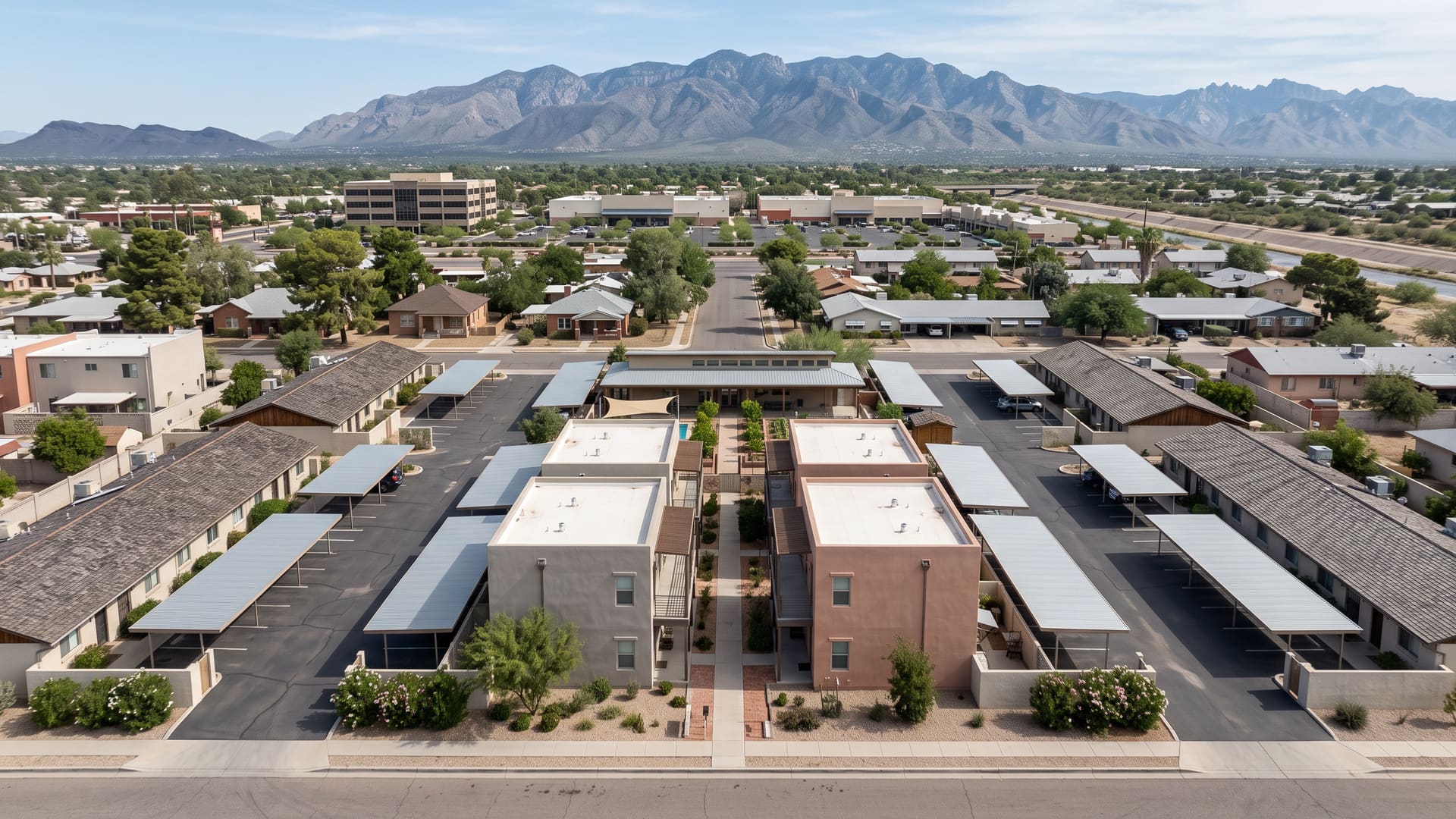
Limberlost Homes for Sale — Tucson, AZ
Limberlost is the rare Tucson neighborhood where the townhouse, not the house, is the normal thing to buy.
Key facts
- Jurisdiction
- Tucson, Arizona — incorporated city, Pima County
- Average sale price
- $290,000
- Price range
- $200K – $350K
- School district
- Amphitheater USD (Rio Vista Elementary, Amphitheater High)
- Approximate population
- ~3,700
- Approximate number of homes
- ~2,300 homes
What defines this area
- Townhouses and condominiums outnumbering detached houses among 58 closings
- Two resident-governed cohousing communities, 84 homes between them
- A $290,000 median across 58 closings in three years
- Limberlost Family Park, six and a half acres inside the line
- Haynes' Rillito Subdivision, 84 lots recorded in May 1908
- A 1973-1979 wave of six townhouse and patio-home plats
- Wetmore Road north, Roger Road south, Oracle Road west
- North First Avenue east, with Stone Avenue down the middle
- The south half of Section 24, half a square mile, 323 acres
- Tucson Mall about four-tenths of a mile from the centre
- Build years running 1937 to 2020, with a 1978 median
- Townhouses the fastest-selling of the three housing forms
- Seven zoning districts, R-2 over three-quarters of the parcels
- 838 county parcels, every one City of Tucson
- No FEMA special flood hazard area and no airport overlay inside
- Annexed in three acts between 1972 and 1982
- One school inside the boundary, and it is the district online academy
- Ward 3, ZIP 85705, about 4.3 miles north of downtown
About Limberlost
Limberlost is the rare Tucson neighborhood where the townhouse, not the house, is the normal thing to buy. Over the three years to October 2026, fifty-eight homes changed hands inside this half square mile of north-central Tucson: twenty-eight townhouses, nine condominiums and twenty-one detached houses — thirty-seven of the fifty-eight attached. All three forms closed within twenty-one thousand dollars of each other, so price is not what tells them apart. Speed is. The townhouses sold fastest and the detached houses slowest, and on every measure of how a sale went the two attached forms came out ahead of the detached houses, which is the opposite of what most buyers expect from a central Tucson half-section and the thing this page spends the most space on. The boundary is the south half of Section 24 — 323 acres, dead flat, almost entirely ZIP 85705. East and West Wetmore Road close it on the north, East and West Roger Road on the south, North Oracle Road on the west with the Tucson Mall retail district four-tenths of a mile beyond it, and North First Avenue on the east, with North Stone Avenue running the length of the middle and Limberlost Drive, which the neighborhood and the park both take their name from, crossing it the same way. Pima County classifies Oracle Road as a state route, Wetmore Road and First Avenue as major local roads and Roger Road as a minor local road, so this is not a frame of four arterials: it is three busy edges and one quieter one. Amphi, which has its own page here, is the full square mile immediately south — all of Section 25 — and the two share Roger Road; Campus Farm, which also has a page here, begins across First Avenue. The recorded plats run in four waves, and the closed-sale record reads as the third of them. The first is detached, old, and older than the state: Haynes' Rillito Subdivision, 84 lots, recorded on 11 May 1908, nearly four years before Arizona was admitted to the Union; then Wetmore Subdivision, 21 lots, in March 1924 and Arizona Acres, 51 lots, in November 1936. The second is post-war and also detached — Marla Manor, 17 lots, in June 1955, then Casa Radin Addition, 27 lots, and Roberta Terrace, 30 lots, both in 1961. The third is the wave that set the character of this ground, and it is dense, attached and falls inside a single seven-year stretch: Limberlost Terrace II, 45 lots, in December 1973; Mills Subdivision, 14 lots, and Patio Villas, 33 lots, in 1974; Gessler Heights II, 15 lots, in July 1976; Western Winds Townhouses, 37 lots, in December 1978; and Ponderosa Estates Townhouses No 1, 69 lots, in March 1979. The fourth is still running and is very small-grained: four lots added to Mills Subdivision in 1983, Arizona Commons and Calle Arizona in October 1989 at twelve and thirteen units apiece, then Home Depot Retail Center in 2006, Stone Lane Townhomes in 2007, Limberlost Condominiums in 2008, Limberlost Commons and Stone Crossing Residential Cluster Project in 2009, Stone Lane Homes in 2017 and a three-lot split in 2020. Twenty-six recorded plats touch the line and twenty-four lie wholly inside it; the two that cross are the 1908 and 1924 plats, both of which continue north over Wetmore Road. Two of those twenty-six are worth naming separately, because they are the most distinctive thing on this ground. Sonora Cohousing, 36 lots plus four dedicated common areas, was recorded in May 1999, and Stone Curves — platted as a cohousing neighborhood under the City's residential cluster project provisions — added 48 lots in August 2003. Both are resident-governed cohousing communities, and both are laid out the same way: private homes drawn tight around a car-free pedestrian lane, parking pushed to the perimeter, and a shared common building at the head of it. Stone Curves lists its own common facilities as a common house with a kitchen and guest rooms, a pool, a central lawn, a community garden, a workshop, a library and a dog park; Sonora describes spaces owned in common by its members. Eighty-four homes between them is a real share of a half-section this size, and buying into either means buying into a governance structure and a participation expectation an ordinary subdivision does not carry — so ask for the community's own agreements alongside the title work. Here is what the three housing forms actually did. The twenty-eight townhouses closed at a median of $279,000 on a median 1,343 square feet, built across 1972 to 2016 with a median year of 1978, at a median $204.85 per square foot. The nine condominiums closed at a median of $297,900 on a median 1,304 square feet, built 2005 to 2016 with a median year of 2005, at a median $240.49 per square foot. The twenty-one detached houses closed at a median of $300,000 on a median 1,620 square feet, built across 1937 to 2020 with a median year of 1962, at a median $206.11 per square foot. So a condominium here — four decades newer than the typical house and on four-fifths of its floor area — closed within about two thousand dollars of it, which is why price per square foot and price per house give different answers in this boundary and why its condominiums hold the most expensive square foot in it by a wide margin. The sharper difference is in the selling, and it separates the attached forms from the detached ones rather than running in one order across all three. The townhouses recorded a median 18 days on market and closed at 0.99 of list, with six of twenty-eight above asking. The condominiums recorded a median 24 days and a sale-to-list ratio the data reports as 1.00, with two of nine above asking. The detached houses recorded a median 27 days, closed at 0.97 of list, and one of twenty-one went above asking. On this ground the attached stock has been the tighter market and the older detached houses the one with the most room in them. Sorted into price bands, the record puts 1 closing under $150,000, 1 from $150,000 to $200,000, 11 from $200,000 to $250,000, 26 from $250,000 to $300,000, 11 from $300,000 to $350,000, 5 from $350,000 to $400,000 and 3 above $400,000. Median floor area climbs without a break from the second band up — 866 square feet, then 1,166, 1,336, 1,349, 1,771 and 2,062 — so the money tracks floor area. Median build year does not: it sits between 1977 and 1979 through the five bands to $350,000 and jumps to 2012 and 2019 in the two above, because the top of this market is its newest construction and everything beneath it is the 1970s. So below $350,000 you are shopping the 1970s at various sizes, and above it the small number of newer houses. The range printed at the top of this page is drawn around the body of that record rather than its ends: 48 of the 58 closed between $200,000 and $350,000, two below and eight above. These are closed sales, not homes currently for sale. Whole-record figures, for completeness. Closing prices ran $120,000 to $515,000 around a median of $290,000, on an average of $289,536; list price $124,000 to $525,000 with a $291,250 median and original list price a $298,750 median. Build years ran 1937 to 2020 with a median of 1978, living areas 780 to 3,095 square feet with a 1,333 median, and price per square foot $117.63 to $337.01 with a $208.26 median. The median listing went under contract 45 days after coming to market and took 50 days from contract to close, with a median 20 days on market, a 0.99 sale-to-list ratio, 9 of the 58 closing above asking and 21 taking a price reduction first. Days on market rest on 55 of the 58 records rather than all of them. Homeowners associations are a real question here and this page can only answer part of it. The plats themselves dedicate common areas on specific developments — two each on Arizona Commons and Calle Arizona, four on Sonora Cohousing, and the two residential cluster projects by their nature — and dedicated common ground has to be owned and maintained by someone, which in practice means an association with an assessment. The condominium plats carry the same implication by definition, and the old detached grid platted between 1908 and 1961 carries no such dedication anywhere in the record. The City of Tucson layer that used to publish its register of homeowners associations is no longer in Pima County's open GIS catalogue, so no association list and no dues figure is stated here: a withdrawn layer is not an area with no associations in it, and guessing which it was would be the worse error. Treat anything attached or clustered here as very likely to carry an association and a house in the old grid as likely not to, and get the resale disclosure package and the current assessment in writing before writing an offer either way. The association called Limberlost is a different thing again: a voluntary neighborhood association registered with the City of Tucson, active, in Ward 3, registered on 1 July 1999, with no assessment power and no covenant authority over anyone's title. Its outline and this boundary are the same object to better than one per cent — 322 acres against 323, with 99.3 per cent of this line inside the association and 99.7 per cent of the association inside this line. Zoning is the other thing to check before planning anything. The county records 838 parcels wholly inside the line, every one under City of Tucson jurisdiction with no unincorporated pocket anywhere, on 267 acres — so roughly 56 of these 323 acres is street right-of-way. Seven zoning districts appear. R-2, the City's medium-density residence zone, is overwhelmingly the largest at 755 parcels on 161 acres; the code gives its purpose as medium-density single-family and multifamily residential development alongside the schools, parks and public services an urban residential area needs. R-3, which permits more again, covers 19 parcels on 28 acres. C-1 takes 33 parcels on 8 acres, C-2 eight on 22 and O-3 eleven on 14, along the Oracle Road and Stone Avenue frontages, and one parcel of a third of an acre is zoned R-1. The outlier is OCR-2, eleven parcels on 34 acres — the City's office, commercial and residential zone, and it sits at the north-west corner, nearest the Oracle Road and Wetmore Road retail district. Current zoning matched original zoning at every one of 81 interior sample points. Read all of it as what the ground is permitted to hold rather than as an account of what stands on it: most of the housing here predates the current code, and Tucson's middle housing amendment, adopted on 16 December 2025 and effective 1 January 2026, widened what is allowed again. The city arrived here late, which is what explains the plat dates. This half-section was annexed in three separate acts rather than one: Ordinance 3865, effective 6 July 1972, covers a small share; Ordinance 5073, effective 28 October 1980, the great bulk; and Ordinance 5646, effective 20 September 1982, the rest. Ordinance 1895 of April 1959, which brought the whole of Amphi into the city in a single act, touches this boundary and reaches none of its interior. So the 1908, 1924 and 1936 plats were laid out and largely built on as unincorporated Pima County, and the City of Tucson did not reach most of this ground until 1980 — more than seventy years after the oldest lots here were platted, and a year after the last of the big townhouse plats. Schools are Amphitheater Unified throughout, and the assignment is uniform at two of the three levels. Pima County's attendance-area polygons return the same elementary school and the same high school at every one of 81 interior sample points — Rio Vista Elementary School at 1351 East Limberlost Drive and Amphitheater High School at 125 West Yavapai Road, both outside this boundary and about a mile out in either direction — and split almost evenly at middle school, where 42 of the 81 points take Amphitheater Middle School on East Prince Road and the other 39 take La Cima Middle School further north. Two further Amphitheater polygons cover all 81 points and neither is an address assignment: Rillito Center, a district programme for students with the highest needs, and Innovation Academy, which is in Oro Valley. Assignments are drawn by address and they change, so confirm a specific address with the district rather than with a neighborhood map. What is worth noticing is the absence: Pima County records exactly one school of any kind inside this half-square-mile — the district's online academy on East Wetmore Road, which has an address here and no classrooms a neighbourhood can walk to — against nine campuses inside the square mile immediately south. Every school assigned to this ground is over one of the four edges. Open space is the thing this boundary has and its southern neighbour does not. Limberlost Family Park sits inside the line at 4255 North 4th Avenue: six and a half acres the City classifies as a neighbourhood park, open 6 a.m. to 10.30 p.m., with a playground, a half basketball court, a multi-use court, a walking path, picnic tables and grills, benches, bicycle racks and a drinking fountain — and, the City's own listing is explicit about this, no ramadas and no restrooms. Its parcel doubles as a Tucson Water wellsite in the city's property record. Beyond the north edge the Rillito River Park path is about four-tenths of a mile from the middle of the boundary, with 22 parks of one kind or another inside two miles. There is no library, fire station, police station or post office inside the line; the nearest library is Woods Memorial on North First Avenue about a mile south, inside the Amphi boundary. Of the City's sixteen property records here, all but three are dedicated right-of-way or sold surplus; the active exceptions are the park wellsite and two parcels on East Camino Villas held by Housing and Community Development under the federal HOPE VI programme. The water record is the one place where the federal answer and the county answer differ, and both are worth having. FEMA's digital flood map puts no special flood hazard area anywhere inside this boundary — the only zones it draws here are Zone X and shaded Zone X, the latter the 0.2 per cent annual chance or five-hundred-year band — while mapping 62 flood-zone polygons within two miles, so the absence is an answer rather than a gap in the data. There is no mapped floodway, sheet flooding, erosion hazard area or local flow corridor inside the line. The county, though, regulates this ground under a study of its own: the Ruthrauff Basin Special Study, engineered by JE Fuller and effective 2 November 2015, with 44 regulatory discharge points inside the boundary carrying modelled hundred-year flows of 4 to 254 cubic feet per second. One short unnamed reach of the county's wash network crosses the line with a 50-foot regulated setback. So: no federal flood insurance requirement arising from the FEMA map, and a local drainage regime the county does map and does enforce at parcel level. A setback is measured outward from the mapped channel rather than from any lot line, so whether one reaches a given property is a question for a survey and a title search. One record that often complicates a Tucson purchase is simply empty here. No part of this boundary falls inside any airport overlay the county maps — not the Tucson Airport Authority's avigation easement and disclosure area, not the Davis-Monthan Air Force Base Vicinity that Arizona Revised Statutes section 28-8461 defines and section 28-8484 attaches a written seller disclosure to, and not the noise, height or compatible-use overlays of either field. All nine of those layers return nothing at 81 interior sample points while seven return features over the two airfields, so the blank is a finding rather than a missing dataset. The rest of the record. The county addresses 869 official address points inside the boundary across 33 street names, led by Limberlost at 179, Roger at 108 and Calle Arizona at 102. All but 11 are ZIP 85705; the exceptions sit along the eastern edge, which the post office puts in 85719. The whole boundary is in Ward 3. Fifteen approved development plans are on file, four of them apartment plans totalling 281 units. Measured from the middle of the boundary, Tucson Mall is about four-tenths of a mile, the Rillito River path about the same, Banner-University Medical Center Tucson about 3.2 miles, the University of Arizona about 3.7, downtown Tucson about 4.3 and Tucson International Airport about 11.5.
Limberlost is an urban neighborhood in the City of Tucson, on the central side of metro Tucson, Arizona, served by Amphitheater USD (Rio Vista Elementary, Amphitheater High). Homes trade in the $200K – $350K range, with an average sale price of $290,000 across roughly 2,300 homes and a population of about 3,700. Kyle Berglund, REALTOR® at Tierra Antigua Realty, represents buyers and sellers here — call (520) 250-8904.
Compare nearby Tucson neighborhoods
- Amphi — Affordable, average $245,000
- Campus Farm — Urban, average $339,000
- Downtown Tucson — Urban, average $400,000
- Midtown Tucson — Urban, average $350,000
- Sam Hughes — Urban, average $650,000
- Barrio Viejo — Urban, average $590,000
- Winterhaven — Urban, average $399,000
- Armory Park — Urban, average $584,900
Frequently asked questions
What city is Limberlost in?
Limberlost is in the City of Tucson, Arizona. Jurisdiction: Tucson, Arizona — incorporated city, Pima County.
What is the average home price in Limberlost, Tucson?
The average sale price in Limberlost is approximately $290,000, with homes generally ranging from $200K – $350K. These are rounded, long-run estimates aggregated from MLSSAZ closed sales through the LiveBy data connection, over this neighborhood's own boundary, for general orientation — not a current-month figure. Averages are means and can be skewed by a small number of high-value sales, so individual home values vary materially.
What school district serves Limberlost?
Limberlost is served by Amphitheater USD (Rio Vista Elementary, Amphitheater High). Confirm exact school assignments by specific address, as boundaries can change.
Is Limberlost a good place to live?
Limberlost is an urban neighborhood in the City of Tucson, on the central side of metro Tucson, Arizona, known for Townhouses and condominiums outnumbering detached houses among 58 closings, Two resident-governed cohousing communities, 84 homes between them, a $290,000 median across 58 closings in three years, Limberlost Family Park, six and a half acres inside the line. Limberlost is the rare Tucson neighborhood where the townhouse, not the house, is the normal thing to buy. It has an approximate population of ~3,700 across roughly ~2,300 homes.
What kind of homes are for sale in Limberlost?
Limberlost is an urban submarket where homes generally trade between $200K – $350K, with an average sale price of $290,000.
Who can help me buy or sell a home in Limberlost?
Kyle Berglund, a licensed Arizona REALTOR® (License #SA668710000) at Tierra Antigua Realty, specializes in Limberlost and the greater Tucson area. Call (520) 250-8904 or email contact@kyleberglund.com for a free consultation.