South Park Homes for Sale — Tucson, AZ
South Park is a long strip of south-central Tucson — about a mile across and two miles deep, 1,041 acres of dead-flat ground in ZIP 85713, a mile and a quarter from downtown at its nearest corner.
Key facts
- Jurisdiction
- Tucson, Arizona — incorporated city, Pima County
- Average sale price
- $303,000
- Price range
- $200K – $500K
- School district
- TUSD (four elementary and four high school attendance areas)
- Approximate population
- ~2,800
- Approximate number of homes
- ~1,200 homes
What defines this area
- Grand View Addition, 540 lots recorded in February 1907
- The Pearl at The Bridges, 126 lots recorded in June 2024
- Silverlake Park, Mirasol Park and Street Scene Park all inside the line
- The Quincie Douglas Library on East 36th Street
- East 22nd Street north, Interstate 10 south-west, Kino Parkway east
- The Union Pacific main line running the whole western boundary
- The Bridges and its 350-acre planned area development
- The University of Arizona Tech Park at The Bridges, 36th and Kino
- Tucson Marketplace retail at the Park Avenue interchange
- Build years 1948-2026 across 62 closings, median 2001
- A $276,400 median, every closing a detached single-family house
- Price banded by age, from 1950s houses to 2024-2026 construction
- Nine zoning districts and no R-1 anywhere inside the line
- 1,553 county parcels, every one City of Tucson
- One recorded HOA, over Casa de Kino, none over the 1907 grid
- Four Tucson Unified attendance-area combinations by address
- Ward 5, ZIP 85713, about a mile and a quarter from downtown
About South Park
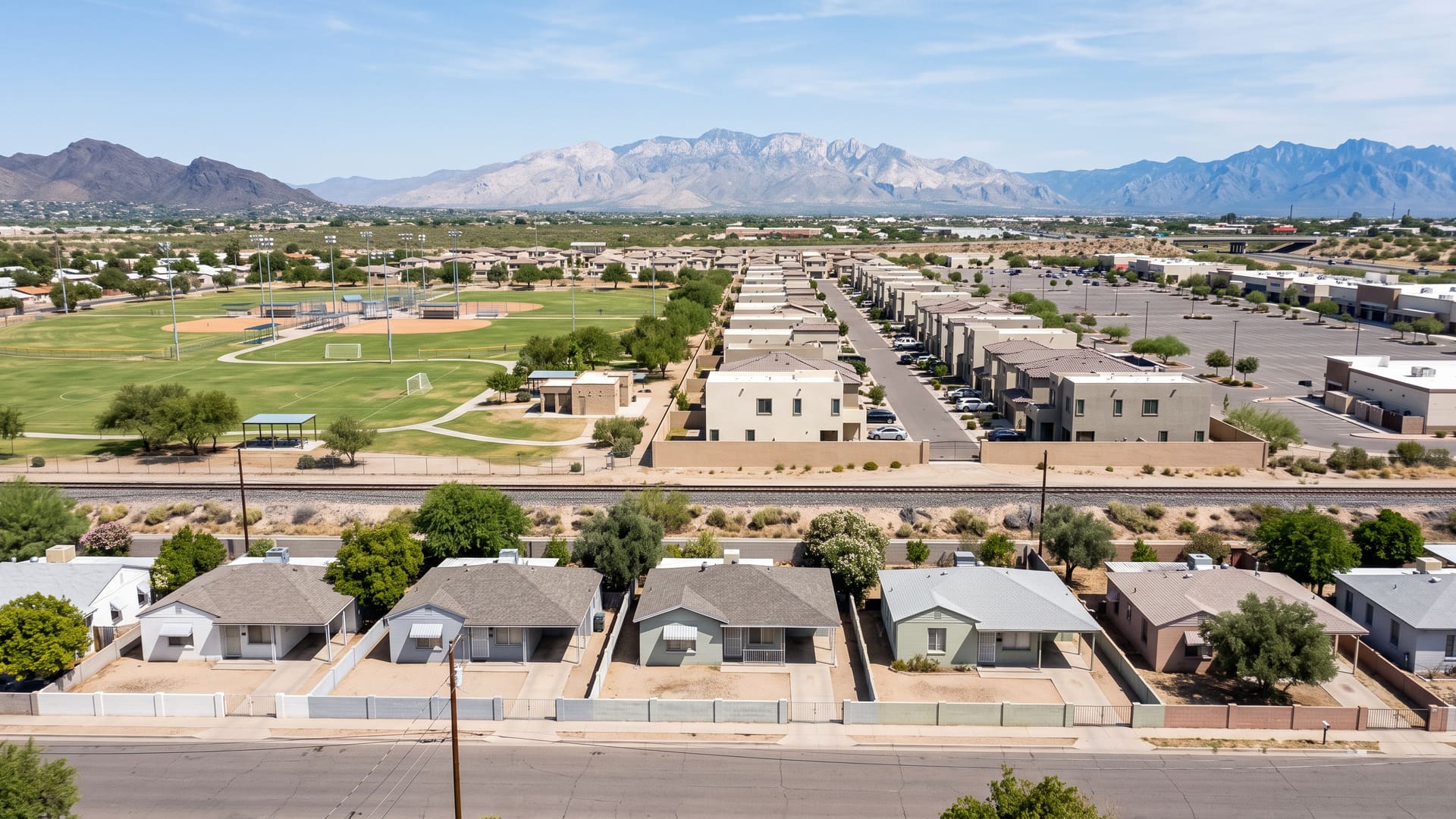
South Park is a long strip of south-central Tucson — about a mile across and two miles deep, 1,041 acres of dead-flat ground in ZIP 85713, a mile and a quarter from downtown at its nearest corner. It holds one of the oldest recorded plats this site has covered and one of the newest subdivisions in the city inside the same boundary: Grand View Addition, 540 lots, recorded on 13 February 1907, five years before Arizona was a state, and The Pearl at The Bridges, 126 lots, recorded on 27 June 2024. The line runs East 22nd Street on the north, the Union Pacific Railroad main line on the west, Interstate 10 on the south-west and South Campbell Avenue, South Martin Avenue and South Kino Parkway on the east, with South Park Avenue down the middle of it. Between those two plats lie a 1929 addition, a 1979 subdivision, two early-1990s ones, a 223-lot build-out between 2000 and 2004, and the 350-acre planned area development that brought a freeway retail district and the University of Arizona's Tech Park at The Bridges onto the south-eastern quarter of it. The closed-sale record reads exactly like that history. Sixty-two homes changed hands inside the line over the three years to September 2026. Every one of them was a detached single-family house — no condominium and no townhouse in the record at all — and their build years ran from 1948 to 2026, a seventy-eight-year span, to a median of 2001. They closed between $93,000 and $587,150 around a median of $276,400, on an average of $302,887. Price tracks age here more cleanly than it tracks anything else, and that is the single most useful thing to know before shopping in this boundary. Sorted into bands, the record puts 4 closings under $150,000 at a median build year of 1957, 3 from $150,000 to $200,000 at 1951, 14 from $200,000 to $250,000 at 1958, 17 from $250,000 to $300,000 at 2002, 9 from $300,000 to $350,000 at 2002, 2 from $350,000 to $400,000 at 2025, 4 from $400,000 to $450,000 at 2024, 3 from $450,000 to $500,000 at 2024 and 6 above $500,000 at 2025. Floor area climbs with the money the same way — a 1,050-square-foot median in the $200,000s, 1,297 in the $250,000s and the $300,000s, 1,700 in the $400,000s and 2,130 above $500,000. So the range printed at the top of this page is drawn around the body of that record rather than around its extremes: 49 of the 62 landed between $200,000 and $500,000, seven below and six above. In practice that is two different products at two different prices inside one boundary — a 1950s block house on a small lot in the old grid, or a new two-storey house behind a perimeter wall at roughly double the money — and which one a search turns up depends almost entirely on where the price filter is set. These are closed sales, not homes currently for sale. The two halves of the market also behave differently on the clock. Across the whole record the median listing went under contract 34 days after it came to market and took 47 days from contract to close, with a median 23 days on market, a 0.97 sale-to-list ratio, 17 of the 62 closing above asking and 21 taking a price reduction first. Split by band, the five bands below $350,000 show days-on-market medians of 24, 22, 15, 21 and 6, and the four bands above show 220, 97, 101 and 140. Builder inventory accrues market time from the day it is listed rather than from the day it is finished, so a long day count on a new house here is not the signal it would be on a resale. Read those four upper bands as thin, too: their day counts rest on 2, 4, 2 and 5 closings, fewer than the 2, 4, 3 and 6 that closed in them. Whole-record figures, for completeness. List price ran $100,000 to $639,262 with a $279,900 median, and original list price the same $279,900 median. Living areas ran 672 to 2,378 square feet with a 1,304 median, and price per square foot $67.11 to $360.12 with a $222.11 median. Days on market rest on 58 of the 62 records and days to contract on 59, rather than all of them. Homeowners associations are the exception here rather than the rule. The City's homeowners-association layer records exactly one inside the boundary — Casa de Kino Homeowners Association, over the 156-lot first Casa de Kino plat on 29 acres, with covenants recorded alongside that plat in January 2000 — and Pima County's layer records none at all. The same query against the neighborhood-association layer returns six features, which is the control that makes the near-zero readable rather than a blank. The Pearl at The Bridges is the other one to ask about: its 2024 plat carries a common area, which is normally held and maintained by an association, and it is too new to appear in the City's layer yet. No dues figure is published in any of these records, so none is stated here — ask for the resale disclosure package and the current assessment before writing an offer in either of those two. Everywhere else, and that includes the whole Grand View grid, no HOA is recorded. The association called South Park is a voluntary neighborhood association registered with the City, which is a different thing: it has bylaws and an annual meeting, and no assessment power and no covenant authority over anyone's title. The name and the boundary are the same object. The City of Tucson carries a registered South Park Neighborhood Association here — active, in Ward 5, registered on 14 May 1991, with bylaws adopted on 17 May 1991 and revised on 2 August 2021, and an annual meeting each October. Its outline covers 1,053 acres against this boundary's 1,041, with 99.5 per cent of this line falling inside the association and 98.3 per cent of the association falling inside this line, and all 62 interior sample points returning South Park and nothing else. The edges check against Pima County's street centreline and railroad layers: East 22nd Street runs the north line to within a couple of metres, South Campbell Avenue the lower east line and South Martin Avenue the middle of it to within one, Interstate 10 the whole south-west diagonal to within the width of its two carriageways, and the west line is not a street at all — it is the Union Pacific main line, whose mapped centreline follows this boundary including its curve for the full two miles. The line steps south around a commercial block at 22nd and Tyndall that the association's own outline includes. Zoning is the other thing to check before planning anything. The county records 1,553 parcels wholly inside the line, every one of them under City of Tucson jurisdiction with no unincorporated pocket anywhere, on 770 acres — so roughly 271 acres of this place is right-of-way, which is what a freeway, a rail corridor and a 1907 street grid cost. Nine zoning districts appear, and R-1 is not one of them. The largest by area is PAD-15, the planned area development over The Bridges, with 209 parcels on 352 acres. Next is R-2, the City's medium-density residence zone, with 1,128 parcels on 293 acres — so every house lot in the old grid sits in a district that permits more than one home on a lot. Then I-1 light industrial on 77 acres, C-2 on 23, P-I on 13, C-1 on 5, C-3 on 4, O-3 on 2.5 and R-3 on 2.2. Read that as what the ground is permitted to hold rather than as an account of what stands on it: most of the housing here predates the current code, and Tucson's middle housing amendment, adopted in December 2025 and effective 1 January 2026, widened what is allowed again. Three City of Tucson parks sit wholly inside the boundary rather than beside it. Silverlake Park, 51.1 acres at 2420 South Kino Parkway, is a metro park open 6 a.m. to 10:30 p.m. with baseball and softball fields, a soccer field, a playground, walking paths, picnic areas, grills, restrooms, drinking fountains and bicycle racks; Proposition 407 bond work there — a new walking-path connection, a covered basketball court, resurfaced parking and a Sky Islands play area — was scheduled to begin in spring 2026. Mirasol Park, 5.3 acres at 1100 East Silverlake Road, is a neighborhood park with a basketball court, a multi-use court, a softball field, a playground, a ramada, picnic tables, grills and a drinking fountain, with its own Prop 407 work — an Active Arroyo play area, resurfaced parking, lighting and a new comfort station — on the same schedule. Street Scene Park, 0.6 of an acre at 744 East 39th Street, is a mini park with a playground, benches, picnic tables, grills, a drinking fountain and an open turf area, and no ramada or restroom. The Quincie Douglas Library, Pima County Public Library's branch at 1585 East 36th Street, is inside the line too, with a 53-seat meeting room, study rooms, computers and printing, pickup lockers and a seed library. The retail and employment side of this place is the ground between Park Avenue, Kino Parkway, 36th Street and Interstate 10 — the site the City of Tucson's adopted planned area development calls the 350-acre Bridges site, and the one Pima County's wash network still ties to an airfield, carrying a channel reach inside this boundary named the Downtown Airport Wash. The county's development-plan record names what went onto it: Tucson Marketplace Phase I in 2009, a Walmart Supercenter at the north-east corner of Interstate 10 and South Park Avenue in 2011, Phase 3 in 2012, Culver's at Block 14 in 2014, Planet Fitness in 2016, a Phase 4 theatre and anchor, the Cherrybell Medical Center in 2017, a JTED campus and a UPS facility. The University of Arizona's Tech Park at The Bridges occupies 65 acres at 36th Street and Kino Parkway on the same land, and the streets it is built on — Innovate Lane, Imagine Lane, Catalyst Drive and Tucson Marketplace Boulevard — lie entirely inside this boundary. The older industrial frontage along the rail corridor is the other employment strip, and the county's plan record there runs back through Finley Distributing, Citizens Transfer and Storage, Ruan Leasing and a printing works. Schools are Tucson Unified throughout, and the assignment is not the same across the boundary — which is the one thing on this page a buyer should not generalise. Pima County's attendance-area polygons return four different combinations across the 62 interior sample points. Twenty-four points take Cavett Elementary, Utterback Middle and Catalina High School; twenty-one take Holladay Fine Arts Magnet Elementary, Utterback Middle and Pueblo High School; thirteen take Borton Magnet, Safford K-8 and Tucson High Magnet School; and four take Pueblo Gardens PreK-8, Utterback Middle and Rincon High School. A LiveBy point query at the centre of the boundary returns the first of those four as assigned, which is the combination that covers the largest share of the ground. Two of those campuses stand inside the line: Borton Magnet at 700 East 22nd Street and Holladay at 1110 East 33rd Street. Assignments are drawn by address and they change, so an address here needs confirming with the district rather than with a neighborhood map. Two airport disclosures touch this ground and they behave differently, which is worth being precise about. The whole boundary — all 62 interior sample points — falls inside the avigation easement and disclosure area the Tucson Airport Authority draws around Tucson International and Ryan Airfield. What that area means is narrower than its name suggests: it is the ground over which the Airport Authority asks for avigation easements and noise disclosure statements as a condition of new development and rezoning. It does not mean an easement is recorded against any particular parcel, and Arizona's mandatory written seller disclosure for airport proximity applies to military airports, which Tucson International is not. Check the title report for an easement actually recorded against the parcel, and the Airport Authority's own current mapping, which is the live version — Pima County documents its copy of that layer as no longer maintained. Davis-Monthan Air Force Base is the second one and here it covers part of the boundary rather than all of it: 17 of the 62 interior points, in the north-eastern third, fall inside the Davis-Monthan Air Force Base Vicinity, the territory Arizona Revised Statutes section 28-8461 defines and section 28-8484 attaches a written seller disclosure to; the other 45 fall outside it. That makes the military-airport disclosure an address-level question in this boundary rather than a neighborhood-level one, and the statutory line runs against a map prepared by the state land department rather than against a county layer, so confirm a specific address against the state's map and the seller's own disclosure. None of the boundary falls inside the base's noise contours, its Air Installation Compatible Use Zone or its mapped approach and departure corridors. Water and the rest of the record. Pima County maps about 7.2 miles of regulated wash channel inside the line: the 18th Street Wash for 2.1 miles in the 1,000-to-2,000-cubic-feet-per-second class at a 25-foot setback, Greyhound Wash for 1.7 miles in the 500-to-1,000 class at 50 feet, Colonia Progresso Wash for 0.9 of a mile at 25 feet, short reaches of Sunland Vista Wash and Downtown Airport Wash, and about 2.5 miles more unnamed. A setback is measured outward from the mapped channel rather than from any lot line, so whether one reaches a given property is a parcel-level question for a survey and a title search. The county addresses 1,712 official address points inside the boundary, every one of them in ZIP 85713, across 61 street names — South Park Avenue carries the most at 102, then 35th, 32nd, 34th, Silverlake, 36th, 33rd, 30th, 31st, 28th and 27th, with Tucson Marketplace Boulevard at 54. The ground came into the City of Tucson in four stages and the earliest is old: Ordinance 202 took in part of it on 17 August 1905, two years before the Grand View plat was recorded, Ordinance 486 followed on 13 July 1919, and Ordinances 1650 and 1677 brought in most of the rest in May and September 1956. The whole boundary sits in Ward 5. Pueblo Gardens, which has its own page here, is the registered neighborhood immediately east across Kino Parkway and reads usefully alongside this one. Measured from the middle of the boundary, the Kino Sports Complex is about 1.8 miles, Banner-University Medical Center South about 2 miles, the Tucson Convention Center about 2.3, downtown Tucson about 2.4, the Reid Park Zoo about 2.4, the University of Arizona about 2.8, the Davis-Monthan main gate about 4 and Tucson International Airport about 5.2.
South Park is an urban neighborhood in the City of Tucson, on the south side of metro Tucson, Arizona, served by TUSD (four elementary and four high school attendance areas). Homes trade in the $200K – $500K range, with an average sale price of $303,000 across roughly 1,200 homes and a population of about 2,800. Kyle Berglund, REALTOR® at Tierra Antigua Realty, represents buyers and sellers here — call (520) 250-8904.
Compare nearby Tucson neighborhoods
- Pueblo Gardens — Affordable, average $245,000
- Downtown Tucson — Urban, average $400,000
- Sahuarita — Affordable, average $360,000
- Rancho Sahuarita — New Build, average $370,000
- Madera Highlands — Affordable, average $400,000
- Midtown Tucson — Urban, average $350,000
- Green Valley — 55+, average $315,000
- Sam Hughes — Urban, average $650,000
Frequently asked questions
What city is South Park in?
South Park is in the City of Tucson, Arizona. Jurisdiction: Tucson, Arizona — incorporated city, Pima County.
What is the average home price in South Park, Tucson?
The average sale price in South Park is approximately $303,000, with homes generally ranging from $200K – $500K. These are rounded, long-run estimates aggregated from MLSSAZ closed sales through the LiveBy data connection, over this neighborhood's own boundary, for general orientation — not a current-month figure. Averages are means and can be skewed by a small number of high-value sales, so individual home values vary materially.
What school district serves South Park?
South Park is served by TUSD (four elementary and four high school attendance areas). Confirm exact school assignments by specific address, as boundaries can change.
Is South Park a good place to live?
South Park is an urban neighborhood in the City of Tucson, on the south side of metro Tucson, Arizona, known for Grand View Addition, 540 lots recorded in February 1907, the Pearl at The Bridges, 126 lots recorded in June 2024, Silverlake Park, Mirasol Park and Street Scene Park all inside the line, the Quincie Douglas Library on East 36th Street. South Park is a long strip of south-central Tucson — about a mile across and two miles deep, 1,041 acres of dead-flat ground in ZIP 85713, a mile and a quarter from downtown at its nearest corner. It has an approximate population of ~2,800 across roughly ~1,200 homes.
What kind of homes are for sale in South Park?
South Park is an urban submarket where homes generally trade between $200K – $500K, with an average sale price of $303,000.
Who can help me buy or sell a home in South Park?
Kyle Berglund, a licensed Arizona REALTOR® (License #SA668710000) at Tierra Antigua Realty, specializes in South Park and the greater Tucson area. Call (520) 250-8904 or email contact@kyleberglund.com for a free consultation.