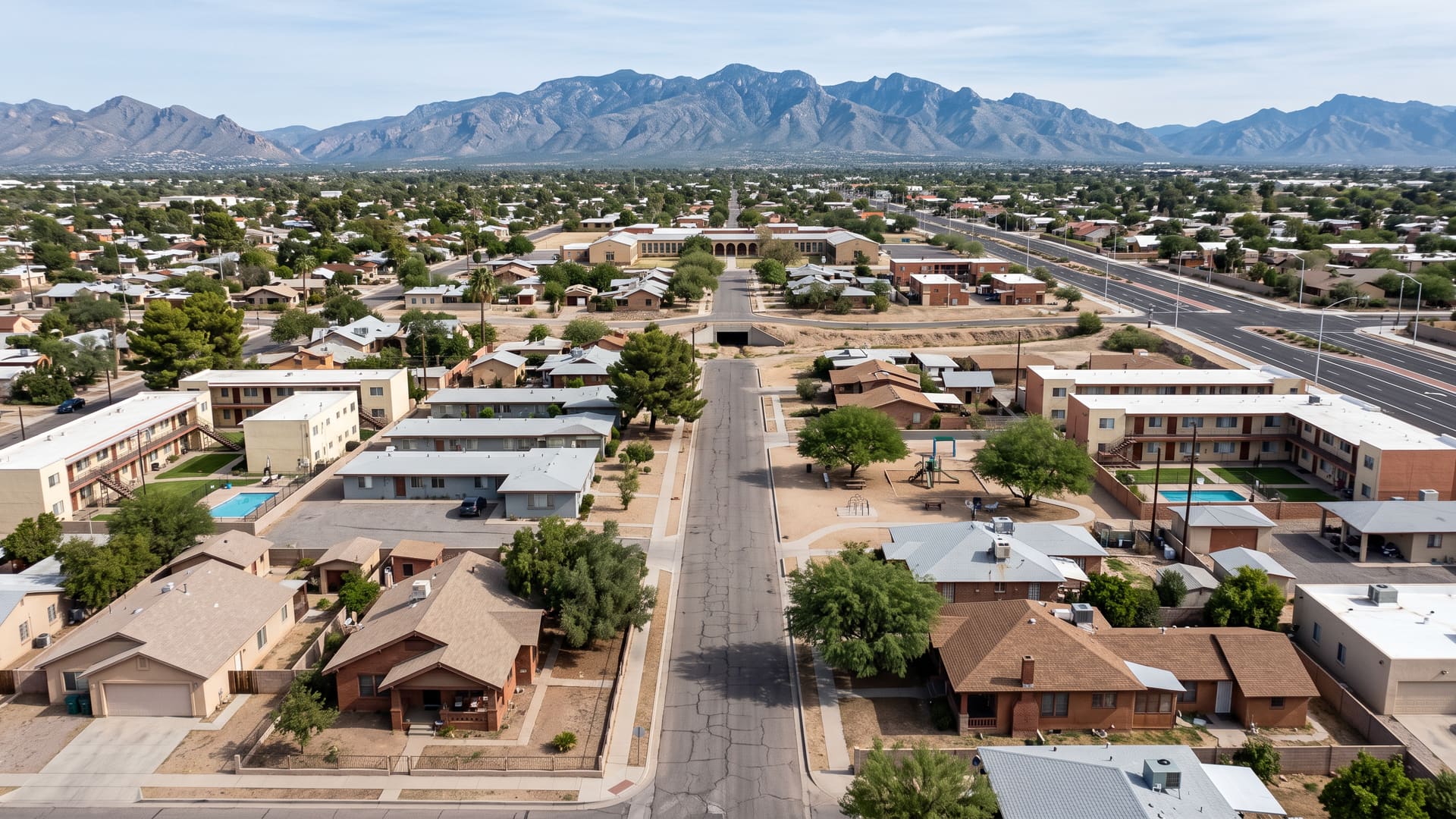
Keeling Homes for Sale — Tucson, AZ
What is standing in Keeling and what changes hands in Keeling are two different housing markets, and the gap between them is the first thing to understand about this neighborhood. Pima County records 1,197 parcels inside the boundary.
Key facts
- Jurisdiction
- Tucson, Arizona — incorporated city, Pima County
- Average sale price
- $253,000
- Price range
- $150K – $350K
- School district
- Amphitheater USD (Keeling, Amphitheater Middle, Amphitheater High)
- Approximate population
- ~4,400
- Approximate number of homes
- ~2,400 homes
What defines this area
- A $255,000 median across 53 closings in three years
- 51 of the 53 closings detached, two townhouses, no condominium
- No income-property sale at all in three years, against 549 city-wide
- 306 of 1,197 parcels under a multiple-residential use code
- 140 duplexes, 31 fourplexes and 69 apartment buildings on the record
- R-2 zoning on 980 of the 1,197 county parcels
- Current zoning equal to original zoning at all 81 sample points
- Two 1920 plats, and eighteen more recorded since, the last in 2026
- 804 of 870 Coronado Heights parcels described as part of a lot
- Stone Avenue, Grant Road, First Avenue and Fort Lowell Road as edges
- The City-registered association's own outline, to 99.7 per cent
- Grant Road rebuilt with a median and managed access, finished 2018
- FEMA Zone X at all 81 sample points, Zone AE only on the north frontage
- Keeling Desert Park, four-tenths of an acre with a walking path
- Keeling Elementary inside the line, the only campus in it
- Named for Helen Brown Keeling; the school opened in 1938
- The first Tucson Gem and Mineral Show, held here in 1955
- Ward 3, 1,689 address points, 2.3 miles from Tucson City Hall
About Keeling
What is standing in Keeling and what changes hands in Keeling are two different housing markets, and the gap between them is the first thing to understand about this neighborhood. Pima County records 1,197 parcels inside the boundary. Of those, 591 carry a single-family residential use code and 306 carry a multiple-residential one: 140 duplexes, 30 triplexes, 31 fourplexes, 52 apartment buildings of five to twenty-four units, two of twenty-five to ninety-nine, fifteen of a hundred or more, and 36 parcels the county records as a mixed complex of more than two residences on a single lot. Another 59 of the single-family parcels are coded as a dominant residence with a second residence or an affixed manufactured home on the same ground, 30 parcels are condominium or townhouse and 38 are manufactured-home homesites. Now the other side of it. Over the three years to October 2026 there were 53 Residential closings inside this line, and 51 of them were single-family detached houses, two were townhouses and not one was a condominium. There were no ResidentialIncome closings at all over those three years, against 549 inside the City of Tucson over the same window. So the duplexes, fourplexes and small apartment courts that are roughly a third of the parcels here almost never reach the resale market, and a buyer reading closed sales sees a house market sitting inside a neighborhood that is not mostly houses. Both halves matter before an offer: the comparable sales available for a valuation on this ground are all of one housing type, and roughly one residential parcel in three here is recorded as holding more than one dwelling. Within that house market, floor area is the axis price moves along and age is not. Sorted into price bands, median living area reads 1,066, then 1,052, then 1,256, then 1,475, then 2,207 square feet from the $150,000-to-$200,000 band up through the closings above $350,000, against median close prices of $170,000, $228,375, $278,000, $305,000 and $376,500 — the typical house roughly doubles in size across that run. Median year built over the same five bands reads 1953, 1954, 1955, 1965 and 1953, which is no movement at all, and the top band's median year is the same as the bottom's. Price per square foot then runs the other way from size: it peaks in the middle of the market at $222.94 in the $250,000-to-$300,000 band and falls to its lowest in the top band at $172.15, so on this ground the biggest houses really are the cheapest square feet. That is the opposite of what this site recorded on the 1950s tract at Rosemont West, which has its own page here, five and a third miles south-east, where price per square foot also peaked mid-market but the cheapest square feet were at the bottom of the record rather than the top. The practical reading is that square footage is the first adjustment to make between two houses here and year built is close to no adjustment at all, which is an unusually clean answer for a neighborhood whose houses were built across ninety years. The reason the stock is so mixed is in the plat record, and it is the opposite of a neighborhood that was laid out once and left alone. Two plats put down the whole of this ground in twenty-five days in the autumn of 1920 — Coronado Heights, 529 lots recorded on 16 September, and Bronx Park Addition, 440 lots on 11 October — and eighteen further plats have been recorded over this boundary in the century since, the most recent on 19 March 2026. Eighteen of the twenty plats that touch the line lie wholly inside it, and the two that do not are the two from 1920, both of which run past it. Bronx Park Addition touches the boundary and accounts for no parcel inside it at all: 1,033 of the 1,197 parcels carry a Coronado Heights legal description, 870 on the 1920 plat and 163 on its 1931 resubdivision, and not one carries a Bronx Park one. The re-platting since has been small, steady and residential — after the 151-lot Coronado Heights resubdivision of April 1931, Leah Heights in 1972, Casitas de Coronado in 1974, Delano Terrace and Geronimo Village in 1981, Estrella Norte in 1982, Coronado Villas in 1983, a Delano Terrace resubdivision in 1990, Pueblo Norte in 1995, Glenstar in 1998, Estrella Heights in 2002, Laguna Terrace Condominiums in 2005, Jacinto Plaza Condominiums in 2006, Estrella Homes in 2007, a Coronado Heights lot split and Raena Mae Homes in 2019, Los Altos Estates in 2024 and Estrella Vista in March 2026 — and no plat recorded here after 1931 put down more than 25 lots. Beneath the plats the original lots have been cut as well: 804 of the 870 Coronado Heights parcels are described in the county record by a measured part of a lot, a west fifty feet or an east sixty or a north half, rather than by a whole lot number. That is a century of lot splitting written into the legal descriptions. The zoning is what permits all of it, and it has not changed since it was first applied. R-2 covers 980 of the 1,197 parcels, and at all 81 interior sample points the City of Tucson's current zoning is identical to the original zoning on file. The City gives R-2's purpose as medium density, single-family and multifamily, residential development together with the schools, parks and other public services necessary for an urban residential environment — it is the only residential zone on this ground, and its own stated purpose names multifamily beside single-family, where the City gives R-1's purpose as urban, low density, single-family residential development and nothing more. That difference is a fair description of what is actually standing here. Everything that is not R-2 is commercial frontage on the four arterials: 157 parcels of C-2, the general commercial zone, 37 of C-3, its mid-rise form, eleven of C-1, eleven of R-3, the high-density residential zone, and one of O-3. Of the 81 sample points, 56 land on R-2, 17 on C-2, five on C-3, two on R-3 and one on C-1. Whole-record figures, for completeness. The 53 closings ran from $116,000 to $392,000 around a median of $255,000 and an average of $252,782, were built between 1929 and 2019 with a median year of 1953, ran 593 to 2,372 square feet with a median of 1,260, and closed at a median $203.39 per square foot across a $115.56 to $451.94 range. List price ran $125,000 to $399,000 to a $260,000 median, and original list price to a $265,000 median against a $450,000 high. The median listing went under contract 42 days after coming to market and closed a median 47 days after listing, with a median 23 days on market against 25.5 cumulative, a 0.98 sale-to-list ratio, 11 of the 53 closing above asking and 14 taking a price reduction first. Days on market rest on 50 of the 53 records, days to contract on 48 and days to close on 51; every price, size and year figure above rests on all 53. The range printed at the top of this page is drawn around the body of that record rather than its ends: 48 of the 53 closed between $150,000 and $350,000, one below and four above. These are closed sales, not homes currently for sale. The boundary is four arterial streets and the City describes it the same way. Ward 3's own neighborhood page gives Keeling as Fort Lowell to the north, 1st Avenue to the east, Grant to the south and Stone Avenue to the west, and each of the four checks against Pima County's own centrelines within metres rather than being assumed from the shape: Fort Lowell Road 0.3 to 1.9 metres from the ring at the measured vertices, Stone Avenue 0.1 to 3.7, Grant Road 0.1 to 8.1 and First Avenue 0.4 to 8.3. The county classifies all four as major local roads. What is left is a plain rectangle a mile deep and about two-thirds of a mile wide, 411.9 acres or about 0.64 of a square mile by a geodesic integration of the ring, filling 99 per cent of its own bounding box, spanning 32.25023 to 32.26481 north and -110.97205 to -110.96098 east, and dead flat throughout. The line these figures are aggregated over and the outline the Keeling Neighborhood Association registered with the City of Tucson on 1 June 1993 are the same polygon — 411.9 acres against 411.3, agreeing to 99.7 per cent in both directions on a 300-by-300 comparison grid, with all 81 interior sample points returning Keeling and no other association. That is the closest agreement between an aggregation boundary and a registered association outline this site has recorded, so every count on this page is a count over the ground the neighborhood itself claims. Six other registered associations touch the edges and reach none of the interior: Amphi and Hedrick Acres, both of which have their own pages here, along with El Cortez Heights, Balboa Heights, Sugar Hill and Coronado Heights. That last one is worth reading carefully, because the Coronado Heights association is a different footprint from the Coronado Heights plat, and the plat is most of the ground inside this line. The name is a person, and the school that carries it came first. Keeling Elementary School opened in 1938, and the City of Tucson's own Ward 3 neighborhood page records that the area is named for Helen Brown Keeling, an educator of many years and the first woman to head the Arizona Education Association, in 1922. The Arizona Daily Star's account adds that she taught in Douglas before moving to Tucson in 1930, taught in the Amphitheater district until she retired in 1957 as its director of elementary schools, and died in 1976 at eighty-nine. One other thing started in that school: the City's page and the Pima County Public Library both record that the first Tucson Gem and Mineral Show was held in the Keeling cafeteria in 1955. Homeowners associations are a question to get in writing here, and the answer the public record supports is a narrow one. The Keeling Neighborhood Association is a neighborhood association registered with the City of Tucson, which is a different thing from a homeowners association, and the City says so itself: its own registration page states that neighborhood associations are not homeowners associations, that an HOA is for members only while a neighborhood association takes in the property owners, renters, businesses and organizations inside its boundaries, and that registration brings notice of rezonings and liquor licence applications and rights under Arizona's Neighborhood Protection Act. The City's register records this one as active in Ward 3, registered in June 1993, with bylaws adopted on 18 June 1994 and updated on 1 April 2008, an annual meeting each September, and the record last updated on 19 February 2026. The association a buyer actually needs to ask about is the other kind, and Arizona defines it narrowly: under A.R.S. section 33-1802 an association is created pursuant to a declaration, so whether a mandatory association runs with a particular title is answered by the recorded declaration in the title work and by nothing else. This page cannot answer it for you, and the reason is a gap in the public data rather than a finding: Pima County's open GIS catalogue carries no register of homeowners associations at all, so no such register can be checked and no dues figure is published here. On ground re-platted eighteen times since 1920, with seventeen of those plats recorded after 1970, the recorded restrictions can differ from one side of a street to the other — get the title work and any resale disclosure package before writing an offer. The south edge is a road the City rebuilt, and that work is finished here. Phase 2 of the City of Tucson's Grant Road Improvement Project ran from Castro Avenue to Santa Rita Avenue, limits that contain the whole of this neighborhood's Grant Road frontage because Castro is west of Stone Avenue and Santa Rita is east of First, and construction completed on 30 October 2018. It added travel lanes, new and wider sidewalks, more signalized crosswalks, improved bicycle lanes, public art and landscaping, and it put in a median with managed access to the businesses along it. The City's own real-property inventory records the acquisition that paid for the width: twelve Transportation parcels on this frontage, between 19 and 301 East Grant Road, every one of them carrying a Grant Road right-of-way status, the dated ones acquired between 7 July 2011 and 17 June 2015, with a thirteenth recorded as surplus right-of-way and sold. Phases 3 and 4 of the same project, Sparkman Boulevard to Swan Road, are miles east of here and were reported in September 2026 as on track to finish in October, and Phases 5 and 6, Fremont Avenue to Sparkman, are in right-of-way acquisition with construction reported as not expected until 2029. Neither touches this boundary. The thing to look at on the ground is the median rather than the construction, because a median permanently changes which direction a car can turn into a driveway, and that matters to a commercial frontage and to the houses behind it in different ways. Water splits the same way the land use does, and the two halves land on different parts of the neighborhood. FEMA's digital flood map returns Zone X at all 81 interior sample points, and the floodway, sheet-flooding, local-floodway and erosion-hazard layers are all empty inside the line. But a Zone AE special flood hazard area, the kind that carries base flood elevations, does reach into this boundary along the north edge, and a centroid test over all 1,197 parcels puts 21 of them inside it. Every one of the 21 sits in the single band of parcels along Fort Lowell Road at the north edge — thirteen addressed on East Fort Lowell Road, three on the avenues that meet it and five with no address on file — and every one of the 21 is zoned C-2. Nineteen carry a commercial, vacant-land or industrial use code; the other two are coded as apartment buildings of five to twenty-four units. So the special flood hazard area here is overwhelmingly, but not entirely, commercial ground. Two FIRM panels cover the ground, 04019C1688L and 04019C1689L, both effective 16 June 2011, and the county also maps one Letter of Map Amendment intersecting the line. The county's wash network puts Cemetery Wash across the north of the neighborhood at a 50-foot standard setback on one reach and 75 feet on another, with six short unnamed reaches at 25 feet, and nothing in the greater-than-2,000-cubic-feet-per-second class touches the boundary at all. Two areas on the county's internal floodplain study layer cover this ground, Navajo-Wilson Wash and Bronx Wash, both with an effective status, and one special-study delineation, Navajo Wash. A centroid test is not a flood determination for any particular address and a setback is measured outward from the mapped channel rather than from a lot line, so an elevation certificate, a survey and a title search are what answer the question for a specific house. The county rates five road segments inside the line as passable during moderate storms. Parks are one park, and it is a small one. Keeling Desert Park is the only park inside the boundary and the City lists it at 0.4 acres at 245 East Glenn Street and its amenity list for the park names benches, bicycle racks, picnic tables, a playground and a walking path, and no ramada and no restroom; Pima County's trail layer records two hard-surfaced accessible path segments inside it. The City bought the two parcels that make it up on 27 November 2001, which is late for a park in a neighborhood platted in 1920, and it sits about a quarter of a mile from the middle of the line. Neither the county's trailhead layer nor its police, post office, fire station, library, hospital or golf course layers return anything inside this boundary, and each of those zeros was taken against a live control elsewhere in the same layer. The nearest are the Woods Memorial library at 1.07 miles, Banner-University Medical Center Tucson and the Kino retail post office at 1.44, and Tucson Fire Department Station 8 at 1.78. Schools are Amphitheater Unified throughout and the assignment is uniform at all three levels rather than splitting at one of them. Pima County's attendance-area polygons return the same set at every one of the 81 interior sample points: Keeling Elementary School at 2837 North Los Altos Avenue, Amphitheater Middle School at 315 East Prince Road and Amphitheater High School at 125 West Yavapai Road, together with two further Amphitheater attendance areas, Rillito Center and Innovation Academy, whose polygons also cover the whole neighborhood. LiveBy's assignment query returns the first three and marks all three assigned. Keeling Elementary stands inside this boundary, about three-tenths of a mile from the middle of the line, and the county records it as the only school campus of any kind inside. No grade range is stated on this page, because the county and LiveBy disagree at the elementary school, and assignments are drawn by address and they change, so confirm a specific address with the district rather than with a neighborhood map. The city itself arrived in two acts, and late. Ordinance 1410, effective 5 November 1953, covers nine of the 81 interior sample points, and Ordinance 1895, effective 26 April 1959, covers the other 72, with no deannexation anywhere and no third annexation ordinance touching the boundary. Both 1920 plats therefore predate the City on this ground by more than thirty years and the 1931 resubdivision by twenty-two: it was platted, sold and built on as county land and taken in afterwards. Every one of the 1,197 parcels carries Pima County's TUCSON jurisdiction code and all 1,197 sit in a single tax area, across 328.8 acres of mapped parcel out of the 411.9 — so about 83 of these 412 acres is street right-of-way rather than lot. The county's ward layer returns Ward 3 at all 81 points. The rest of the record. There are 1,689 official address points inside the line across 29 street names, and the naming is a 1920s habit rather than a 1950s one: Fontana carries 218 of them, Geronimo 152, Estrella 142, Jacinto 110, Alturas 108, Delano 98, Glenn 97, Los Altos 93, Laguna 91, Blacklidge 88 and Kelso 83, with Incas, Cortez, Hopi, Amaro and Placita Estrella among the rest, and First and Second are the only numbered avenues. ZIP code 85705 covers 1,612 of the 1,689 address points; the other 77 are in 85719, and 75 of those 77 are on the First Avenue frontage along the east edge, so a Keeling address can carry either. The City of Tucson's real-property inventory returns 29 records inside the line: twelve held by Housing and Community Development, the eleven dated ones acquired between 1949 and 2009 and spread one lot at a time across the neighborhood rather than clustered, three of them recorded against named programs; twelve held by Transportation, every one of them a Grant Road right-of-way parcel; the two parcels of Keeling Desert Park; one Tucson Water wellsite on North Geronimo Avenue; and two recorded as sold. Only six development plans are on file over the whole boundary, five of them commercial and approved between February 1986 and May 2001, and one residential plan of five units on East Fort Lowell Road. There is no National Register historic district inside the boundary, no brownfields target area, no Neighborhood Stabilization Program target area and no airport overlay of any kind — all nine of the county's airport layers return nothing here, and all nine were checked against features over Davis-Monthan, Tucson International and Marana Regional first, so those zeros are findings rather than missing data. Measured from the middle of the boundary, Keeling Desert Park is about a quarter of a mile away, Keeling Elementary about three-tenths, the Woods Memorial library 1.07, Amphitheater High School 1.20, Amphitheater Middle School 1.21, Banner-University Medical Center Tucson and the Kino retail post office 1.44, the University of Arizona 1.75, Tucson Fire Department Station 8 1.78, Tucson City Hall 2.27, Tucson Mall 2.37, the Tucson Convention Center 2.54, St Mary's Hospital 2.69 and Tucson International Airport 9.39. Point features are measured to the point and parks to the nearest polygon edge.
Keeling is an urban neighborhood in the City of Tucson, on the central side of metro Tucson, Arizona, served by Amphitheater USD (Keeling, Amphitheater Middle, Amphitheater High). Homes trade in the $150K – $350K range, with an average sale price of $253,000 across roughly 2,400 homes and a population of about 4,400. Kyle Berglund, REALTOR® at Tierra Antigua Realty, represents buyers and sellers here — call (520) 250-8904.
Compare nearby Tucson neighborhoods
- Rosemont West — Urban, average $326,000
- Amphi — Affordable, average $245,000
- Hedrick Acres — Urban, average $242,000
- Downtown Tucson — Urban, average $400,000
- Midtown Tucson — Urban, average $350,000
- Sam Hughes — Urban, average $650,000
- Barrio Viejo — Urban, average $590,000
- Winterhaven — Urban, average $399,000
Frequently asked questions
What city is Keeling in?
Keeling is in the City of Tucson, Arizona. Jurisdiction: Tucson, Arizona — incorporated city, Pima County.
What is the average home price in Keeling, Tucson?
The average sale price in Keeling is approximately $253,000, with homes generally ranging from $150K – $350K. These are rounded, long-run estimates aggregated from MLSSAZ closed sales through the LiveBy data connection, over this neighborhood's own boundary, for general orientation — not a current-month figure. Averages are means and can be skewed by a small number of high-value sales, so individual home values vary materially.
What school district serves Keeling?
Keeling is served by Amphitheater USD (Keeling, Amphitheater Middle, Amphitheater High). Confirm exact school assignments by specific address, as boundaries can change.
Is Keeling a good place to live?
Keeling is an urban neighborhood in the City of Tucson, on the central side of metro Tucson, Arizona, known for a $255,000 median across 53 closings in three years, 51 of the 53 closings detached, two townhouses, no condominium, No income-property sale at all in three years, against 549 city-wide, 306 of 1,197 parcels under a multiple-residential use code. What is standing in Keeling and what changes hands in Keeling are two different housing markets, and the gap between them is the first thing to understand about this neighborhood. It has an approximate population of ~4,400 across roughly ~2,400 homes.
What kind of homes are for sale in Keeling?
Keeling is an urban submarket where homes generally trade between $150K – $350K, with an average sale price of $253,000.
Who can help me buy or sell a home in Keeling?
Kyle Berglund, a licensed Arizona REALTOR® (License #SA668710000) at Tierra Antigua Realty, specializes in Keeling and the greater Tucson area. Call (520) 250-8904 or email contact@kyleberglund.com for a free consultation.